


Taipei will soon become the first city in the country to set up a police unit to exclusively handle cases of animal abuse, the city government said yesterday.
Taipei City deputy police commissioner Chen Chien-fa (陳建發) said 28 police officers will be selected from the city’s 14 precincts next month to man the new unit.
Taipei City Councilor Dai Hsi-chin (戴錫欽) of the Chinese Nationalist Party (KMT), who has long advocated establishing an animal protection police unit, said the proposed group would be an informal task force rather than a new formal division of the department.
Establishing a division, he said, requires the potentially time-consuming step of amending the law, and the city government felt that the police needed to be involved in animal protection without delay.
“Without the help of the police, it is almost impossible to prevent animal abuse,” Dai said.
The councilor touted the move as a major step forward for the country in animal protection, and he suggested that the new police unit might even be the first set up in Asia.
According to the city’s Animal Protection Office, more than 400 animal abuse cases were reported between January and July this year.
However, as members of the office and private animal protection groups do not have the legal authority to make arrests or enforce the law, their animal rescue efforts are often hampered, officials said.
Animal protection office director Yen I-feng (嚴一峰) said at the Taipei City Council that people from animal protection bodies can conduct administrative investigations, but they may not be able to stop animal abuse even if they find something wrong at the scene of a case.
Chen, the city’s deputy police commissioner, said his department will train the newly recruited police officers assigned to the animal protection unit to familiarize them with related laws and professional skills.
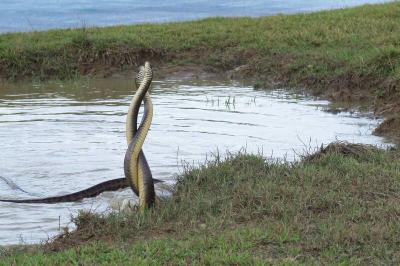
Kenting National Park service technician Yang Jien-fon (楊政峰) won a silver award in World Grand Prix Photography Awards Spring Season for his photograph of two male rat snakes intertwined in combat. Yang’s colleagues at Kenting National Park said he is a master of nature photography who has been held back by his job in civil service. The awards accept entries in all four seasons across six categories: architectural and urban photography, black-and-white and fine art photography, commercial and fashion photography, documentary and people photography, nature and experimental photography, and mobile photography. Awards are ranked according to scores and divided into platinum, gold and
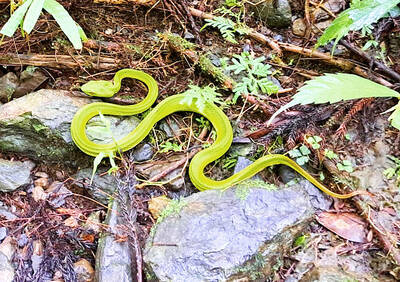
More than half of the bamboo vipers captured in Tainan in the past few years were found in the city’s Sinhua District (新化), while other districts had smaller catches or none at all. Every year, Tainan captures about 6,000 snakes which have made their way into people’s homes. Of the six major venomous snakes in Taiwan, the cobra, the many-banded krait, the brown-spotted pit viper and the bamboo viper are the most frequently captured. The high concentration of bamboo vipers captured in Sinhua District is puzzling. Tainan Agriculture Bureau Forestry and Nature Conservation Division head Chu Chien-ming (朱健明) earlier this week said that the

The Chinese Nationalist Party (KMT) caucus yesterday said it opposes the introduction of migrant workers from India until a mechanism is in place to prevent workers from absconding. Minister of Labor Hung Sun-han (洪申翰) on Thursday told the Legislative Yuan that the first group of migrant workers from India could be introduced as early as this year, as part of a government program. The caucus’ opposition to the policy is based on the assessment that “the risk is too high,” KMT caucus secretary-general Lin Pei-hsiang (林沛祥) said. Taiwan has a serious and long-standing problem of migrant workers absconding from their contracts, indicating that

SPACE VETERAN: Kjell N. Lindgren, who helps lead NASA’s human spaceflight missions, has been on two expeditions on the ISS and has spent 311 days in space Taiwan-born US astronaut Kjell N. Lindgren is to visit Taiwan to promote technological partnerships through one of the programs organized by the US for its 250th national anniversary. Lindgren would be in Taiwan from Tuesday to Saturday next week as part of the US Bureau of Educational and Cultural Affairs’ US Speaker Program, organized to celebrate the 250th anniversary of the signing of the Declaration of Independence, the American Institute in Taiwan (AIT) said in a statement yesterday. Lindgren plans to engage with key leaders across the nation “to advance cutting-edge technological partnerships and inspire the next generation of scientists and engineers,”


 RSS
RSS