


A Chinese official yesterday urged Taipei and Beijing to seek more common ground rather than focusing on disagreements to resolve differences. The official, however, denied that the remarks were aimed at the Mainland Affairs Council (MAC) chief, who last week urged Beijing to abolish policies and laws concerning military deployments against Taiwan.
Assistant Minister of the Taiwan Affairs Office Li Yafei (李亞飛) said that both sides of the Taiwan Strait should put aside disputes and create a win-win scenario.
“Putting aside differences means making an effort to find a common ground, rather than picking out contrarieties,” he said.
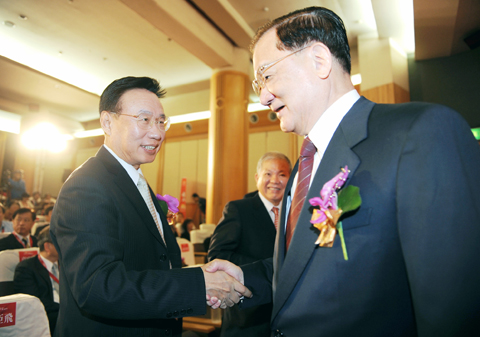
PHOTO: LO PEI-DER, TAIPEI TIMES
“The first step to achieving this goal is to accumulate mutual trust,” he said, adding that mutual trust could be established by “jointly opposing Taiwanese independence.”
Li made the remarks while visiting Straits Exchange Foundation Vice Chairman Kao Koong-lian (高孔廉) yesterday afternoon.
Asked what he meant by “picking out contrarieties,” Li downplayed his comment, saying he meant to stress that both sides must work in concert to maintain sound mutual trust and peaceful development.
“My comment wasn’t directed at anything. It’s nothing special,” he said.
Li’s comment was the first official response from Beijing after Mainland Affairs Council Minister Lai Shin-yuan (賴幸媛) last week urged Beijing to abolish “policies and laws” on military deployments targeting Taiwan.
While giving a speech at the American Enterprise Institute in Washington on Wednesday last week, Lai said China’s military buildup and its “policy of taking Taiwan by force” were obstacles that must be removed if cross-strait relations were to move forward.
While Lai stopped short of mentioning China’s “Anti-Secession” Law, Mainland Affairs Council Deputy Minister Liu Te-shun (劉德勳) in Taipei on Thursday last week called on China to review the law, which he described as “something unnecessary” in cross-strait relations.
Lai later denied that China had played a role in her cancellation of a speech scheduled on Saturday in Los Angeles. The last-minute change of plan prompted speculation that China had pressured her to cancel the speech after her remarks.
While Lai also said that the timing and conditions were not ripe for military or political negotiations, Li yesterday said the two sides did not necessarily have to resolve all the problems at the moment.
However, if both sides felt the need for talks to advance developments in bilateral ties, cross-strait problems would “naturally” be resolved, he said.
Over the past two years, the two sides have laid a sound foundation for economic cooperation and exchanges under the so-called “1992 consensus” and opposition to Taiwanese independence, he said.
Li said the “1992 consensus” was a “verbal consensus reached by the SEF and the ARATS [Association for Relations Across the Taiwan Strait] in 1992 that the two sides of the Taiwan Strait insist on the ‘one China principle.’”
The Taiwanese government, however, maintains that the so-called “1992 consensus” posits that the two sides “agree to disagree” on the meaning of “one China.”
Since Taipei and Beijing signed the Economic Cooperation Framework Agreement (ECFA) in June, cross-strait exchanges would move from economic matters to culture, education and healthcare, Li said.
Li, who arrived on Tuesday for a three-day visit, also took part in a cross-strait wealth-creation forum held by the Want Want China Times Group.
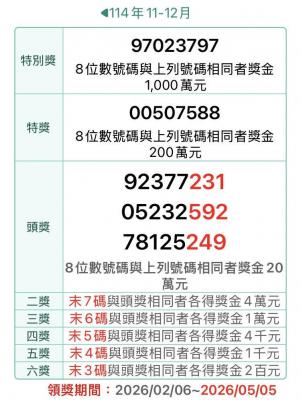
Seven of the 17 NT$10 million (US$311,604) winning receipts from the November-December uniform invoice lottery remain unclaimed as of today, the Ministry of Finance said, urging winners to redeem their prizes by May 5. The reminder comes ahead of the release of the winning numbers for the January-February lottery tomorrow. Among the unclaimed receipts was one for a NT$173 phone bill in Keelung, while others were for a NT$5,913 purchase at Costco in Taipei's Neihu District (內湖), a NT$49 purchase at a FamilyMart in New Taipei City's Tamsui District (淡水), and a NT$500 purchase at a tea shop in New Taipei City's
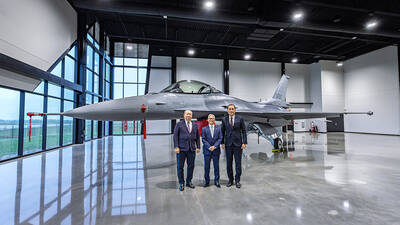
Taiwanese officials were shown the first of 66 F-16V fighter jets purchased by Taiwan from the United States, the Ministry of National Defense said yesterday, adding the aircraft has completed an initial flight test and is expected to be delivered later this year. A delegation led by Deputy Minister of National Defense Hsu Szu-chien (徐斯儉) visited Lockheed Martin’s F-16 C/D Block 70 (also known as F-16V) assembly line in South Carolina on March 16 to view the aircraft. The jet will undergo a final acceptance flight in the US before being delivered to Taiwan, the
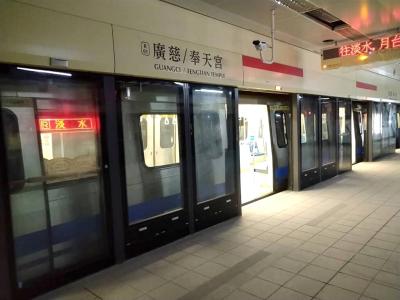
The New Taipei Metro's Sanyin Line and the eastern extension of the Taipei Metro's Tamsui-Xinyi Line (Red Line) are scheduled to begin operations in June, the National Development Council said today. The Red Line, which terminates at Xiangshan Station, would be connected by the 1.4km extension to a new eastern terminal, Guangci/Fengtian Temple Station, while the Sanyin Line would link New Taipei City's Tucheng and Yingge stations via Sanxia District (三峽). The council gave the updates at a council meeting reviewing progress on public construction projects for this year. Taiwan's annual public infrastructure budget would remain at NT$800 billion (US$25.08 billion), with NT$97.3
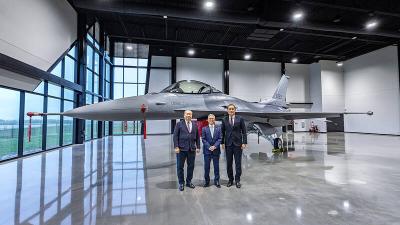
Deliveries of delayed F-16V jets are expected to begin in September, Minister of National Defense Wellington Koo (顧立雄) said today, after senior defense officials visited the US last week. The US in 2019 approved a US$8 billion sale of Lockheed Martin F-16 jets to Taiwan, a deal that would take the nation’s F-16 fleet to more than 200 jets, but the project has been hit by issues including software problems. Koo appeared today before a meeting of the legislature’s Foreign Affairs and National Defense Committee, which is discussing different versions of the special defense budget this week. The committee is questioning officials today,


 RSS
RSS