


President Ma Ying-jeou (馬英九) yesterday promised to establish a major cultured grouper industry and to initiate a “grouper festival” to further introduce the nation’s grouper farming businesses to the world.
Inviting a cultured grouper farmer in Pingtung to discuss the future of the industry following the signing of the cross-strait Economic Cooperation Framework Agreement (ECFA), Ma said the grouper industry produced NT$1.4 billion (US$43 million) in revenues last year, enormous growth from the NT$2.7 million the industry made in 2007, thanks to cross-strait direct flight services.
“The grouper industry has been growing significantly since the launch of direct flight services and the opening up of 11 harbors in China this year ... We believe the grouper industry will produce more revenue as groupers will be given zero-tariff treatment under the ECFA,” Ma said in his weekly online speech.
Groupers — which are mainly raised in Kaohsiung and Pingtung counties — were included on Taiwan’s “early harvest” list of goods and services that will enjoy preferential tariff treatment under the ECFA.
The Ma administration has predicted that Taiwan will become the largest source of grouper in the world.
The grouper farmer from Pingtung, Dai Kun-tsai (戴昆財), told Ma that the high quality of the fish and the zero-tariff treatment are expected to increase the economic potential of the product in the post-ECFA era, and he suggested that the government establish a “grouper festival” to promote the development of the industry.
Ma said the government should be able to organize a festival next year and that it would invite local and foreign grouper farmers to take part in the event.
Continuing his ECFA promotional tour, Ma yesterday visited two companies in Taipei County. He said the government will seek to sign further trade deals after the successful signing of the ECFA.
“We want to make friends and make money, not make war with other countries,” Ma said after visiting the two companies.
Ma defended his administration’s focus on the development of economic ties with China, saying the ECFA would prompt other countries to sign similar agreements with Taiwan.
“Whether we like it or not, we cannot deny or ignore the fact that mainland China has turned from a world factory into a world market,” he said.
The president promised to sign economic pacts with other countries and lower tariffs to seek better economic cooperation with other nations, and to create more opportunities for local businesses in the Chinese market.
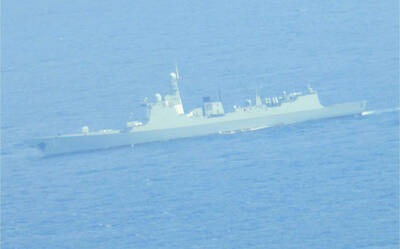
The military has spotted two Chinese warships operating in waters near Penghu County in the Taiwan Strait and sent its own naval and air forces to monitor the vessels, the Ministry of National Defense (MND) said. Beijing sends warships and warplanes into the waters and skies around Taiwan on an almost daily basis, drawing condemnation from Taipei. While the ministry offers daily updates on the locations of Chinese military aircraft, it only rarely gives details of where Chinese warships are operating, generally only when it detects aircraft carriers, as happened last week. A Chinese destroyer and a frigate entered waters to the southwest
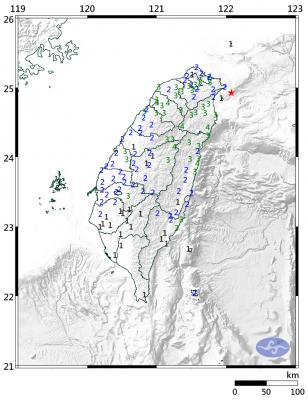
A magnitude 6.1 earthquake struck off the coast of Yilan County at 8:39pm tonight, the Central Weather Administration (CWA) said, with no immediate reports of damage or injuries. The epicenter was 38.7km east-northeast of Yilan County Hall at a focal depth of 98.3km, the CWA’s Seismological Center said. The quake’s maximum intensity, which gauges the actual physical effect of a seismic event, was a level 4 on Taiwan’s 7-tier intensity scale, the center said. That intensity level was recorded in Yilan County’s Nanao Township (南澳), Hsinchu County’s Guansi Township (關西), Nantou County’s Hehuanshan (合歡山) and Hualien County’s Yanliao (鹽寮). An intensity of 3 was
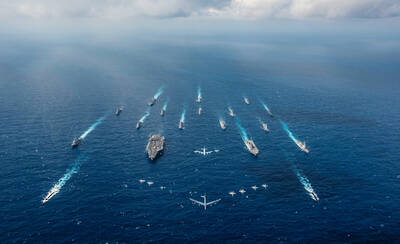
Japanese Prime Minister Sanae Takaichi’s comment last year on Tokyo’s potential reaction to a Taiwan-China conflict has forced Beijing to rewrite its invasion plans, a retired Japanese general said. Takaichi told the Diet on Nov. 7 last year that a Chinese naval blockade or military attack on Taiwan could constitute a “survival-threatening situation” for Japan, potentially allowing Tokyo to exercise its right to collective self-defense. Former Japan Ground Self-Defense Force general Kiyofumi Ogawa said in a recent speech that the remark has been interpreted as meaning Japan could intervene in the early stages of a Taiwan Strait conflict, undermining China’s previous assumptions
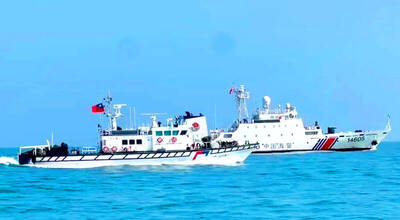
Instead of focusing solely on the threat of a full-scale military invasion, the US and its allies must prepare for a potential Chinese “quarantine” of Taiwan enforced through customs inspections, Stanford University Hoover fellow Eyck Freymann said in a Foreign Affairs article published on Wednesday. China could use various “gray zone” tactics in “reconfiguring the regional and ultimately the global economic order without a war,” said Freymann, who is also a nonresident research fellow at the US Naval War College. China might seize control of Taiwan’s links to the outside world by requiring all flights and ships entering or leaving Taiwan


 RSS
RSS