


Taipei Times (TT): The government released the ECFA’s early harvest lists — goods and services that will be subject to immediate tariff reductions — for the first time on Thursday. It looks like the list will favor Taiwanese exporters as China will lower tariffs for 539 Taiwanese items, Taiwan’s market will open up to 267 items from China. What’s your thoughts on this list?
Taiwan Solidarity Union (TSU) Chairman Huang Kun-huei (黃昆輝): All these figures that the government talks about don’t reflect the true realities of an ECFA.
What we are concerned about is neither Taiwan nor China’s early harvest list of tariff reductions, but instead the continued opening of Taiwan’s market to China — a move that could liberalize up to 90 percent of China’s exports toward Taiwan in 10 years.
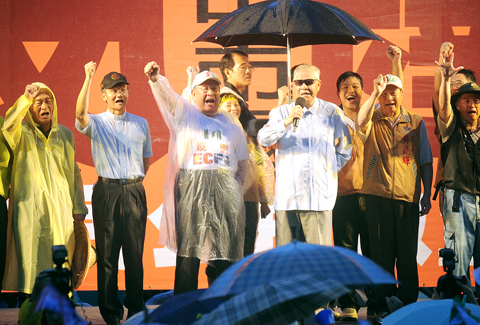
PHOTO: LIAO CHEN-HUEI, TAIPEI TIMES
Under the WTO [both Taiwan and China are members of the WTO] regulations, both sides will have to significantly lower customs barriers ... 10 years after the agreement is signed. So, while we see that Taiwan has more goods and services subject to tariff reductions than China, we have to take into account that this is only the first negotiations.
For example, the government says that agricultural goods won’t be liberalized, but this is only for now, what about the future? The labor market is the same: It’s not open for now, but how about in the future?
TT: Which exactly is this WTO regulation that you mentioned?
Huang: The WTO’s regulations state that if a free-trade Agreement (FTA) is signed between two member countries, trade between the two must be liberalized by up to 90 percent within a decade. So, if the government considers [an ECFA] to be an FTA under the WTO framework, or a transition toward an FTA, we must accept WTO regulations.
So when they say that agricultural products won’t be opened, it is only for now that we have not included them in our early harvest list. But in the future? Every six months, we have to reopen negotiations, every year twice and in 10 years we will have had 20 meetings that will deliberately and continuously tear down our trade barriers.
TT: So far, we have heard mixed comments from government officials on whether an ECFA would constitute an FTA. Based on your understanding, is an ECFA an FTA?
Huang: Currently, the talks between Taiwan and China on an ECFA seem to treat it like a transitional agreement to an FTA, but it is very ambiguous. After we sign an ECFA, we will have to meet two challenges: If we recognize that this is an FTA, we will have to open up our market. But on the other hand, if we don’t want to follow WTO regulations, then an ECFA will entirely become a domestic law.
Under a domestic law, China will assume a commanding position and Taiwan will be entirely subject to Chinese authority.
However, as I see it, [an ECFA] should count as a transitional agreement to an FTA.
TT: One of the arguments your party has used to oppose the signing of an ECFA is the fear that the trade pact would result in Taiwan becoming part of a “one China market” — a concern the government has denied. The government says the talks have not infringed on Taiwan’s sovereignty, what are you views toward this?
Huang: The Chinese side has already made their position very clear — that signing an ECFA takes place under the “one China framework.” An ECFA is the start of a “one China” market — which Taiwan’s market would become part of and be locked into.
We have to ask ourselves why we cannot just sign an FTA with them; after all, we are both WTO members that have equal rights and responsibilities. Instead, we have to sign an ECFA that degrades our status — a move that puts Taiwan and Hong Kong into the same category. Both Hong Kong and Macau have Closer Economic Partnership Arrangements (CEPA) with China, both of which are not FTAs.
China wants to complete its unification goals by first signing the CEPAs and then an ECFA with Taiwan.
TT: You allege that China harbors dangerous political ambitions toward Taiwan. How does this affect the signing of an ECFA and your opposition to it?
Huang: China’s strategy has been very clear since 2008 — they want to unify Taiwan through the use of economic integration and use this to move toward political unification. China’s policies are to use its business clout to further its political interests and use economics to influence politics.
Let’s think about this, if our economy is entirely under their control and we lose our financial independence, it will be very hard to maintain our political sovereignty.
Taiwan’s democracy is based on the foundation of a strong middle class, but when this middle class becomes destitute, how will we maintain our democratic ideals?
No one can say that politics is politics and economics is economics — it’s not like that. Politics and the economy are directly related, they are interlocked and cannot be separated.
It’s not easy for China to attack Taiwan; after all we live in a highly internationalized society. At the same time, Taiwanese will also not accept both sides heading into political negotiations.
Instead, they are aiming to give Taiwan short-term economic benefits and undermine Taiwan’s business and economy — moves that are easier for them to undertake.
TT: You have said on previous occasions that the government has not carefully analyzed an ECFA’s impact on Taiwan, politically and economically. At the same time, you have focused much of your criticism on an ECFA’s potential impact on Taiwan’s middle class salaries and traditional industries, why is that?
Huang: Let’s start with traditional industries. Now, I have said previously that the part we are most concerned about in an ECFA is that market liberalization will continue to take place after it is signed. Taiwan has a small market, it really cannot stand up to an influx of cheaper goods from China.
Our traditional industries are focused on selling to Taiwan’s own domestic market. The import of cheaper Chinese products will eventually replace our own industries.
On the other hand, the bulk of Taiwan’s export-oriented industries have already moved to China. You won’t find some of Taiwan’s high technology sectors on the early harvest list at all because China wants them to move their entire factories over there.
They want to use our investment dollars to manufacture goods in China and sell them overseas, which allows them to accrue foreign current holdings. Our factories in China also provide their labor market with job opportunities.
How will Taiwan survive if our export-oriented industries relocate to China and our domestic market-oriented companies are replaced because of competition from Chinese products?
And now the government even wants to open up Taiwan’s services sector to China — a move that will expose our middle class white collar workers to competition from the Chinese work force and their lower wages. Our wages are currently high, while China’s are low. If we were to equalize our salaries, the money that we make would be reduced.
Currently, our university graduates are happy if they can earn NT$20,000 to NT$22,000 a month after graduation. But at the end of president Lee Teng-hui’s (李登輝) presidency in 2000, our university graduates were already making NT$30,000 a month. Our wages have gone down and it’s because our investments and our industries have gone to China. Our industries are empty now and our job opportunities are gone.
In a recent job recruitment fair, 40 vacant positions were contested by thousands of people. The newly hired are happy that they’ve been accepted, how are they going to ask for higher wages?
That’s the way it will be. I believe that because of an ECFA, future Taiwanese employment will be limited to low-wage, low-skilled jobs marked by high work hours and no benefits. How can we say that an ECFA will not have a huge impact on Taiwan’s middle class?
TT: These arguments you use against an ECFA, including lower wages and affected industries, are often heard before FTA negotiations worldwide, including when the US signed the North American Free-Trade Agreement with Mexico and Canada. However, these concerns have often failed to materialize or have proven not to be serious issues after the agreement is signed. Could this not be the case here in Taiwan?
Huang: The signing of an FTA will more or less have similar effects around the world — but the signing of an ECFA between Taiwan and China is different. We have to take into account the cultural and linguistic similarities between both sides. While the FTA between the US and Mexico has its impact, Taiwan’s will be much more serious because of these similarities.
Let’s use the US fast food chain McDonalds as an example, after it came to Taiwan, it had a direct impact on [Taiwanese restaurants]. Our competition with the US is a competition between steamed buns and hamburgers; but some people don’t like to eat hamburgers. On the other hand, our competition with China is between steamed buns and steamed buns, their products compete directly with ours.
What I mean is that any competition between two other countries will always have its slight differences in goods and products, but these differences are very small when it comes to Taiwan and China.
Furthermore, when we talk about differences between an ECFA and other FTAs, we cannot but take into account political considerations. While the US does not want to annex Mexico, China has very publicly said that it wants to one day unify with Taiwan.
Signing an ECFA sends the international community the wrong message. It says that Taiwan wants to be part of China, like Hong Kong and Macau. It makes it seem that Taiwanese development is entirely dependent on China.
The fact is, instead of reaching out internationally, an ECFA locks Taiwan into a “one China” framework. The government insists that an ECFA has to be signed ... but in all this time that we haven’t yet signed the agreement, hasn’t Taiwan continued to move forward?
Taipei Times (TT): You have advocated that an economic cooperation framework agreement (ECFA) should first be subject to a public referendum before it is signed. Why do you believe it is so important that the public vote on the proposal?
Huang Kun-huei (黃昆輝): The government continues to say that signing an ECFA will benefit Taiwan, but it never talks about the potential negative impacts. They make the proposal sound very good, but economists, opposition parties and members of the public have raised many concerns about this ECFA — concerns that the government has yet to fully address.
While everybody can agree that an ECFA is a piece of important national policy, that it’s an agreement that will affect Taiwan’s economy and possibly have an impact on our country’s future development, it is nevertheless an extremely controversial agreement. Under these circumstances ... it should be up to the public to make a final decision in a nationwide referendum. We should let the people have the final responsibility for agreeing to this proposal.
When we say that we want a referendum, it doesn’t necessarily mean that it will be voted down. In fact, the government should see the referendum as a confirmation by the people of its policies. After all, the government’s power and authority ultimately come from the people and it should recognize this.
Since there has been so much controversy, so much debate over an ECFA, it’s clear that the agreement should be decided democratically, using the most democratic method — a referendum — to resolve this issue. The government should not just say that it will go ahead and sign this agreement unilaterally. This should not be happening.
TT: The Referendum Review Committee has twice rejected proposals by both the TSU and the Democratic Progressive Party [DPP] to hold a referendum on the issue. In a 12-to-four ruling earlier this month, the committee ruled that your referendum question was in violation of Article 14, Section 1.4 under the Referendum Act (公民投票法) because of a contradiction in its content. What are your thoughts on this?
Huang: The [review] committee wrote off our referendum proposal based on completely illogical reasons. I don’t think there is a single country that places such limits on how we should write the text of a referendum question or how we should style the question.
We have to take into account that the Central Election Commission — the governing body of the Referendum Act — already ruled earlier that they did not believe our referendum proposal had a contradiction in its content. In a full committee decision, it said it did not find any conflicts with our proposal and Article 14, Section 1 of the act.
Under the Referendum Act, the review committee is only responsible for determining whether a referendum question is based on one of four issues allowed under law: the review of a law, the initiation or review of legislative procedures, the initiation or review of important policies or an amendment to the constitution. Our ECFA proposal clearly falls under the review of an important policy issue.
On the other hand, it also looks for issues that are prohibited from being put to a referendum — investment, tax and government personnel-related decisions. Those are issues that our ECFA referendum question did not address.
So when the review committee rejected our proposal by saying that there was a contradiction in our referendum content — a finding that directly contradicted the previous ruling by the CEC — they were clearly abusing their authority.
TT: The TSU says a majority of the public is against an ECFA, a figure that the government denies. However, let’s say that the public did vote down an ECFA through a referendum. What would happen then? Would it cause a repeat of the US beef controversy if the government were forced to re-open negotiations with China?
Huang: The US beef controversy was caused because President Ma Ying-jeou’s (馬英九) administration conducted negotiations with the US secretly and without public input. They did not consult with related businesses or consumers before deciding that they would relax restrictions on [select parts of bone-in] beef from the US. The public was completely kept in the dark.
Because they did not take public opinion into account, they were completely unprepared for the level of opposition after they [signed the agreement] with the US. The government was completely at fault there, not the people. We had hoped that through this process, the government would have learned a lesson it could apply to cross-strait negotiations, but that was not the case.
The negotiations on an ECFA were done in secret. Not until [last week] did the government finally release the details of an “early harvest” list [of goods and services subject to immediate tariff reductions]. Their attempts to come up with reasons to explain why they could not reveal the details of the negotiations were a complete joke.
As a former Mainland Affairs Council [MAC] chairman. I know the government can reveal the items covered in negotiations and gather public opinion without giving away our bottom line. After all, public opinion should be the best gauge of whether a government’s policy is heading in the right direction.
TT: The government said that its inability to publicize its negotiations with China on an ECFA was because they had yet to finish at the time, but the TSU has alleged that the secrecy was a result of Chinese pressure. Can you elaborate on this?
Huang: Chinese pressure to keep the negotiations under wraps is ultimately what caused the Taiwanese government to follow suit. China has an autocratic government, it does not have to publicize anything or gather public opinion. However, we have a democratic government, one that should put the public first and foremost. Our government should not have yielded to China; it should have instead listened to the public.
What our government should have done was talk to the people and gauge their opinions, including those from businesses and experts on what we should be negotiating. When we talk about signing an ECFA, the government should first identify which industries we should be protecting and which we should be developing. It should have had this basic information at hand when the negotiations with China were held.
Instead, the government questioned why the public wanted to hold a referendum on the issue; because it wasn’t transparent during the negotiations, the people did not understand what an ECFA was. As a democratic country, we need public consensus, acquired through clear and transparent negotiations.
While [the government] maintains that an ECFA would be subject to substantive review from the legislature, we have to take into account the fact that Chinese Nationalist Party [KMT] legislators account for almost three-fourths of the total number of seats. Considering that they did not so much as speak out during the previous 12 agreements the government has signed with China, it is hard to imagine they will give an ECFA more than a glance.
TT: On the issue of the government’s China policies, during your stint as MAC chairman, you were the direct superior to Ma, who served as deputy minister at the time. How do you view his current China approach?
Huang: I think a reliance on China is the Ma administration’s only political policy. It relies on China economically and it also relies on China for its foreign affairs. But how can we rely on China when it has said that it wants to swallow us up, to annex Taiwan?
How can Ma not know this? Of course he says he knows China’s ambitions, yet he continues to believe in eventual unification — that’s his conviction. Instead, by understanding China’s ambitions, it is easier for Ma to cooperate with it on this front. There is nothing the government hasn’t cooperated with China on.
Ma says that none of the 12 agreements signed with China [during his term in office] infringe upon Taiwan’s sovereignty. Well, let’s take a closer look at his policies for cross-strait direct flights. When he worked under me as first deputy chairman, I asked him to draw up an analysis for the possibility of cross-strait direct flights.
At the time, the outline of what he wrote was that Taiwan could not engage in direct flights with China, because of three large barriers on the Chinese side. The first was that China continued to maintain that Taiwan was a provincial government, while they were the central government. The second barrier was on the issue of security, as China had not given up the threat of using force against Taiwan. The third barrier was because the Convention on International Civil Aviation states that direct flights should include national registrations on aircraft. China does not recognize our country, so our aircraft were unable to carry national registration.
Ma said at the time that unless the [Chinese] removed these three barriers, we would not be able to engage in direct fights with them. But now, he has changed his position and, at the same time, changed his thinking.
He told DPP Chairperson Tsai Ing-wen (蔡英文) during their debate [on the ECFA issue in April] that he succeeded in opening direct flights where the previous DPP administration failed, but at what cost? It was done at the sacrifice of our sovereignty. The DPP could have done the same if it wanted, but it didn’t.
TT: How about an ECFA, how do you view the agreement in the context of the future development of cross-strait relations?
Huang: Once this ECFA is signed, I think that not only will it fail to improve cross-strait relations, as both the KMT and China hope, but instead will cause cross-strait relations to decline. I say this because I believe that [an ECFA] will widen income disparity in Taiwan, lower the living standards of Taiwanese, cause job opportunities to decrease and unemployment to go up.
Our export-related industries are moving to China, while our domestic industries will be replaced because of competition from cheaper Chinese products. So Taiwanese will have to work harder and wages will flatline — all because of China. So when we think about better cross-strait relations, I don’t think that an ECFA will be a magical cure, instead it will continue to poison the relationship.
TT: Saturday’s DPP rally brought out tens of thousands of protesters against Ma’s China policies and against an ECFA. Do you expect this level of opposition to continue? How about the TSU, what is your party’s next step in opposing an ECFA?
Huang: Opposition from the Taiwanese society against an ECFA will continue. Recently, we have seen a great deal of public participation and debate on the issue of an ECFA. While the majority of the public originally supported an ECFA, most people now oppose it. As more and more people continue to talk about it, this will become the trend.
When the government killed our ECFA proposal ... it wanted to buy time before it signed the agreement. We have appealed the decision through the courts and launched an investigation into the rejection through the Control Yuan. To be honest, all these processes will take time and the government still has a certain amount of control over these proceedings.
In the meantime, we will continue to launch new ECFA referendum proposals. The government rejected the aspirations of the 110,000 people who signed our petition the last time around, but we will not give up. And I think that this time around the public is watching. This government will one day pay a price for its political maneuvering.
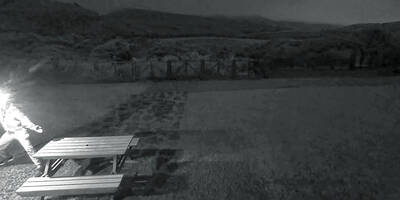
Yangmingshan National Park authorities yesterday urged visitors to respect public spaces and obey the law after a couple was caught on a camera livestream having sex at the park’s Qingtiangang (擎天崗) earlier in the day. The Shilin Police Precinct in Taipei said it has identified a suspect and his vehicle registration number, and would summon him for questioning. The case would be handled in accordance with public indecency charges, it added. The couple entered the park at about 11pm on Thursday and began fooling around by 1am yesterday, the police said, adding that the two were unaware of the park’s all-day live
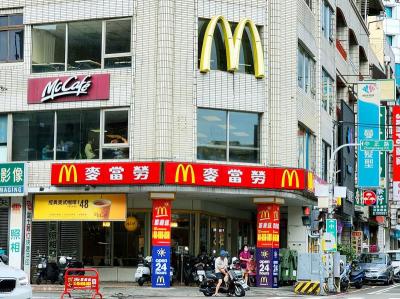
Fast food chain McDonald's is to raise prices by up to NT$5 on some products at its restaurants across Taiwan, starting on Wednesday next week, the company announced today. The prices of all extra value meals and sharing boxes are to increase by NT$5, while breakfast combos and creamy corn soup would go up by NT$3, the company said in a statement. The price of the main items of those meals, if ordered individually, would remain the same. Meanwhile, the price of a medium-sized lemon iced tea and hot cappuccino would rise by NT$3, extra dipping sauces for chicken nuggets would go up
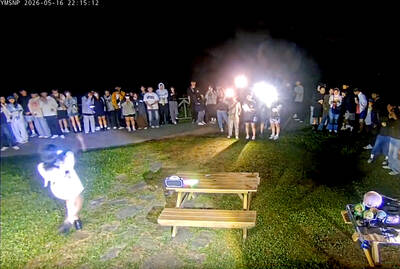
Yangmingshan National Park’s Qingtiangang (擎天崗) nature area has gone viral after a park livestream camera observed a couple in the throes of intimate congress, which was broadcast live on YouTube, drawing large late-night crowds and sparking a backlash over noise, bright lights and disruption to wildlife habitat. The area’s livestream footage appeared to show a couple engaging in sexual activity on a picnic table in the park on Friday last week, with the uncensored footage streamed publicly online. The footage quickly spread across social media, prompting a tide of visitors to travel to the site to “check in” and recreate the

Minister of Digital Affairs Lin Yi-ching (林宜敬) yesterday cited regulatory issues and national security concerns as an expert said that Taiwan is among the few Asian regions without Starlink. Lin made the remarks on Facebook after funP Innovation Group chief executive officer Nathan Chiu (邱繼弘) on Friday said Taiwan and four other countries in Asia — China, North Korea, Afghanistan and Syria — have no access to Starlink. Starlink has become available in 166 countries worldwide, including Ukraine, Malaysia, the Philippines and Vietnam, in the six years since it became commercial, he said. While China and North Korea block Starlink, Syria is not


 RSS
RSS