


A major political row is brewing over US President Barack Obama’s nomination of law professor Goodwin Liu (劉弘威) — the son of Taiwanese immigrants — to be a judge at the powerful San Francisco-based appeals court.
The nomination must be approved by the US Senate and conservative Republicans — the politicians who are generally most friendly toward Taiwan — are dead set against him as they see the 39-year-old Liu, the assistant dean and law professor at the University of California at Berkeley, as an extreme liberal who would move the US toward the political left.
“He is far outside the mainstream of American jurisprudence,” said Senator Jeff Sessions of Alabama, the senior Republican on the Senate Judiciary Committee.
UNUSUAL
What makes the nomination far more important than is usually the case are reports that if Liu is confirmed he would automatically go onto Obama’s shortlist for a seat on the US Supreme Court.
The Washington Post and other leading US newspapers said Liu has already “been discussed as the first person of Asian descent who could be chosen for the Supreme Court.”
If that happened and he was confirmed as a Supreme Court justice, he would become the most powerful person of Taiwanese descent in US history.
Liu’s parents are both active in the US Taiwanese community and are members of the Formosa Association for Public Affairs, which supports freedom and independence for Taiwan and peaceful coexistence with China as a friendly neighbor.
Senate hearings on Liu’s confirmation will open this week and are certain to be both controversial and difficult.
The situation has become even more tense because of the announcement by Justice John Paul Stevens on Friday that he would retire from the Supreme Court later this year.
TEST
While Liu is not a candidate for Stevens’ seat, Republican senators will use his confirmation hearings as a testing ground for challenges to Obama’s next Supreme Court nominee if that nominee is another strong liberal as expected.
It is more than likely that another member of the Court — Justice Ruth Bader Ginsburg — will retire while Obama is still in power.
Providing Liu makes it through confirmation hearings for the 9th US Circuit Court of Appeals — serving California, Arizona, Nevada, Oregon, Washington, Idaho, Hawaii and Montana — he would be a leading candidate for Ginsburg’s seat.
The Washington Times said last week that Liu’s nomination hearings would be “a test of whether President Obama can win confirmation for an unabashed liberal.”
All seven Republicans on the Senate Judiciary Committee have asked the Democratic chairman, Senator Patrick Leahy of Vermont, to postpone the hearings and he has refused.
QUESTIONS
The Republicans claim that Liu has not answered their preliminary questions and that he may be intentionally hiding information on his liberal background.
While the hearing process is underway, Liu and those close to him have been asked not to grant interviews.
A former Rhodes Scholar and Yale University graduate, Liu is widely regarded as having a brilliant legal mind.
“I can easily imagine him as a Supreme Court nominee,” said Erwin Chemerinsky, dean of the law school at the University of California at Irvine.
In a scathing letter to Leahy, however, the Republicans said: “At best, this nominee’s extraordinary disregard for the Committee’s constitutional role demonstrates incompetence; at worst, it creates the impression that he knowingly attempted to hide his most controversial work from the Committee.”
The letter said that Liu failed to answer all of the initial questions on a series of forms sent to him by the Republicans.
“Professor Liu’s unwillingness to take seriously his obligation to complete these basic forms is potentially disqualifying and has placed his nomination in jeopardy,” it added.
Leahy said the Democrats were prepared to fight for Liu’s nomination.
“I had hoped that in this new year, we could put political rancor aside and come together to openly and fairly debate President Obama’s qualified judicial nominees,” he said. “I am disappointed that, instead, we have seen the same delays and obstructionist approach.”
Liu clerked for Ginsburg at the Supreme Court, worked in the administration of former US president Bill Clinton and was active in education reform.
He won a distinguished teaching award at the University of California.
The American Bar Association has given him its highest approval rating.
Not one of the 175 judges now serving on the appeals courts is Asian-American.
“He is an outspoken advocate of liberal causes, including same-sex marriage and affirmative action,” the Washington Post said.

UPGRADE: The Kang Ding-class frigate is replacing its Chaparall missiles with Tien Chien II and Hua Yang VLS, which would provide it with long-range, 360° air defense Taiwan plans to produce 1,200 to 1,376 Hai Chien II missiles (海劍二, Sea Sword II) — also known as TC-2N — to serve as the standard air defense system of the navy’s surface combatant fleet, a source said yesterday. Last week, the Hai Chien II, the naval version of the Tien Kung II missile (天劍二, Sky Sword II), completed a live-fire test in waters off the National Chungshan Institute of Science and Technology’s Jiupeng facility (九鵬) in Pingtung County’s Manjhou Township (滿州). The MIM72 Chaparral and other dated air defense missiles that currently arm Taiwanese ships have inadequate range to combat Chinese

REASONS FOR TRAVEL: An assistant professor said that proposed amendments to penalize drivers if they used drugs overseas would not deter people from traveling People who operate a motor vehicle under the influence of marijuana would have their driver’s license revoked, even if they used the substance while overseas, the Ministry of Transportation and Communications said yesterday, citing proposed amendments to the Road Traffic Management and Penalty Act (道路交通管理處罰條例). The amendments would also authorize the government to revoke the licenses of people determined to have used Category 1 or Category 2 narcotics, even if they were not operating a vehicle while under the influence of drugs, as well as ban them from taking the license test for three years, the ministry said. People aged 18 or
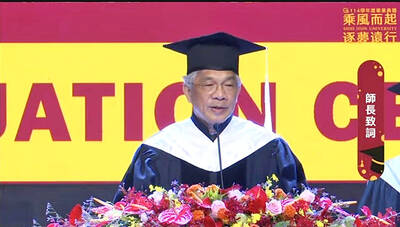
Shih Hsin University President Chen Ching-he (陳清河) yesterday issued a public apology for comments made in his commencement speech last week, stating that he has asked the school to suspend his duties and halt his wages for two months as a show of contrition. At the commencement ceremony on May 30, Chen said, “If you don’t manage your time well, or your own emotions, or your health, then I am telling every one of you — put a quick end to ‘you,’ because the world has no need for ‘you.’” The comments have sparked significant controversy online, and Chen through an open
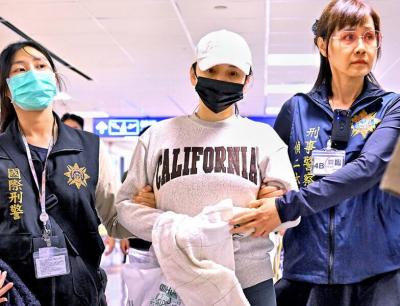
Johanne Liou (劉喬安), a Taiwanese woman who shot to unwanted fame during the Sunflower movement protests in 2014, returned to Taiwan last night after being deported from the US. She is to stand trial in Taiwan for charges involving embezzlement, fraud and drug crimes. The Criminal Investigation Bureau (CIB) said it took her into custody at Taiwan Taoyuan International Airport and would first question her before transferring her to the New Taipei District Prosecutors’ Office. She was arrested upon disembarking a flight from San Francisco that landed shortly before 7pm. Liou absconded to the US in 2019 after jumping bail


 RSS
RSS