


The weeks-long legislative impasse continued yesterday as lawmakers again failed to reach a consensus on whether to grant businesses tax breaks for specific categories or to lower the general business income tax.
Legislative Speaker Wang Jin-pyng (王金平), who convened a cross-party negotiation session yesterday morning, told reporters that the pan-blue and pan-green camps still could not find common ground on a draft act promoting innovative industries.
Minister of Finance Lee Sush-der (李述德) expressed reservations during the session about the Democratic Progressive Party’s (DPP) proposal to lower business income tax from 20 percent to 17.5 percent, adding that the state coffers could lose NT$40.3 billion (US$1.2 billion) in annual tax revenue as a result, Wang said.
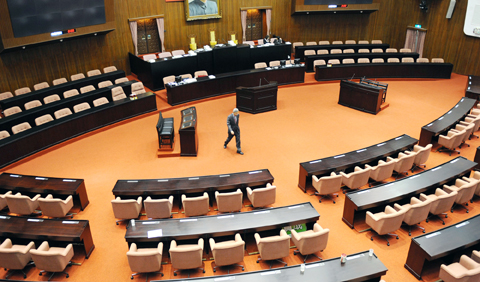
PHOTO: LO PEI-DER, TAIPEI TIMES
The minister said the government has lost NT$80.8 billion in revenue since the business income tax rate was lowered from 25 percent to 20 percent last year, Wang said.
Lee added that lowering the rate and allowing the rate to apply to all businesses instead of granting companies tax breaks in terms of nurturing talent or innovation did not live up to the spirit of the draft act of facilitating industrial development, Wang said.
However, the DPP still questioned whether small and medium-sized companies would be able to benefit from the tax breaks proposed by the Executive Yuan, he said.
Lawmakers are scheduled to hold another round of negotiations this afternoon.
The gridlock has meant all other bills have been stalled for several weeks as legislators across party lines agreed to give priority to the bill in the current session.
The bill is meant to be an extension of the Act for Industrial Upgrading (促進產業升級條例), which expired at the end of last year, and aims to encourage businesses to invest in innovation, research and development.
Earlier yesterday, Chinese Nationalist Party (KMT) caucus deputy secretary-general Huang Chih-hsiung (黃志雄) said the caucus would be open to any suggested business income tax rate cut.
DPP caucus Policy Research Committee head Ker Chien-ming (柯建銘) said his caucus supported deliberating the draft act rationally.
Meanwhile, Wang defended media criticism that the legislature was left idling all day long due to yesterday’s failed negotiations, saying that “discussing bills rationally helps improve the quality of legislation.”
Wang said the legislature could always hold extra sessions to deal with other bills if necessary.

The military has spotted two Chinese warships operating in waters near Penghu County in the Taiwan Strait and sent its own naval and air forces to monitor the vessels, the Ministry of National Defense (MND) said. Beijing sends warships and warplanes into the waters and skies around Taiwan on an almost daily basis, drawing condemnation from Taipei. While the ministry offers daily updates on the locations of Chinese military aircraft, it only rarely gives details of where Chinese warships are operating, generally only when it detects aircraft carriers, as happened last week. A Chinese destroyer and a frigate entered waters to the southwest

The eastern extension of the Taipei MRT Red Line could begin operations as early as late June, the Taipei Department of Rapid Transit Systems said yesterday. Taipei Rapid Transit Corp said it is considering offering one month of free rides on the new section to mark its opening. Construction progress on the 1.4km extension, which is to run from the current terminal Xiangshan Station to a new eastern terminal, Guangci/Fengtian Temple Station, was 90.6 percent complete by the end of last month, the department said in a report to the Taipei City Council's Transportation Committee. While construction began in October 2016 with an
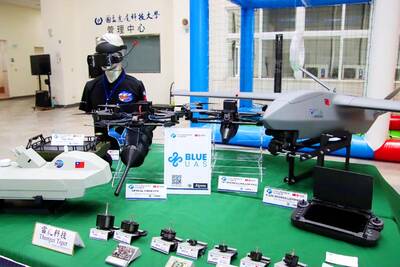
NON-RED SUPPLY: Boosting the nation’s drone industry is becoming increasingly urgent as China’s UAV dominance could become an issue in a crisis, an analyst said Taiwan’s drone exports to Europe grew 41.7-fold from 2024 to last year, with demand from Ukraine’s fight against Russian aggression the most likely driver of growth, a study showed. The Institute for Democracy, Society and Emerging Technology (DSET) in a statement on Wednesday said it found that many of Taiwan’s uncrewed aerial vehicle (UAV) sales were from Poland and the Czech Republic. These countries likely transferred the drones to Ukraine to aid it in its fight against the Russian invasion that started in 2022, it said. Despite the gains, Taiwan is not the dominant drone exporter to these markets, ranking second and fourth

Japanese Prime Minister Sanae Takaichi’s comment last year on Tokyo’s potential reaction to a Taiwan-China conflict has forced Beijing to rewrite its invasion plans, a retired Japanese general said. Takaichi told the Diet on Nov. 7 last year that a Chinese naval blockade or military attack on Taiwan could constitute a “survival-threatening situation” for Japan, potentially allowing Tokyo to exercise its right to collective self-defense. Former Japan Ground Self-Defense Force general Kiyofumi Ogawa said in a recent speech that the remark has been interpreted as meaning Japan could intervene in the early stages of a Taiwan Strait conflict, undermining China’s previous assumptions


 RSS
RSS