


Just in time for International Women's Day tomorrow, Council of Labor Affairs Minister Jennifer Wang (王如玄) said yesterday that female workers could start taking pregnancy leave for up to one year by June.
Wang made the remarks at an event at the Taiwan Women's Center in Taipei yesterday at a celebration marking the 100th anniversary of International Women’s Day.
“Many female workers have complained that they sometimes feel very uncomfortable or fear having a miscarriage when at work and would like to take days off,” she said.
“However, current laws don’t allow them [to take as many days off as they need],” she told the audience. “That's why we have come up with a plan to allow women to take pregnancy leave for up to a year.”
Wang said that while women going on pregnancy leave would not be paid, they would keep their job and labor insurance coverage.
She said that women wanting to go on pregnancy leave would have to provide a note from a doctor confirming the pregnancy.
“We will change regulations so that an employer will not be able to refuse the request,” Wang said.
“The program will be launched in late May or early June,” she said.
The plan was supported by Premier Wu Den-yih (吳敦義), who attended the celebration.
President Ma Ying-jeou (馬英九), who also participated in the event, said the lyrics of some military songs should be changed, as some may violate the spirit of gender equality.
Ma, who served in the Marine Corps during his compulsory military service, asked frogwoman Hsu Yu-ting (徐郁婷) to sing the Marines' Hymn with him and then asked the audience if they sensed something was wrong.
“Don't you think it's a bit odd to sing ‘boys become heroes here’ when we actually have female officers in the Marine Corps?” Ma asked.
“Things have changed over the past 100 years,” he said.
The president asked the Ministry of National Defense to look for regulations and song lyrics that needed to be revised to reflect gender equality.
A special exhibition on the equal rights movement in Taiwan was inaugurated after the event and will be open until March 26 on the 9th Floor of No. 15 Hangzhou S Rd Sec. 1 in Taipei.

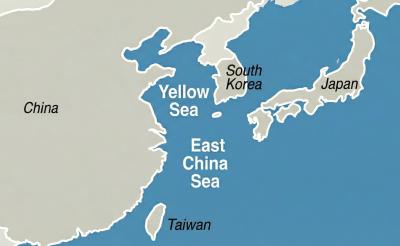
China has reserved offshore airspace in the Yellow Sea and East China Sea from March 27 to May 6, issuing alerts usually used to warn of military exercises, although no such exercises have been announced, the Wall Street Journal (WSJ) reported yesterday. Reserving such a large area for 40 days without explanation is an “unusual step,” as military exercises normally only last a few days, the paper said. These alerts, known as Notice to Air Missions (Notams), “are intended to inform pilots and aviation authorities of temporary airspace hazards or restrictions,” the article said. The airspace reserved in the alert is

South Korea is planning to revise its controversial electronic arrival card, a step Taiwanese officials said prompted them to hold off on planned retaliatory measures, a South Korean media report said yesterday. A Yonhap News Agency report said that the South Korean Ministry of Foreign Affairs is planning to remove the “previous departure place” and “next destination” fields from its e-arrival card system. The plan, reached after interagency consultations, is under review and aims to simplify entry procedures and align the electronic form with the paper version, a South Korean ministry official said. The fields — which appeared only on the electronic form

A bipartisan group of US senators has introduced a bill to enhance cooperation with Taiwan on drone development and to reduce reliance on supply chains linked to China. The proposed Blue Skies for Taiwan Act of 2026 was introduced by Republican US senators Ted Cruz and John Curtis, and Democratic US senators Jeff Merkley and Andy Kim. The legislation seeks to ease constraints on Taiwan-US cooperation in uncrewed aerial systems (UAS), including dependence on China-sourced components, limited access to capital and regulatory barriers under US export controls, a news release issued by Cruz on Wednesday said. The bill would establish a "Blue UAS
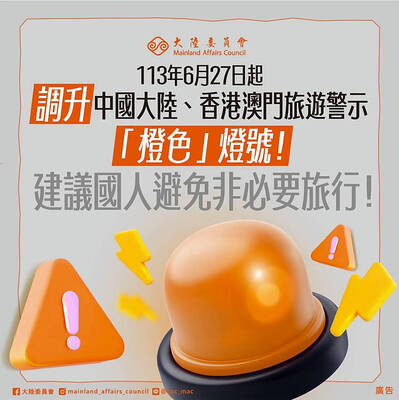
More than 6,000 Taiwanese students have participated in exchange programs in China over the past two years, despite the Mainland Affairs Council’s (MAC) “orange light” travel advisory, government records showed. The MAC’s publicly available registry showed that Taiwanese college and university students who went on exchange programs across the Strait numbered 3,592 and 2,966 people respectively. The National Immigration Agency data revealed that 2,296 and 2,551 Chinese students visited Taiwan for study in the same two years. A review of the Web sites of publicly-run universities and colleges showed that Taiwanese higher education institutions continued to recruit students for Chinese educational programs without


 RSS
RSS