


A telecommunications industry association said that plans by the National Communications Commission (NCC) to reduce fees for communications services were unacceptable and that the association would file an appeal if the reductions were implemented.
Starting on April 1, fees for fixed network communication services will drop 5.686 percent, while fees for mobile communication will fall by 5.87 percent, the NCC said.
“The commission estimates that consumers will be able to enjoy a reduction in communication charges that amounts to approximately NT$20.26 billion [US$633 million],” NCC spokesperson Chen Jeng-chang (陳正倉) said. “All 23 million people in Taiwan will benefit.”
Fixed network communication services that would be affected include Internet peering fees, leased circuit fees between telecom carriers, asymmetric digital subscriber line (ADSL) circuit fees and charges for long-distance calls.
Mobile communication services that would use the new rate include text messaging services, voice interconnection fees and communication charges between two different networks, as well as those between mobile phones and regular phones.
The policy would be in effect from April 1 to March 31, 2011. Chen, however, said the commission is gearing toward lifting the price cap for retail telecoms prices and capping wholesale prices instead.
Chen said that both the legislature’s Transportation and Finance committees have passed resolutions asking the commission to lower telecommunication charges. He also said that a price reduction does not necessarily lead to a decline in revenue. China Mobile, he said, lowered charges by about 9 percent, which led to a 15 percent increase in revenue.
However, Liu Li-chau (劉莉秋), Taiwan Telecommunication Industry Development spokesperson, said the new policy would cause a “tsunami” in the nation’s telecommunication industry.
“We are baffled by the way they calculated our costs and profit,” Liu said. “The range of services where the new policy applies is much wider than last time, more than we can tolerate.”
“We estimate that the policy will cost us NT$37 billion in revenues,” she said. “This will cause us to reduce our investment in innovative services. We are also less likely to provide discounted services to customers.”
Liu said that if the NCC implemented the policy as it was written, the association would file an appeal to the Executive Yuan.
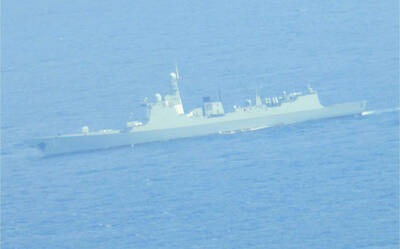
The military has spotted two Chinese warships operating in waters near Penghu County in the Taiwan Strait and sent its own naval and air forces to monitor the vessels, the Ministry of National Defense (MND) said. Beijing sends warships and warplanes into the waters and skies around Taiwan on an almost daily basis, drawing condemnation from Taipei. While the ministry offers daily updates on the locations of Chinese military aircraft, it only rarely gives details of where Chinese warships are operating, generally only when it detects aircraft carriers, as happened last week. A Chinese destroyer and a frigate entered waters to the southwest
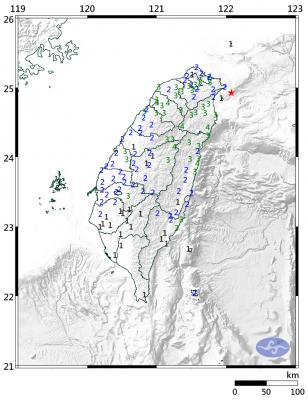
A magnitude 6.1 earthquake struck off the coast of Yilan County at 8:39pm tonight, the Central Weather Administration (CWA) said, with no immediate reports of damage or injuries. The epicenter was 38.7km east-northeast of Yilan County Hall at a focal depth of 98.3km, the CWA’s Seismological Center said. The quake’s maximum intensity, which gauges the actual physical effect of a seismic event, was a level 4 on Taiwan’s 7-tier intensity scale, the center said. That intensity level was recorded in Yilan County’s Nanao Township (南澳), Hsinchu County’s Guansi Township (關西), Nantou County’s Hehuanshan (合歡山) and Hualien County’s Yanliao (鹽寮). An intensity of 3 was
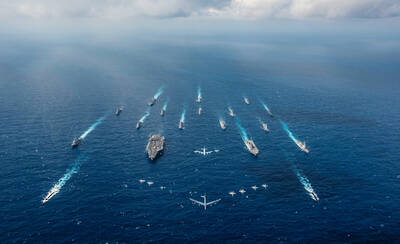
Japanese Prime Minister Sanae Takaichi’s comment last year on Tokyo’s potential reaction to a Taiwan-China conflict has forced Beijing to rewrite its invasion plans, a retired Japanese general said. Takaichi told the Diet on Nov. 7 last year that a Chinese naval blockade or military attack on Taiwan could constitute a “survival-threatening situation” for Japan, potentially allowing Tokyo to exercise its right to collective self-defense. Former Japan Ground Self-Defense Force general Kiyofumi Ogawa said in a recent speech that the remark has been interpreted as meaning Japan could intervene in the early stages of a Taiwan Strait conflict, undermining China’s previous assumptions
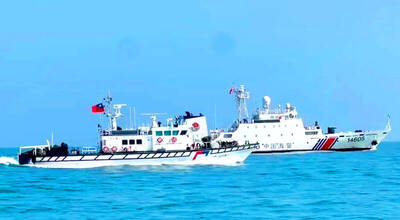
Instead of focusing solely on the threat of a full-scale military invasion, the US and its allies must prepare for a potential Chinese “quarantine” of Taiwan enforced through customs inspections, Stanford University Hoover fellow Eyck Freymann said in a Foreign Affairs article published on Wednesday. China could use various “gray zone” tactics in “reconfiguring the regional and ultimately the global economic order without a war,” said Freymann, who is also a nonresident research fellow at the US Naval War College. China might seize control of Taiwan’s links to the outside world by requiring all flights and ships entering or leaving Taiwan


 RSS
RSS