


Birds fly over mangrove forests in search of the day’s catch, while local fishermen check their nets and oyster sheds in the lagoons.
These are the wetlands along the coast of Cigu Township (七股), Tainan County, and Annan District (安南), Tainan City. The rich ecosystem here includes fiddler crabs, mudskippers, various mangrove species and the endangered black-faced spoonbill.
For generations, residents have set up Z-shaped fishing nets in the bayous to catch fish, shrimp and crabs, set up wooden racks in the lagoons to farm oysters, and raised milk fish in manmade ponds.
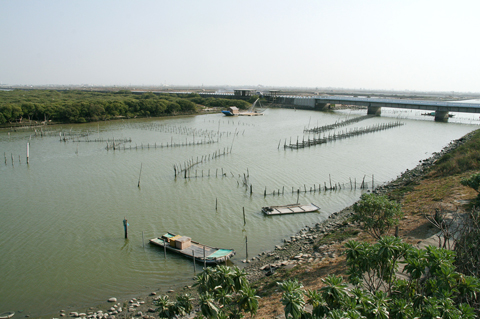
PHOTO: LOA IOK-SIN, TAIPEI TIMES
They used to harvest salt too, but most of the salt fields have since been abandoned because of the commodity’s reduced economic value.
This peaceful and picturesque centuries-old lifestyle was almost destroyed when two corporations filed an application 16 years ago for a massive land reclamation project to turn the wetlands and lagoons into a site for oil refineries and steel works called the Binnan Industrial Park (濱南工業區).
A fierce battle fought by local environmentalists to save the wetlands began the day that the Yeh-lung and Tuntex groups submitted the development plan — and it did not end until Taijiang National Park (台江國家公園), which now covers the area, was inaugurated last Monday.
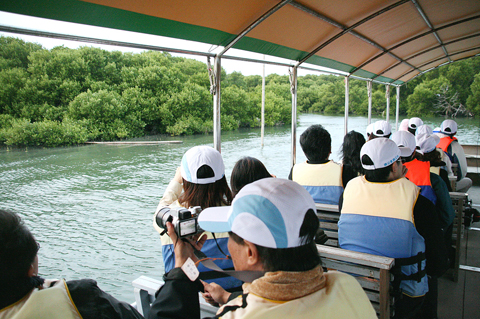
PHOTO: LOA IOK-SIN, TAIPEI TIMES
The campaign against the Binnan project was not easy. Residents and the government alike were largely unaware of the importance of preserving the ecology.
“At first, many locals supported the development project, because they thought it would bring economic benefits,” said Lee Chin-tien (李進添), executive director of the Mangroves Protection Association of Tainan City.
Environmentalists had to work hard to educate residents about the importance of wetland ecology, Lee said.
“At least 50 or 60 forums were organized by environmentalists to talk to locals face-to-face about the significance of these wetlands,” he said.
“I often tell people that as long as the lagoons are there, you, your children and your grandchildren can always make a living by catching fish, crabs and shrimp, or raising oysters and milk fish,” he said. “But once the government takes over, you would only get a few million NT dollars in compensation. How long do you think that money would last when you have to buy another house and start your life over?”
Tsai Chin-chu (蔡金助), an ecologist and now a guide at the national park, said the lagoons and mangroves were the lungs and air-conditioning of nearby towns and villages: They can reduce pollution and help reduce the local effects of global warming.
“An industrial park with highly polluting oil refineries and steel works would only bring pollution detrimental to its neighbors,” Tsai said, adding that residents around a similar industrial park in Yunlin County are now seven times more likely to get cancer than before.
In addition to the challenge of winning over residents, activists encountered other resistance.
In 1994, three men broke into the house of a local anti-Binnan group leader, Chen Chao-lai (陳朝來), and threatened his family.
Fortunately, the activists also received some help.
“Before, most people living in Cigu’s Shifen Village [十份] didn’t know what black-faced spoonbills were, even though they lived right on the edge of the bird’s habitat,” Tsai said.
“But since the former village chief was also an environmentalist and worked hard to raise community awareness about the birds, the villagers are now passionate about protecting them,” he said.
Tainan County Commissioner Su Huan-chih (蘇煥智), a native of Cigu who was a legislator at the time, was active in organizing public hearings at the legislature and holding press conferences with environmental groups to make the campaign against Binnan a nationwide issue.
Pointing to sculptures of a black-faced spoonbill and milk fish outside the Cigu Township Office, Tsai said: “More than a decade ago, the Cigu Township Office was a strong supporter of the Binnan project, but now it’s proud of the wildlife here and is using the bird and the fish as symbols of Cigu.”
Although the Ministry of the Interior finally rejected the Binnan proposal in 2006 after a prolonged administrative process and review, the story didn’t end there. In January last year, a court struck down the ministry’s decision.
Su was alarmed by the court ruling and soon agreed to add scattered sections of Cigu as wildlife and wetlands conservation areas to a proposal for Taijiang National Park just two months before the park was approved by the Cabinet last June.
The park, proposed by the Tainan City Government, was originally intended only to cover wetlands in Tainan City and the waters between Tainan and Dongji Island (東吉嶼) in Penghu County.
Minister of the Interior Jiang Yi-huah (江宜樺) said Taijiang National Park — the country’s eighth national park — is the first to have been initiated locally and the first that aims not only to protect the ecosystem, but also a traditional economy.
Jiang said the government would help traditional local industries and work to develop ecotourism in the new park.
“The creation of Taijiang National Park has put an end to the Binnan development project and from this day forward we are relieved at last that the wetland ecology will be preserved, since it’s now under the strictest protection of National Park Act [國家公園法],” Su said with a smile.

Yangmingshan National Park authorities yesterday urged visitors to respect public spaces and obey the law after a couple was caught on a camera livestream having sex at the park’s Qingtiangang (擎天崗) earlier in the day. The Shilin Police Precinct in Taipei said it has identified a suspect and his vehicle registration number, and would summon him for questioning. The case would be handled in accordance with public indecency charges, it added. The couple entered the park at about 11pm on Thursday and began fooling around by 1am yesterday, the police said, adding that the two were unaware of the park’s all-day live

Fast food chain McDonald's is to raise prices by up to NT$5 on some products at its restaurants across Taiwan, starting on Wednesday next week, the company announced today. The prices of all extra value meals and sharing boxes are to increase by NT$5, while breakfast combos and creamy corn soup would go up by NT$3, the company said in a statement. The price of the main items of those meals, if ordered individually, would remain the same. Meanwhile, the price of a medium-sized lemon iced tea and hot cappuccino would rise by NT$3, extra dipping sauces for chicken nuggets would go up

Yangmingshan National Park’s Qingtiangang (擎天崗) nature area has gone viral after a park livestream camera observed a couple in the throes of intimate congress, which was broadcast live on YouTube, drawing large late-night crowds and sparking a backlash over noise, bright lights and disruption to wildlife habitat. The area’s livestream footage appeared to show a couple engaging in sexual activity on a picnic table in the park on Friday last week, with the uncensored footage streamed publicly online. The footage quickly spread across social media, prompting a tide of visitors to travel to the site to “check in” and recreate the

Minister of Digital Affairs Lin Yi-ching (林宜敬) yesterday cited regulatory issues and national security concerns as an expert said that Taiwan is among the few Asian regions without Starlink. Lin made the remarks on Facebook after funP Innovation Group chief executive officer Nathan Chiu (邱繼弘) on Friday said Taiwan and four other countries in Asia — China, North Korea, Afghanistan and Syria — have no access to Starlink. Starlink has become available in 166 countries worldwide, including Ukraine, Malaysia, the Philippines and Vietnam, in the six years since it became commercial, he said. While China and North Korea block Starlink, Syria is not


 RSS
RSS