


Members of a group supporting the idea that “the people are the master of the country” finished a walk around Taiwan, which started at Taipei City’s Lungshan Temple on Nov. 8, reaching their starting point yesterday after walking about 1,030km.
Lin I-hsiung (林義雄), a long-time democracy stalwart and former Democratic Progressive Party (DPP) chairman who initiated the campaign, urged the public to pay attention to its appeal.
Having staged nationwide marches in 1994, 1997 and 2002 to call for a referendum on the Fourth Nuclear Power Plant that is currently under construction, this time Lin organized the march after a proposal by the DPP to hold a plebiscite on the government’s plan to sign an economic cooperation framework agreement (ECFA) with China was rejected by the Cabinet’s Referendum Review Committee.
The walk called for a referendum on any cross-strait agreements, including an ECFA, and amendments to some articles of the Referendum Law (公民投票法), which members of the group said repressed rather than ensured people’s right to hold a referendum.
During the last leg of the march from the Sun Yat-sen Memorial Hall to Lungshan Temple yesterday, participants took a break at Da-an Forest Park, with those who walked more than 800km in 49 days sharing their experiences.
Chen Li-kuei (陳麗貴) said she attended the campaign to express her wish that the government let the people of Taiwan determine the country’s destiny.
“It’s an ingenuous plan of action and we behaved with the strictest discipline to earn the approval of others. No matter where we were, in every corner of Taiwan, there were people joining us or giving us donations. We felt really appreciated and will continue our efforts,” Chen said.
Lin Min-da (林銘達), a retired teacher who found walking difficult, said he started to practice walking everyday when he heard of the campaign six months before it began.
“I am worried that beautiful Taiwan will be sold out if people do not come forward to fight for self-determination,” Lin said.
Chiang Liang-min (江良民), who has fourth stage colorectal cancer, said that this “silent” and “peaceful” campaign was more effective than fierce opposition.
During the campaign, participants were required to wear the same T-shirt and leaf hats and were prohibited from talking, smoking or eating while walking.
Hsu Fan-ting (許芳庭), who completed the whole journey, said she believed that any goal could be achieved peacefully through perseverance, while violence would only cause more violence.

FUKUOKA SITUATION: Japanese media reported that the pathogen is expected to be identified by the summer, while the CDC downplayed the idea that it was hMPV A “mysterious cold-like illness” reported in Japan’s Fukuoka Prefecture does not seem to be a new disease, but Japanese authorities have been asked about the situation, the Centers for Disease Control (CDC) said yesterday. The Fukuoka Prefectural Medical Association on Wednesday told a news conference that a “mystery cold” that has become a hot topic on social media is “highly likely to be caused by some kind of viral infection,” Japan’s KBC News reported. “Many people are experiencing symptoms starting with a sore throat, followed by a runny nose, phlegm and a severe cough,” KBC News reported, citing association officials. Health authorities are

Nvidia Corp CEO Jensen Huang (黃仁勳) arrived in Taiwan yesterday ahead of upcoming AI and technology events, saying he plans to meet with clients and Taiwan Semiconductor Manufacturing Co Chairman C.C. Wei (魏哲家) during his visit. After landing at Taipei Songshan Airport, Huang posed for photos with fans and handed out Yakult drinks to reporters and supporters waiting at the scene, saying he has “a lot to do” during the trip. Asked about reports that Nvidia’s planned headquarters site in Taipei’s Beitou Shilin Technology Park could break ground on May 27, Huang said that if the company holds an event, he would

The Ministry of Finance this afternoon announced the winning numbers for the March-April uniform invoice lottery. The winning number for the NT$10 million (US$318,060) special prize is 19531471, and the winning number for the NT$2 million grand prize is 85941329. Three numbers were drawn for the NT$200,000 first prize: 07225810, 20231230 and 83518781. Those with receipts matching the last seven digits of any of the first-prize numbers will win the NT$40,000 second prize, while those matching the last six digits will win the NT$10,000 third prize. Those whose receipts match the last five digits of the first-prize numbers can claim the NT$4,000 fourth prize,
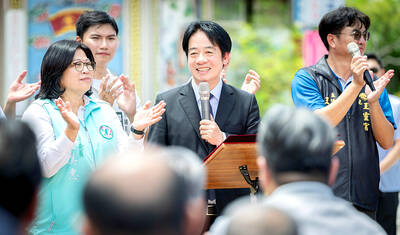
SIX SUBSIDIES: The monthly allowance for older farmers is to increase to NT$10,000, and NT$5,000 is to be given to homemakers under the national pension system, Lai said The government is to implement major welfare policies for disadvantaged groups, including raising the monthly allowance for older farmers to NT$10,000 and providing homemakers with NT$5,000 per month, President William Lai (賴清德) said yesterday. Lai made the remarks during a visit to Wangling Temple in Chiayi County, saying that the planned increases were being introduced amid economic growth and an increase in tax revenue. Touting a policy, in which the government plans to provide a monthly allowance of NT$5,000 for every child under the age of 18 in a bid to address Taiwan’s low birthrate, Lai said that if received for the


 RSS
RSS