


Taiwanese director Leon Dai (戴立忍) told the government on Thursday that without its help the local film industry would be finished.
“Without you, without revival efforts, Taiwan’s film industry will be reduced to doing OEM [original equipment manufacturer] work for the movie industry in China,” Dai said during a discussion with Hollywood director John Woo (吳宇森) in Taipei on the limited resources available to the local film industry.
Dai and Woo were invited to discuss film industry issues at a forum attended by government officials, film industry specialists and the media, as part of the 53rd Asian-Pacific Film Festival.
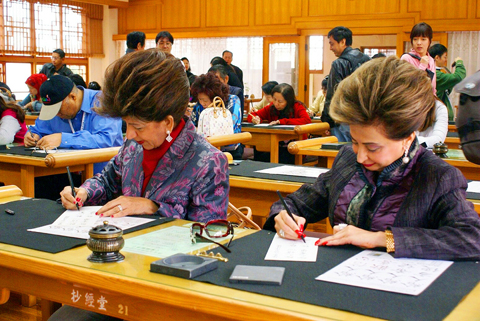
PHOTO: CNA
Dai is seen as an emerging talent in the nation’s movie industry, while Woo is an acclaimed Hong Kong director known for his highly choreographed 1980s action films and his success in Hollywood during the past decade.
At the forum, Woo praised Dai’s Golden Horse Award-winning No Pudeo Visir Sin Ti, saying that with better promotion it could have done even better at the box office.
In response, a frustrated Dai said the production crew did the best they could with a budget of just NT$4 million (US$130,000) to package the film.
“You cannot expect a film with such a small budget to achieve box office records,” Dai said.
The gap between Hollywood productions and those of Taiwanese directors is like the difference between a posh restaurant and a roadside food stand, Dai said, adding that like many Taiwanese directors he must eat at the food stand.
Dai said that because the traditional Chinese concept of theater is merely entertainment, he doubted that the government would make the film industry a key sector for incentives.
He urged the government to give adequate support to the local movie industry to help it avoid the fate of becoming an OEM for China, as has already happened to some manufacturing industries.
He said the government should put similar effort into reviving the movie industry as it has done for the electronics sector, by providing incentives.
In response, Frank Chen (陳志寬), director of the Government Information Office’s (GIO) Department of Motion Pictures, said the office has mapped out a five-year development plan to provide more incentives to film producers and that a market research institute was also being planned.
Citing market research and his experience of the international market, Woo said Taiwanese producers attempt to make movies in all the various genres.
“If you want to explore the international market, you must be able to find the movie language recognized by audiences of different regions and cultures,” he said.
The local film industry was greatly encouraged last year by the success of local production Cape No. 7, which achieved a box office record of NT$350 million in a domestic market generally dominated by Hollywood movies.
Following that success, Dai impressed audiences and the jury at the Golden Horse Film Festival last month with his movie based on a true story about an impoverished single father’s struggle to retain the guardianship of his young daughter.
No Pudeo Visir Sin Ti won four Golden Horse Awards — best feature film, best director, best original screenplay and most outstanding Taiwanese film of the year.
While the awards may help propel his movie career, however, Dai said they do not guarantee financial support for his future projects and he still needs to find capital from investors at home and abroad.
“Creativity is one of Taiwan’s advantages in the development of its film industry,” he said, adding that he wants the government to provide more support to the local film industry to create an original Taiwanese cultural brand.

The military has spotted two Chinese warships operating in waters near Penghu County in the Taiwan Strait and sent its own naval and air forces to monitor the vessels, the Ministry of National Defense (MND) said. Beijing sends warships and warplanes into the waters and skies around Taiwan on an almost daily basis, drawing condemnation from Taipei. While the ministry offers daily updates on the locations of Chinese military aircraft, it only rarely gives details of where Chinese warships are operating, generally only when it detects aircraft carriers, as happened last week. A Chinese destroyer and a frigate entered waters to the southwest

A magnitude 6.1 earthquake struck off the coast of Yilan County at 8:39pm tonight, the Central Weather Administration (CWA) said, with no immediate reports of damage or injuries. The epicenter was 38.7km east-northeast of Yilan County Hall at a focal depth of 98.3km, the CWA’s Seismological Center said. The quake’s maximum intensity, which gauges the actual physical effect of a seismic event, was a level 4 on Taiwan’s 7-tier intensity scale, the center said. That intensity level was recorded in Yilan County’s Nanao Township (南澳), Hsinchu County’s Guansi Township (關西), Nantou County’s Hehuanshan (合歡山) and Hualien County’s Yanliao (鹽寮). An intensity of 3 was

Japanese Prime Minister Sanae Takaichi’s comment last year on Tokyo’s potential reaction to a Taiwan-China conflict has forced Beijing to rewrite its invasion plans, a retired Japanese general said. Takaichi told the Diet on Nov. 7 last year that a Chinese naval blockade or military attack on Taiwan could constitute a “survival-threatening situation” for Japan, potentially allowing Tokyo to exercise its right to collective self-defense. Former Japan Ground Self-Defense Force general Kiyofumi Ogawa said in a recent speech that the remark has been interpreted as meaning Japan could intervene in the early stages of a Taiwan Strait conflict, undermining China’s previous assumptions
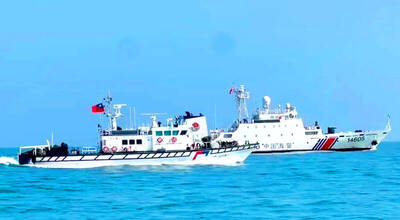
Instead of focusing solely on the threat of a full-scale military invasion, the US and its allies must prepare for a potential Chinese “quarantine” of Taiwan enforced through customs inspections, Stanford University Hoover fellow Eyck Freymann said in a Foreign Affairs article published on Wednesday. China could use various “gray zone” tactics in “reconfiguring the regional and ultimately the global economic order without a war,” said Freymann, who is also a nonresident research fellow at the US Naval War College. China might seize control of Taiwan’s links to the outside world by requiring all flights and ships entering or leaving Taiwan


 RSS
RSS