


Dozens of protesters gathered outside the Executive Yuan yesterday to urge the government to focus on the creation of renewable energy instead of relying on nuclear power.
The group, led by officials from the Green Party and the Taiwan Environmental Protection Union (TEPU), demanded the government scrap a proposal to extend the operating life of Jinshan (金山) nuclear power plant as well as plans to build a fourth plant.
“The government should stop pushing nuclear power under the guise of lowering carbon emissions. It is not an alternative for real sustainable energy sources,” Green Party spokesman Pan Han-shen (潘翰聲) said. “Nuclear power is a dying trend.”
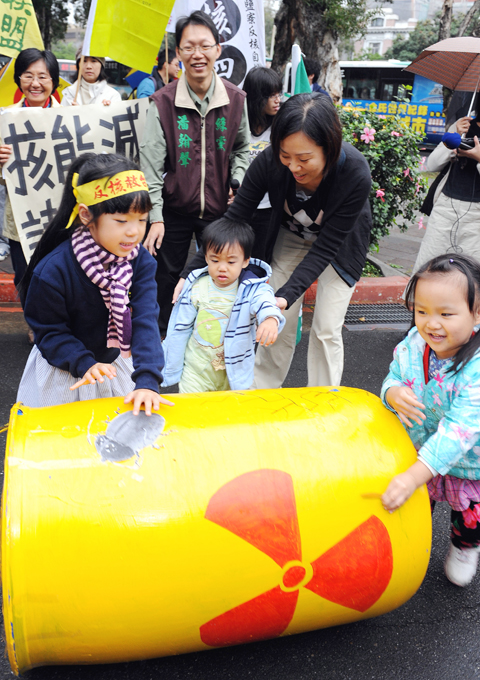
PHOTO: CHANG CHIA-MING, TAIPEI TIMES
Pan said that authorities have yet to achieve public consensus on the issue and he slammed the Ma government for ignoring public opinion and refusing to implement large-scale development for sustainable and clean alternative energies, such as solar, wind and tidal power.
“The public should be wary of recent media reports saying nuclear power is a lesser evil than global warming,” TEPU secretary-general Lee Cho-han (李卓翰) said.
Lee was referring to a Washington Post article last month that cited environmentalists, including former Greenpeace campaigner Steven Tindale, as saying that nuclear power was a necessary tool to combat emissions increases.
“It really is a question about the greater evil — nuclear waste or climate change,” Tindale was quoted as saying in the article.
“But there is no contest anymore. Climate change is the bigger threat, and nuclear is part of the answer,” he was quoted as saying.
Tindale had previously led Greenpeace protests against the construction of nuclear power plants in the UK.
Hong Kong-based Greenpeace representatives said Tindale made the comments after he had left the organization and the group was still firmly opposed to the development of nuclear power.
“Nuclear power is not the answer to global warming,” Greenpeace representative Chow Yuen-ping (周婉蘋) told the Taipei Times.
“[In Taiwan] as in other parts of the world, nuclear power is taking resources away from real solution — as a result, Greenpeace continues to oppose nuclear power,” Chow said.
Protestors chanting “We want our children to live in a nuclear- free world” and “Don’t nuke the environment,” were met by scores of police officers at the main entrance to the Executive Yuan.
The activists also highlighted concerns about the safety of state-owned Taipower’s proposal to extend the operating life of the Jinshan nuclear reactors by 20 years to 2038.
Atomic Energy Council officials have said the proposal was safe and similar extensions have been implemented in the US and Japan.
“The [Jinshan plant] is 100 percent safe — we do not foresee any problems in extending its operating life for another 20 years,” Department of Nuclear Regulation director Chen Yi-bin (陳宜彬) said.
Chen said his department expects to complete a safety analysis of the Jinshan extension proposal by July 2011.

Considering that most countries issue more than five denominations of banknotes, the central bank has decided to redesign all five denominations, the bank said as it prepares for the first major overhaul of the banknotes in more than 24 years. Central bank Governor Yang Chin-lung (楊金龍) is expected to report to the Legislative Yuan today on the bank’s operations and the redesign’s progress. The bank in a report sent to the legislature ahead of today’s meeting said it had commissioned a survey on the public’s preferences. Survey results showed that NT$100 and NT$1,000 banknotes are the most commonly used, while NT$200 and NT$2,000

The Centers for Disease Control (CDC) yesterday reported the first case of a new COVID-19 subvariant — BA.3.2 — in a 10-year-old Singaporean girl who had a fever upon arrival in Taiwan and tested positive for the disease. The girl left Taiwan on March 20 and the case did not have a direct impact on the local community, it said. The WHO added the BA.3.2 strain to its list of Variants Under Monitoring in December last year, but this was the first imported case of the COVID-19 variant in Taiwan, CDC Deputy Director-General Lin Ming-cheng (林明誠) said. The girl arrived in Taiwan on

South Korea is planning to revise its controversial electronic arrival card, a step Taiwanese officials said prompted them to hold off on planned retaliatory measures, a South Korean media report said yesterday. A Yonhap News Agency report said that the South Korean Ministry of Foreign Affairs is planning to remove the “previous departure place” and “next destination” fields from its e-arrival card system. The plan, reached after interagency consultations, is under review and aims to simplify entry procedures and align the electronic form with the paper version, a South Korean ministry official said. The fields — which appeared only on the electronic form

The Ministry of Foreign Affairs (MOFA) is suspending retaliation measures against South Korea that were set to take effect tomorrow, after Seoul said it is updating its e-arrival system, MOFA said today. The measures were to be a new round of retaliation after Taiwan on March 1 changed South Korea's designation on government-issued alien resident certificates held by South Korean nationals to "South Korea” from the "Republic of Korea," the country’s official name. The move came after months of protests to Seoul over its listing of Taiwan as "China (Taiwan)" in dropdown menus on its new online immigration entry system. MOFA last week


 RSS
RSS