


Packing a Tatung rice cooker, Hung Shen-hsing (洪慎杏), who has a master’s degree from National Taiwan Normal University’s (NTNU) Graduate Institute of Teaching Chinese as a Second Language, set off for New York in August as one of the Ministry of Education’s (MOE) “exported Mandarin teachers.”
Settled in a studio in Manhattan provided by Columbia University, she will teach Mandarin to undergraduate students for a year.
As the only “exported” Mandarin teacher from Taiwan at Columbia, Hung has to teach two classes, with a total of 25 students.
Hung said she went abroad to broaden her horizons but she also carries great responsibility. Apart from teaching, her job is to boost knowledge of the quality of Taiwan’s Mandarin teaching.
The MOE launched its Mandarin Teachers Export Project in 1985 as part of plans to boost the international profile of Taiwan’s Mandarin teaching.
Most placements were achieved through cooperation with universities and schools in Thailand, Vietnam, Britain and elsewhere.
According to the Republic of China Annual Almanac published by the Government Information Office last November, the ministry had sent 214 Mandarin teachers overseas as of 2005, while 95 Mandarin teachers went abroad through the project in 2007.
Mandarin teachers from Taiwan have an edge in terms of teaching traditional Chinese characters abroad. At Columbia, Mandarin classes for freshmen and sophomores begin with traditional Chinese characters, while teachers enjoy the freedom to choose between traditional and simplified characters when it comes to classes for juniors and seniors.
But teachers like Hung face uncertainty as the university is mulling whether to teach simplified characters only.
“If students only plan to work in China instead of planning to study Chinese literature or history, there is no need for them to learn traditional characters,” Hung said.
The rise of China has also made it increasingly difficult for traditional characters to gain sway over their simplified counterparts.
But the global economic crisis has aggravated the situation.
Hung conceded that few schools were willing to create openings for teachers using traditional characters amid the economic downturn.
Nevertheless, the MOE is seeking breakthroughs in promoting Taiwan’s Mandarin teaching.
The MOE-funded Steering Committee for the Test Of Proficiency-Huayu has focused on creating Mandarin proficiency tests for non-native speakers of Mandarin in Taiwan and abroad.
Part of the committee’s pioneering efforts has been to develop a set of screening tests for young learners of Mandarin abroad.
“Teaching young children Mandarin and creating proficiency tests for them is a rather new area,” said Chao Chia-pi (趙家璧), a member of the committee’s Research and Development Division.
Developers of the test, called the Children’s Chinese Competency Certification (CCCC), distinguish the CCCC from the Young Learners Chinese Test (YCT), which was created by China and enjoys dominant status globally in terms of proficiency tests.
“Hanban [The Chinese Language Council International] has been aggressively promoting Mandarin [screening tests] ... but the YCT does not normally include phonetic transcriptions with characters or give test-takers pictures [to help them understand the test content],” Chao said.
Ho Wen-chun (何文君), another committee official responsible for developing the CCCC, said some South Korean professors told the NTNU’s Mandarin Training Center that young examinees were frustrated by the YCT.
“The concept behind [the CCCC] is different [from that of the YCT]. YCT is more like a test for language knowledge while we [with the CCCC] tend to help children acquire the ability to use the language in their daily life,” Ho said.
In contrast to the text-based YCT, test-takers — aged between 7 and 12 — are given a large number of pictures in the CCCC to keep them interested in the target language, Ho said.
“If they lose interest at the very beginning they will not want to learn Mandarin anymore,” Ho said.
But with a rival like the YCT, which has been widely adopted worldwide, it is tough for the developers to persuade schools to give the CCCC a try, Chao said.
Developers of the CCCC have had difficulty expanding the test to schools overseas outside of those for Taiwanese expats, partly because of a lack of manpower and partly because of the YCT’s dominance, Chao said.
“Seeing China’s Hanban aggressively push [their tests and Mandarin teaching], I really hope our government can establish an agency specifically responsible for promoting [the CCCC and Taiwan’s Mandarin teaching],” said a committee official who wished to remain anonymous.

Yangmingshan National Park authorities yesterday urged visitors to respect public spaces and obey the law after a couple was caught on a camera livestream having sex at the park’s Qingtiangang (擎天崗) earlier in the day. The Shilin Police Precinct in Taipei said it has identified a suspect and his vehicle registration number, and would summon him for questioning. The case would be handled in accordance with public indecency charges, it added. The couple entered the park at about 11pm on Thursday and began fooling around by 1am yesterday, the police said, adding that the two were unaware of the park’s all-day live

Fast food chain McDonald's is to raise prices by up to NT$5 on some products at its restaurants across Taiwan, starting on Wednesday next week, the company announced today. The prices of all extra value meals and sharing boxes are to increase by NT$5, while breakfast combos and creamy corn soup would go up by NT$3, the company said in a statement. The price of the main items of those meals, if ordered individually, would remain the same. Meanwhile, the price of a medium-sized lemon iced tea and hot cappuccino would rise by NT$3, extra dipping sauces for chicken nuggets would go up
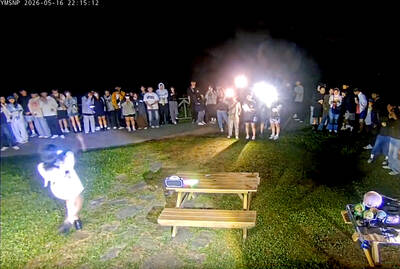
Yangmingshan National Park’s Qingtiangang (擎天崗) nature area has gone viral after a park livestream camera observed a couple in the throes of intimate congress, which was broadcast live on YouTube, drawing large late-night crowds and sparking a backlash over noise, bright lights and disruption to wildlife habitat. The area’s livestream footage appeared to show a couple engaging in sexual activity on a picnic table in the park on Friday last week, with the uncensored footage streamed publicly online. The footage quickly spread across social media, prompting a tide of visitors to travel to the site to “check in” and recreate the

Minister of Digital Affairs Lin Yi-ching (林宜敬) yesterday cited regulatory issues and national security concerns as an expert said that Taiwan is among the few Asian regions without Starlink. Lin made the remarks on Facebook after funP Innovation Group chief executive officer Nathan Chiu (邱繼弘) on Friday said Taiwan and four other countries in Asia — China, North Korea, Afghanistan and Syria — have no access to Starlink. Starlink has become available in 166 countries worldwide, including Ukraine, Malaysia, the Philippines and Vietnam, in the six years since it became commercial, he said. While China and North Korea block Starlink, Syria is not


 RSS
RSS