

The Ministry of Transportation and Communications (MOTC) is scheduled to start work on the electrification of the railway line between Hualien and Taitung next month.
The electrification of the Hualien-Taitung railway service was one of the 12 “I-Taiwan” projects (愛台十二項建設) promised by President Ma Ying-jeou (馬英九) during his presidential electoral campaign.
The work is scheduled to be completed by 2013.
TRAVEL TIME
Chou Yung-hui (周永暉), deputy director general of the Railway Reconstruction Bureau, said yesterday that it takes about two hours and 40 minutes to go from Hualien to Taitung. Once the electrification work is complete, travel time will be reduced by about 30 minutes.
“In the future, passengers will be able to go straight from Taipei to Taitung without having to change trains in Hualien,” Chou said. “The travel time can potentially be shortened to four hours. The operational speed will be increased from 110kph to 130kph.”
Currently, passengers going from Taipei to Taitung need to switch to diesel-powered trains in Hualien, with the exception of those travelling by diesel-powered Tzuchiang express trains.
The Hualien-Taitung route uses a single-track system and Chou said the project would also involve the installation of a double-track system on some sections, including those inside tunnels and on bridges.
STRETCH
The project covers a 155km stretch of railway. When it is finished, about 42km of this will be double-tracked.
Chou said the bureau had submitted a plan to make the entire route double-track, which had yet to be approved by the Executive Yuan.
The bureau originally planned to spend seven years on the project, but it would now try to accomplish the task within four years.
The cost is estimated to top NT$15.5 billion (US$480,000) and the bureau has also budgeted an additional NT$6 billion to renovate stations on the route.
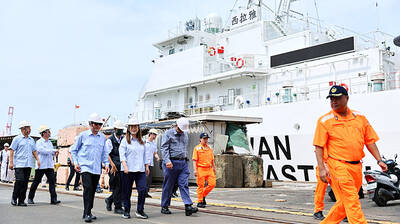
Ocean Affairs Council (OAC) Minister Kuan Bi-ling (管碧玲) on Wednesday said decommissioned coast guard vessels were given to the Philippines to enhance regional rescue capacity and would not affect Taiwanese fishers’ rights and benefits. Kuan made the remarks after confirmation on Tuesday that a 500-tonne Coast Guard Administration (CGA) patrol and rescue vessel would be given to the Philippine Coast Guard. The donation ceremony was reportedly done in Manila, but whether the vessel — previously numbered “CG123” and named Kinmen (金門) — has been handed over has yet to be confirmed. China’s Taiwan Affairs Office (TAO) on Wednesday criticized the donation for “taking

The Ministry of Finance today announced the winning numbers for the July-August uniform invoice lottery. The winning number for the NT$10 million (US$314,663) special prize is 89996565, while the winning number for the NT$2 million grand prize is 91098182. Three numbers were drawn for the NT$200,000 first prize: 54348835, 44991397 and 06595111. Those with receipts matching the last seven digits of any of the first-prize numbers can claim the NT$40,000 second prize, while those matching the last six digits qualify for the NT$10,000 third prize. Those whose receipts match the last five digits of the first-prize numbers are eligible for the NT$4,000 fourth prize,
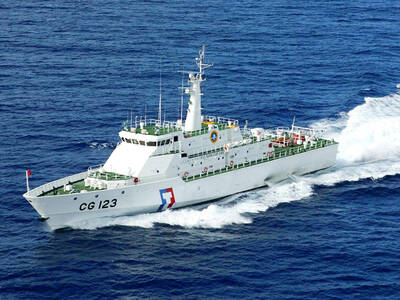
A decommissioned 500-tonne Kinmen-class patrol vessel recently donated by Taiwan’s Coast Guard Administration (CGA) has been delivered to the Philippine Coast Guard (PCG), a source said yesterday. The source said the vessel transferred to the PCG at a ceremony organized by the Philippine Non-government WPS Foundation on Monday was donated by the CGA. The CGA confirmed the donation on Wednesday last week following a United Daily News (UDN) report of a Philippine law enforcement vessel registered as "BLINGNO.1" setting sail for sea trials from Kaohsiung Port that day, citing tracking data from
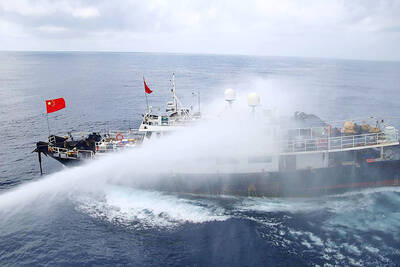
Taiwan has upgraded its maritime patrol capacity around the Pratas Islands (Dongsha Islands, 東沙群島) in the disputed South China Sea, including regularly sending larger ships there, the government said on Wednesday, responding to an increase in Chinese activities. Lying roughly between southern Taiwan and Hong Kong, the Taiwan-controlled Pratas Islands are seen by security experts as vulnerable to a Chinese attack due to their distance — more than 400km — from Taiwan. In a statement late on Wednesday, the Coast Guard Administration (CGA) said its overall patrol and enforcement capacity in Pratas waters has been “comprehensively upgraded.” With the completion of a wharf


 RSS
RSS