


Democratic Progressive Party (DPP) Legislator William Lai (賴清德) yesterday asked Minister of Justice Wang Ching-feng (王清峰) to launch a probe into whether Premier Wu Den-yih (吳敦義) has tried to influence next month’s Nantou County commissioner election through illegal means.
In a closed-door meeting between the two at the Ministry of Justice, Lai told Wang prosecutors should investigate whether Wu asked gang members to scare Non-Partisan Party candidate Chen Chen-sheng (陳振盛) out of running in the election, which would violate the Criminal Code and the Recall Act of Public Servants (公職人員選舉罷免法).
In a written petition, Lai said Chen was threatened on Oct. 6 by a gang member, who told Chen he would be “taken care of” if he ran in the election. Lai said he suspected Wu was linked to the incident.
Lai urged prosecutors to probe the matter immediately because a month had already passed since the incident.
The ministry accepted Lai’s petition and said the case would be processed in accordance with the law.
Speaking to reporters afterward, Lai said Wang had declined to allow reporters to attend their meeting because she feared public scrutiny of the case.
“I urge the public to keep an eye on this case so that it is not forgotten,” he said.
Wu has been on the defensive since allegations surfaced that he has connections to organized crime.
Wu has conceded that he went on a trip to Bali, Indonesia, with a group that included Nantou County Commissioner Lee Chao-ching (李朝卿) and Chiang Chin-liang (江欽良), a former gangster.
Chiang, now chairman of the Tsaoyetun Night Market Association in Caotun Township (草屯), Nantou County, was convicted of murder in two separate cases: the slaying of a Changhua gangster and a Nantou County council member in 1983 and 1985 respectively.
On Tuesday, Wu’s lawyer filed a slander lawsuit against DPP Nantou County commissioner candidate Lee Wen-chung (李文忠) for saying Wu had links to organized crime.
In other news, a group of academics and Chinese Nationalist Party (KMT) Legislator Chiang Ling-chun (江玲君) yesterday urged candidates running in this weekend’s KMT Central Standing Committee by-election to practice clean politics.
The group told a press conference at the legislature that they would e-mail or fax a written pledge to the 73 candidates and release the names of those who sign it ahead of tomorrow’s poll.
Chiang said the candidates had performed well so far and she hoped that none would resort to smearing their opponents.
Liu Teng-chung (劉燈鐘), deputy director of the KMT’s Department of Youth Affairs and a professor at Kang-Ning Junior College of Medical Care and Management, called for a clean election after allegations of bribery in an earlier poll.
Liu was referring to last month’s Central Standing Committee election. Claims of rampant bribery overshadowed the results of the election. Most of the committee members resigned after the KMT’s Evaluation and Disciplinary Committee suspended the membership rights of 12 committee members.
The party at first said it would not redo the poll, but President Ma Ying-jeou (馬英九), who doubles as KMT chairman, and high-ranking KMT officials urged committee members to resign in order to necessitate a second election.


UPGRADE: The Kang Ding-class frigate is replacing its Chaparall missiles with Tien Chien II and Hua Yang VLS, which would provide it with long-range, 360° air defense Taiwan plans to produce 1,200 to 1,376 Hai Chien II missiles (海劍二, Sea Sword II) — also known as TC-2N — to serve as the standard air defense system of the navy’s surface combatant fleet, a source said yesterday. Last week, the Hai Chien II, the naval version of the Tien Kung II missile (天劍二, Sky Sword II), completed a live-fire test in waters off the National Chungshan Institute of Science and Technology’s Jiupeng facility (九鵬) in Pingtung County’s Manjhou Township (滿州). The MIM72 Chaparral and other dated air defense missiles that currently arm Taiwanese ships have inadequate range to combat Chinese

REASONS FOR TRAVEL: An assistant professor said that proposed amendments to penalize drivers if they used drugs overseas would not deter people from traveling People who operate a motor vehicle under the influence of marijuana would have their driver’s license revoked, even if they used the substance while overseas, the Ministry of Transportation and Communications said yesterday, citing proposed amendments to the Road Traffic Management and Penalty Act (道路交通管理處罰條例). The amendments would also authorize the government to revoke the licenses of people determined to have used Category 1 or Category 2 narcotics, even if they were not operating a vehicle while under the influence of drugs, as well as ban them from taking the license test for three years, the ministry said. People aged 18 or
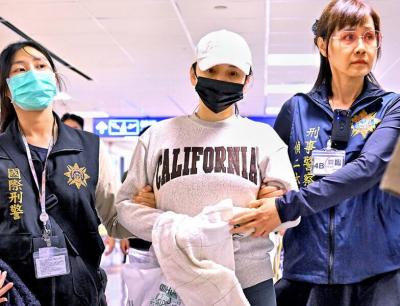
Johanne Liou (劉喬安), a Taiwanese woman who shot to unwanted fame during the Sunflower movement protests in 2014, returned to Taiwan last night after being deported from the US. She is to stand trial in Taiwan for charges involving embezzlement, fraud and drug crimes. The Criminal Investigation Bureau (CIB) said it took her into custody at Taiwan Taoyuan International Airport and would first question her before transferring her to the New Taipei District Prosecutors’ Office. She was arrested upon disembarking a flight from San Francisco that landed shortly before 7pm. Liou absconded to the US in 2019 after jumping bail
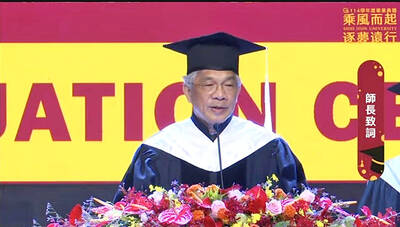
Shih Hsin University President Chen Ching-he (陳清河) yesterday issued a public apology for comments made in his commencement speech last week, stating that he has asked the school to suspend his duties and halt his wages for two months as a show of contrition. At the commencement ceremony on May 30, Chen said, “If you don’t manage your time well, or your own emotions, or your health, then I am telling every one of you — put a quick end to ‘you,’ because the world has no need for ‘you.’” The comments have sparked significant controversy online, and Chen through an open


 RSS
RSS