


President Ma Ying-jeou (馬英九) yesterday pledged to increase the international competitiveness of the country’s universities and said he expected more colleges to offer courses taught in English.
“Higher education in Taiwan should not keep its doors closed any more. We need to promote the idea of studying in Taiwan and attract great students to Taiwan,” Ma said yesterday in his weekly online speech.
“If we refuse to make changes, great teachers and students will be gone and it will be more difficult for us to raise competitiveness,” he said.
Ma said the government would redouble efforts to attract foreign students. The Ministry of Foreign Affairs, for example, has offered scholarships to more than 2,000 foreign students over the years.
The ministry will add NT$100 million (US$3.1 million) to its budget next year and provide even more scholarships for foreign students, he said.
Thirty-nine of the 70 public and private universities in Taiwan offer a total of 9,350 English-speaking courses, while foreign students make up 1.3 percent of all college students.
The government expects to double the percentage of foreign students to 2.6 percent in the near future, Ma said.
The president said attracting foreign students, including those from China, would create more opportunities for educational exchanges and expand the vision of Taiwanese students.
“College students in mainland China work very hard because of the intense competition, and students in Taiwan have lost their competitiveness because it is too easy to get into college,” he said.
The education industry brings tens of thousands of foreign students to US schools every year, bringing annual revenue of about NT$15 billion to the country.
In related news, a Hong Kong university is offering attractive scholarships to lure elite Taiwanese senior high school students.
At a presentation held on Friday at Taipei Municipal Jianguo High School, one of Taiwan’s most prestigious boys’ high schools, Hong Kong Polytechnic University offered a scholarship package worth HK$480,000 (US$62,112) in financial support to each student.
The scholarship will include HK$80,000 for tuition and HK$40,000 for living expenses per year per student.
Laura Lo, the university’s Chinese mainland affairs department chief, said at the presentation that hopefuls can apply based on their academic proficiency exam scores. As long as the applicants are outstanding, the school will offer them scholarships.
“There will be no quota restrictions, “ she said, adding that if there are many talented Taiwanese students, the school will increase the scholarship quota for Taiwanese students at the expense of those from other areas.
A similar presentation was made at Taipei First Girls’ Senior High School, said Lo, who added that the response from students at both schools had been enthusiastic.
Earlier this year, the University of Hong Kong also made presentations in Taipei offering scholarships worth HK$150,000 per year for up to four years.
Meanwhile, National Taiwan University Chief Secretary Liao Hsien-hao (廖咸浩) said his school has been actively recruiting foreign students to create a multicultural campus environment.
“We have been working hard to retain outstanding students in Taiwan. In addition to luring foreign students by offering scholarships, we have also been actively forging cooperative ties with famous foreign schools for student exchanges. Our goal is for one-third of our students to be able to study on foreign campuses as exchange students,” Liao said.
ADDITIONAL REPORTING BY CNA

NATIONAL SECURITY: Authorities are working to confirm the identities of the military personnel involved and investigating possible illegal conduct and regulatory violations Authorities are probing possible national security implications after Kinmen police and immigration officers on Sunday found a Chinese woman allegedly posing as a tourist while engaging in prostitution involving more than 10 military personnel. The woman, surnamed Chen (陳), has since been deported, authorities said, adding that investigators are still working to confirm the identities of those implicated, as the records only listed code names and aliases. The case stemmed from a report received by the Kinmen District Prosecutors’ Office on Friday last week from the Jinhu Precinct of the Kinmen County Police Bureau. On Sunday, police, along with the National Immigration

GLOBALGIVING: ‘ Caving to external pressure is not acceptable for an organization that has cultivated justice reform and human rights for 30 years,’ one NGO said A slew of non-government organizations (NGOs) have withdrawn from the GlobalGiving fundraising platform after it announced it would use “Chinese Taipei” instead of “Taiwan” from next month. The Taiwan Good Rice Association wrote on Facebook on Friday that it was informed on April 28 via a teleconference call of the change, which was made because the platform wanted to operate in China. Taiwan Good Rice is to terminate all cooperative relationships with GlobalGiving in response to the platform’s “unilateral and non-negotiable” decision to remove references to Taiwan, the NGO said. “Taiwan is in the official name of Taiwan Good Rice Association and the

HEAVY WEATHER: Typhoon Jangmi is due to crash straight into the Ryukyus as airlines look to shift flights to larger aircraft or cancel flights to Okinawa entirely Taiwan’s international air carriers announced flight adjustments over the weekend as Typhoon Jangmi is forecast to hit the Ryukyu Islands today and tomorrow. The Central Weather Administration (CWA) upgraded Jangmi from a tropical storm to a typhoon at 8am yesterday, with the eye located 580km south of Naha city. It was moving north at 19kph. Today, China Airlines’ CI-120, CI-121, CI-122 and CI-123 flights between Taoyuan and Naha, Okinawa, have been canceled as well as CI-132 and CI-133 between Kaohsiung and Naha. EVA Air’s BR-112, BR-113, BR-186 and BR-185 flights between Taoyuan and Naha are also canceled. Low-cost carrier Tigerair Taiwan canceled IT-230,
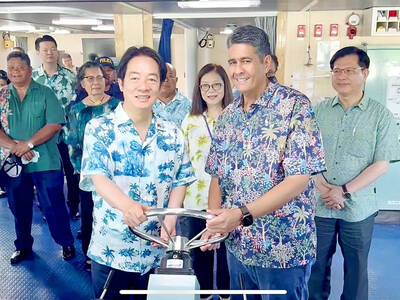
MULTIPRONGED APPROACH: China has sought to pressure Palau across a number of fronts, but the island nation has staunchly resisted overtures to ditch Taiwan Palau has been firm in backing Taiwan despite Chinese pressure that uses tourism economics, cyberattacks and criminal infiltration as tools to threaten the Pacific ally into renouncing its recognition of Taiwan as a sovereign state. The Presidential Office yesterday announced that Vice President Hsiao Bi-khim (蕭美琴) would visit Palau from Saturday to Wednesday next week at the invitation of Palauan President Surangel Whipps Jr. Whipps in April said in an interview that China had outspokenly asked Palau to “denounce Taiwan.” “And we have said: ‘We have no enemies, but nobody tells us who our friends are,’” he said. Whipps has told reporters multiple times


 RSS
RSS