


The American Chamber of Commerce in Taipei (AmCham) yesterday called on Taipei and Washington to resume the long-stalled Trade and Investment Framework Agreement (TIFA) talks now that the controversial issue of Taiwan's restrictions on US beef imports has been resolved.
In a statement issued yesterday, AmCham welcomed the announcement that Taipei and Washington had reached agreement on a protocol on the liberalization of imports of US beef products into Taiwan.
“The protocol removes what had been a major irritant in the bilateral economic relationship. AmCham now urges the two governments to quickly schedule the long-delayed next round of TIFA talks, which should take place in Taipei,” AmCham said.
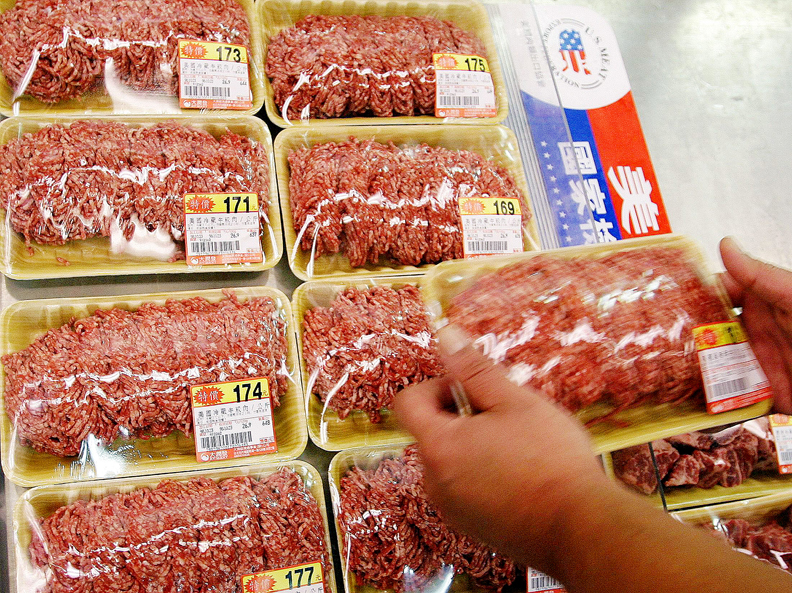
PHOTO: PICHI CHUANG, REUTERS
“TIFA talks have proven in the past to be a highly useful vehicle for the two sides to discuss trade and investment-related issues in detail, moving bilateral economic relations forward to the benefit of both economies,” the statement added.
At a separate setting yesterday, Minister of Economic Affairs Shih Yen-shiang (施顏祥) said TIFA talks are expected to resume by the end of this year now that the issue of beef imports from the US has been resolved.
Shih said he recently reported to Vice Premier Eric Chu (朱立倫) about the importance of renewing TIFA talks and said that under the TIFA dialogue framework, Taiwan will seek to talk about e-commerce, product verification and other issues.
Shih's remarks echoed those made by William Stanton, the top US envoy to Taiwan, who said on Thursday that as soon as the beef issue “hurdle” was cleared, TIFA talks aimed at strengthening bilateral economic and trade relations between Taiwan and the US could be resumed.
Taiwan and the US signed the TIFA in 1994 as a stepping stone to a Taiwan-US free trade agreement. Under this framework, meetings were held once or twice a year until July 2007.
Nefeterius Akeli McPherson, senior media affairs liaison of the Office of the US Trade Representative, welcomed Taiwan's decision to lift the ban on US bone-in beef from young cattle.
The latest development is conducive to a resumption of the TIFA talks, McPherson said.
“We look forward to seeing both sides getting the opportunity to communicate, since there are so many trade issues to be settled,” she said.
Meanwhile, a Washington-based Taiwanese official cast doubt on whether the new round of TIFA talks will take place this year, given that the US government is running a tight schedule for the rest of this year, including an annual meeting of the China-US Joint Commission on Commerce and Trade, a visit to China by US President Barack Obama and the APEC leadership summit.

The Ministry of Finance this afternoon announced the winning numbers for the March-April uniform invoice lottery. The winning number for the NT$10 million (US$318,060) special prize is 19531471, and the winning number for the NT$2 million grand prize is 85941329. Three numbers were drawn for the NT$200,000 first prize: 07225810, 20231230 and 83518781. Those with receipts matching the last seven digits of any of the first-prize numbers will win the NT$40,000 second prize, while those matching the last six digits will win the NT$10,000 third prize. Those whose receipts match the last five digits of the first-prize numbers can claim the NT$4,000 fourth prize,
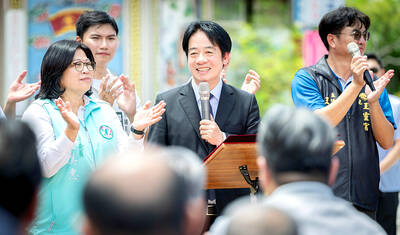
SIX SUBSIDIES: The monthly allowance for older farmers is to increase to NT$10,000, and NT$5,000 is to be given to homemakers under the national pension system, Lai said The government is to implement major welfare policies for disadvantaged groups, including raising the monthly allowance for older farmers to NT$10,000 and providing homemakers with NT$5,000 per month, President William Lai (賴清德) said yesterday. Lai made the remarks during a visit to Wangling Temple in Chiayi County, saying that the planned increases were being introduced amid economic growth and an increase in tax revenue. Touting a policy, in which the government plans to provide a monthly allowance of NT$5,000 for every child under the age of 18 in a bid to address Taiwan’s low birthrate, Lai said that if received for the
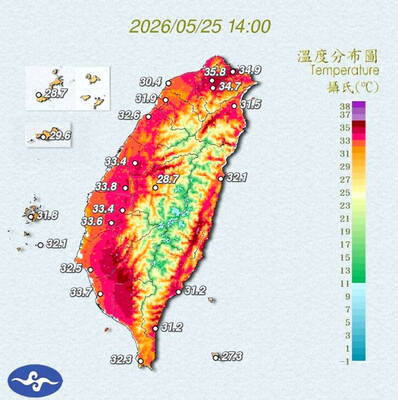
STAY COOL: The HPA recommended that people stay hydrated, use air-conditioning or fans while indoors, wear loose-fitting clothes and walk in the shade while outdoors Employers must implement measures such as installing cooling equipment, and providing drinking water and rest breaks for outdoor workers starting from Monday next week, the Taipei Department of Labor said on Sunday. Employers who fail to comply could face fines of NT$30,000 to NT$300,000 under the Occupational Safety and Health Act (職業安全衛生法), the department said. Businesses in Taipei employing fewer than 100 workers, as well as registered self-employed workers with labor insurance coverage, could receive on-site assessments and guidance from occupational safety consultants to help them apply for central government subsidies to implement or improve heat-protection measures, it said. Under the Ministry of
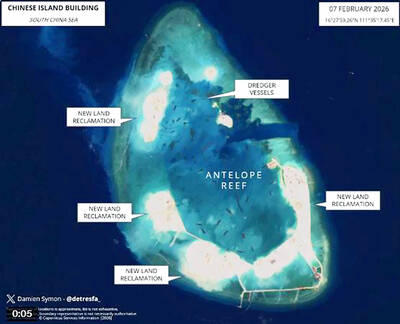
ISOLATION: The outposts would serve as support and backup bases, forcing US forces to either face China head-on or reroute, increasing travel time and operational costs China’s outposts in the South China Sea could be used to delay and constrain foreign forces during a conflict in the Taiwan Strait, giving Beijing a critical window to carry out amphibious landing and blockade operations, a report said. The Chinese Communist Party’s (CCP) forward operating bases on islands and reclaimed features in the South China Sea could delay foreign forces long enough for the Chinese People’s Liberation Army (PLA) to secure a key 48-to-72-hour window in the Taiwan Strait, a report commissioned by the Mainland Affairs Council found. The report, conducted by the Institute for National Defense and Security Research, examined


 RSS
RSS