


Taoyuan County Commissioner Eric Chu’s (朱立倫) rise to vice premier is the latest step up the career ladder for the popular Chinese Nationalist Party (KMT) vice chairman.
Few were surprised on Monday when Chu was named the new vice premier.
“It was only a matter of when,” said Taoyuan County Council Speaker Tseng Chung-yi (曾忠義), who said he thought Chu would be able to make his expertise felt in the Cabinet because of his strong educational background and rich experience in both the legislative and administrative arenas.
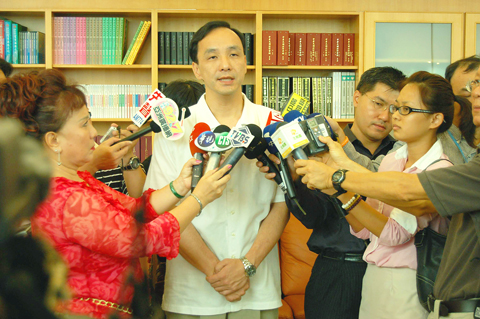
PHOTO: CHEN WEN-CHENG, TAIPEI TIMES
Chu, 48, was an accounting professor at National Taiwan University before he entered politics as a Chinese Nationalist Party (KMT) legislator in 1999. He often received higher approval ratings than his KMT legislative counterparts, something that was attributed to his business and finance skills.
Chu is also well connected: He is the son-in-law of former KMT legislator and Twinhead International Corp (倫飛電腦) chairman Kao Yu-jen (高育仁).
Chu’s political career began to gain steam when he was recruited by the KMT leadership in 2001 to run for county chief in Taoyuan after the Democratic Progressive Party had taken over what had long been a KMT stronghold.
To the KMT’s relief, Chu won the Taoyuan election by 11 percentage points and was re-elected in 2005 by nearly double that margin.
Since 2003, Chu has been part of an “iron triangle” called “Ma-Li-Chiang” that referred to the party’s biggest vote getters — then Taipei Mayor Ma Ying-jeou (馬英九), Chu, and Taichung Mayor Jason Hu (胡志強). “Li” and “Chiang” refer to characters in Chu and Hu’s names.
Chu has been selected many times in opinion polls as one of the three most-favored local government leaders in the country and one of the most popular leaders in KMT-controlled areas.
He has made strenuous efforts to solicit businesses to relocate their operations to Taoyuan and expand education and tourism development.
Under the leadership of Chu, Taoyuan County has ranked as the No. 1 administrative district in the country in terms of annual tax revenue contributions over the past several years.
In anticipation of warming cross-strait relations and increased cross-strait exchanges, he has recently pushed to develop a Taoyuan Aviation City, with the Taiwan Taoyuan International Airport as its center.
Taoyuan’s population has continuously grown under Chu’s administration and is expected to top 2 million next year, moving the county one step closer to its target of being upgraded to a metropolitan city.
In March, Chu was one of three local government heads named by the Intelligent Community Forum (ICF) think tank as a recipient of its prestigious annual Founders Awards for efforts in digital and technology development. The forum studies the impact of technology on 21st century communities.
The two other award recipients were Dave Carter, head of the Manchester Digital Development Agency of the UK, and Andrew Spano, county executive for Westchester County, New York.
Chu offered an apology on Monday to residents of Taoyuan for leaving office before his term finishes at the end of the year.
“I couldn’t turn down the appointment or make other decision as the country needs me at a time when it is facing the most trying challenge it has ever seen,” Chu said at a news conference after accepting his appointment.
He also expressed his appreciation to his constituents for their support over the past eight years.
Chu said his feelings were mixed when he was approached by Ma two days earlier to help the KMT government in the wake of Typhoon Morakot, which battered southern Taiwan and undermined confidence in the KMT.
Chu’s popularity will be in for a test as some political observers say that Chu and premier-designate Wu Den-yih (吳敦義) will face more serious challenges than they might anticipate, including a struggling economy, record-high unemployment and government efforts to improve its image in the wake of Typhoon Morakot.
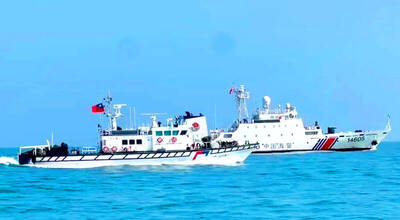
Instead of focusing solely on the threat of a full-scale military invasion, the US and its allies must prepare for a potential Chinese “quarantine” of Taiwan enforced through customs inspections, Stanford University Hoover fellow Eyck Freymann said in a Foreign Affairs article published on Wednesday. China could use various “gray zone” tactics in “reconfiguring the regional and ultimately the global economic order without a war,” said Freymann, who is also a nonresident research fellow at the US Naval War College. China might seize control of Taiwan’s links to the outside world by requiring all flights and ships entering or leaving Taiwan
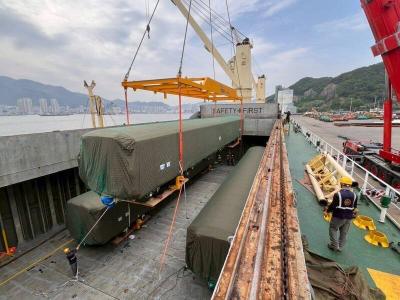
The first of 10 new high-capacity trains purchased from South Korea’s Hyundai Rotem arrived at the Port of Taipei yesterday to meet the demands of an expanding metro network, Taipei Rapid Transit Corp (TRTC) said yesterday. The train completed a three-day, 1,200km voyage from the Port of Masan in South Korea, the company said. Costing NT$590 million (US$18.79 million) each, the new six-carriage trains feature a redesigned interior based on "human-centric" transportation concepts, TRTC said. The design utilizes continuous longitudinal seating to widen the aisles and optimize passenger flow, while also upgrading passenger information displays and driving control systems for a more comfortable
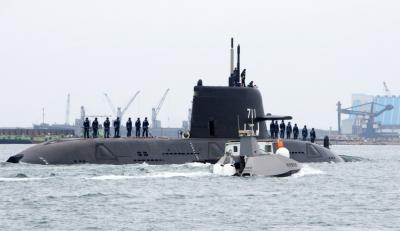
Taiwan's first indigenous defense submarine, the SS-711 Hai Kun (海鯤, or Narwhal), departed for its 13th sea trial at 7am today, marking its seventh submerged test, with delivery to the navy scheduled for July. The outing also marked its first sea deployment since President William Lai (賴清德) boarded the submarine for an inspection on March 19, drawing a crowd of military enthusiasts who gathered to show support. The submarine this morning departed port accompanied by CSBC Corp’s Endeavor Manta (奮進魔鬼魚號) uncrewed surface vessel and a navy M109 assault boat. Amid public interest in key milestones such as torpedo-launching operations and overnight submerged trials,
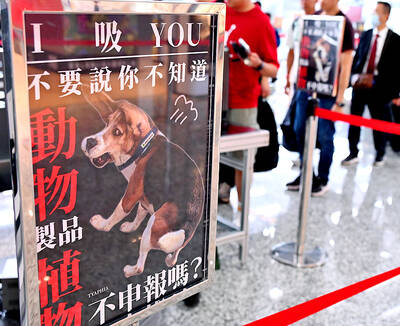
Quarantine awareness posters at Taiwan Taoyuan International Airport have gone viral for their use of wordplay. Issued by the airport branch of the Animal and Plant Health Inspection Agency, the posters feature sniffer dogs making a range of facial expressions, paired with advisory messages built around homophones. “We update the messages for holidays and campaign needs, periodically refreshing materials to attract people’s attention,” quarantine officials said. “The aim is to use the dogs’ appeal to draw focus to quarantine regulations.” A Japanese traveler visiting Taiwan has posted a photo on X of a poster showing a quarantine dog with a


 RSS
RSS