


Survivors of a village devastated by Typhoon Morakot yesterday urged legislators to consider their long-term future when formulating a new reconstruction bill.
Villagers from Siaolin (小林) in Kaohsiung County’s Jiasian Township (甲仙) held a press conference at the Legislative Yuan to express their concerns as legislators worked to finalize the bill.
The survivors asked the government to give them farmland near their relocation site so that they can continue their way of life, and to investigate the cause of a landslide.
“Before Morakot, Siaolin had about 200 households and 500 or so people, but on Aug. 9, the landslide took the lives of more than 400 of our families, relatives and neighbors. I still cannot believe it happened,” said Siaolin Self-help Association spokesperson, Huang Chin-pao (黃金寶).
Before the disaster, most of the survivors were bamboo, taro, ginger or leaf vegetable farmers, Huang said.
“What we ask is simple: we want a safe place for relocation, and we want farmland so we can return to our previous lives,” he said.
“Though we have been receiving public donations and compensation and housing from the government, if the government doesn’t give us land, we don’t know how we will make a living in the future,” survivor Weng Jui-chi (翁瑞琪) said.
Huang also said the soil, rocks and wood that now cover their former village — valued at more than NT$100 million (US$3 million) — should become government property instead of going to business groups.
“The money should be used to fund reconstruction plans,” he said.
Huang said his people wanted to find out who was responsible for the devastation of their village.
“We asked the county government for help right before the landslide but no one paid attention to us … We also had to wait in the rubble for 36 hours before the first helicopter arrived … The judicial system should investigate this and tell us who was responsible,” he said.
In related news, the Ministry of National Defense (MND) yesterday said it has set aside a total of 15 facilities with capacity for 7,000 people to host flood victims.
MND Spokesman Major General Yu Sy-tue (虞思祖) told a press conference yesterday that the facilities are ready and can be used at anytime.
“These places may not be luxurious, but they can offer shelter to those who lost their homes during the floods,” Yu said.
Yu denied reports that soldiers were asked to read out Minister Chen Chao-min’s (陳肇敏) letter of encouragement every day before they began their rescue work.
“I think there has been some sort of misunderstanding. We requested group leaders to forward the minister’s note of encouragement to soldiers helping with the rescue work. We did not ask soldiers to read them out loud,” Yu said.
ADDITIONAL REPORTING BY JIMMY CHUANG

LOUD AND PROUD Taiwan might have taken a drubbing against Australia and Japan, but you might not know it from the enthusiasm and numbers of the fans Taiwan might not be expected to win the World Baseball Classic (WBC) but their fans are making their presence felt in Tokyo, with tens of thousands decked out in the team’s blue, blowing horns and singing songs. Taiwanese fans have packed out the Tokyo Dome for all three of their games so far and even threatened to drown out home team supporters when their team played Japan on Friday. They blew trumpets, chanted for their favorite players and had their own cheerleading squad who dance on a stage during the game. The team struggled to match that exuberance on the field, with
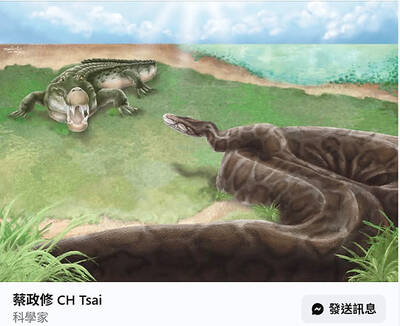
Taiwanese paleontologists have discovered fossil evidence that pythons up to 4m long inhabited Taiwan during the Pleistocene epoch, reporting their findings in the international scientific journal Historical Biology. National Taiwan University (NTU) Institute of Ecology and Evolutionary Biology associate professor Tsai Cheng-hsiu (蔡政修) led the team that discovered the largest snake fossil ever found in Taiwan. The single trunk vertebra was discovered in Tainan at the Chiting Formation, dated to between 400,000 and 800,000 years ago in the Middle Pleistocene, the paper said. The area also produced Taiwan’s first avian fossil, as well as crocodile, mammoth, saber-toothed cat and rhinoceros fossils, it said. Discoveries

Taiwanese paleontologists have discovered fossil evidence that pythons up to 4m long inhabited Taiwan during the Pleistocene epoch, reporting their findings in the international scientific journal Historical Biology. National Taiwan University (NTU) Institute of Ecology and Evolutionary Biology associate professor Tsai Cheng-hsiu (蔡政修) led the team that discovered the largest snake fossil ever found in Taiwan. A single trunk vertebra was discovered in Tainan at the Chiting Formation, dated to between 800,000 to 400,000 years ago in the Middle Pleistocene, the paper said. The area also produced Taiwan’s first avian fossil, as well as crocodile, mammoth, sabre-toothed cat and rhinoceros fossils, it said. Discoveries

Whether Japan would help defend Taiwan in case of a cross-strait conflict would depend on the US and the extent to which Japan would be allowed to act under the US-Japan Security Treaty, former Japanese minister of defense Satoshi Morimoto said. As China has not given up on the idea of invading Taiwan by force, to what extent Japan could support US military action would hinge on Washington’s intention and its negotiation with Tokyo, Morimoto said in an interview with the Liberty Times (sister paper of the Taipei Times) yesterday. There has to be sufficient mutual recognition of how Japan could provide


 RSS
RSS