


President Ma Ying-jeou (馬英九) yesterday visited Liouguei Township's (六龜) Sinkai Community (新開部落), where mudslide victims had put up a cardboard sign reading “32 people killed, SOS” to call attention to their plight during rescue efforts in the wake of Typhoon Morakot.
Leading government officials to pay their respects to the victims on the river bed of Laonong River (荖濃溪), Ma shook the hands of survivors and patted them on the back.
One survivor was upset to see Ma and told him that his presence would only hamper relief efforts. Ma shook his hand and moved along with his entourage, leaving the man behind.

PHOTO: CNA
Unlike Xiaolin Village (小林) in Kaohsiung County which Ma visited on Wednesday, survivors at Sinkai Community did not swarm around Ma to voice their grievances, but instead looked on solemnly from a distance.
Ma promised to complete the excavation work within a week, adding that he would order bulldozers to come in and not leave after one survivor complained that a bulldozer was ordered in but then transferred somewhere else.
Ma also promised to provide more resources, including machinery and manpower. He said he was surprised to learn from the newspaper that there were no troops in the village helping out with the relief work.
Before going to Sinkai, Ma visited an orphanage in Liouguei. Apologizing for coming too late, Ma told the children that he felt “uneasy” and “blamed himself” for the relief work, which he said was not as good, fast or orderly as the public had expected.
Ma promised to set a timetable for reconstruction work but did not give a specific date.
In a temporary shelter in Liouguei that Ma was scheduled to visit, a 70-year-old grandmother and her family tearfully left before Ma arrived. She said they left home at around 1pm and arrived at around 2pm, but were disappointed that Ma was three hours late and they did not want to wait any more.
Meanwhile, Presidential Office Spokesman Wang Yu-chi (王郁琦), who accompanied Ma on the visits, dismissed speculation that Ma had performed his regular exercise routine at the height of the disaster.
Rejecting the allegation as a “fabrication,” Wang said it was not true that Ma had early morning swimming sessions last weekend and urged the accuser to refrain from “turning suffering into a political maneuver.”
Wang also denied that the Presidential Office was aware of a memo the Ministry of Foreign Affairs sent to embassies and representative offices declining foreign aid.
However, he confirmed that the ministry and Mainland Affairs Council had consulted the National Security Council (NSC) about inquiries from Washington and China on offering assistance.
While the NSC asked the foreign ministry to inquire with the Executive Yuan's Homeland Security Office about the offer of foreign assistance, the security council told the Mainland Affairs Council that the nation welcomed humanitarian aid from all countries, Wang said.

LOUD AND PROUD Taiwan might have taken a drubbing against Australia and Japan, but you might not know it from the enthusiasm and numbers of the fans Taiwan might not be expected to win the World Baseball Classic (WBC) but their fans are making their presence felt in Tokyo, with tens of thousands decked out in the team’s blue, blowing horns and singing songs. Taiwanese fans have packed out the Tokyo Dome for all three of their games so far and even threatened to drown out home team supporters when their team played Japan on Friday. They blew trumpets, chanted for their favorite players and had their own cheerleading squad who dance on a stage during the game. The team struggled to match that exuberance on the field, with
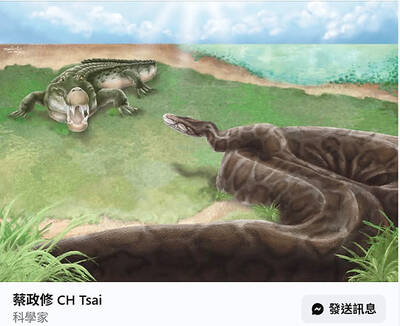
Taiwanese paleontologists have discovered fossil evidence that pythons up to 4m long inhabited Taiwan during the Pleistocene epoch, reporting their findings in the international scientific journal Historical Biology. National Taiwan University (NTU) Institute of Ecology and Evolutionary Biology associate professor Tsai Cheng-hsiu (蔡政修) led the team that discovered the largest snake fossil ever found in Taiwan. The single trunk vertebra was discovered in Tainan at the Chiting Formation, dated to between 400,000 and 800,000 years ago in the Middle Pleistocene, the paper said. The area also produced Taiwan’s first avian fossil, as well as crocodile, mammoth, saber-toothed cat and rhinoceros fossils, it said. Discoveries

Taiwanese paleontologists have discovered fossil evidence that pythons up to 4m long inhabited Taiwan during the Pleistocene epoch, reporting their findings in the international scientific journal Historical Biology. National Taiwan University (NTU) Institute of Ecology and Evolutionary Biology associate professor Tsai Cheng-hsiu (蔡政修) led the team that discovered the largest snake fossil ever found in Taiwan. A single trunk vertebra was discovered in Tainan at the Chiting Formation, dated to between 800,000 to 400,000 years ago in the Middle Pleistocene, the paper said. The area also produced Taiwan’s first avian fossil, as well as crocodile, mammoth, sabre-toothed cat and rhinoceros fossils, it said. Discoveries
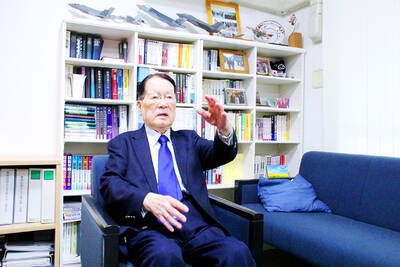
Whether Japan would help defend Taiwan in case of a cross-strait conflict would depend on the US and the extent to which Japan would be allowed to act under the US-Japan Security Treaty, former Japanese minister of defense Satoshi Morimoto said. As China has not given up on the idea of invading Taiwan by force, to what extent Japan could support US military action would hinge on Washington’s intention and its negotiation with Tokyo, Morimoto said in an interview with the Liberty Times (sister paper of the Taipei Times) yesterday. There has to be sufficient mutual recognition of how Japan could provide


 RSS
RSS