


President Ma Ying-jeou (馬英九) should rein in Chinese Nationalist Party (KMT) members who are spreading racist and gender-biased propaganda in a bid to snatch votes for the year-end local elections and support for a controversial trade pact with China, the Democratic Progressive Party (DPP) said yesterday.
Acting DPP Spokesman Chao Tien-lin (趙天麟) said at a press conference that the KMT’s Chiayi County branch has been running a “questionable, negative advertisement” insinuating that the DPP nominee in the county commissioner’s race, Chang Hwa-kuan (張花冠), was involved in adulterous relations with the current commissioner, Chen Ming-wen (陳明文).
The ad, which appeared in major Chinese-language newspapers on Thursday, compared the DPP’s decision to nominate Chang, a legislator, to a popular soap opera plot line by saying the party resorted to the “second wife” strategy to secure the seat.
Chang, 55, is the widow of late KMT legislator and prominent businessman Tseng Chen-nung (曾振農). At the announcement of Chang’s nomination, DPP Chairperson Tsai Ing-wen (蔡英文) praised her for making the transition from the wife of a businessman to a politician.
Both Chen and Chang said yesterday they were prepared to sue their pan-blue rivals for defamation.
“It is regrettable that the KMT has stooped so low this early in the race. But this will not stand in my way of winning the seat,” Chang said.
Calling the KMT’s ad part of a smear campaign, Chao yesterday urged Ma, who doubles as KMT chairman, to stop his party members using “low-class” and discriminatory tactics in the battle for the commissionership.
Chao said that during Ma’s presidential campaign, his supporters had also published several profanely worded ads in publications around the country.
During the presidential campaign of 2007, Ma’s supporters in Kaohsiung draped a giant banner on the side of a building bearing a phrase that used Ma’s last name in an allusion to a swear word. A pan-blue underground radio station at that time also started its show with a jingle making use of what sounded like an obscene phrase.
“Now, as the president, he has allowed the Ministry of Economic Affairs to distribute racist propaganda to boost support for the economic cooperation framework agreement [ECFA] that it wants to sign with Beijing. It is difficult not to suspect that these are all mere reflections of Ma’s real sentiments,” he said.
Chao was referring to a comic strip that the ministry had created to promote the ECFA. The cartoon features two stereotypical characters, Yi-ge (一哥), an ethnic Taiwanese vocational school graduate who opposes the ECFA, and Fa-sao (發嫂), a sharp-minded Hakka career woman who supports the deal.
The DPP last month expressed outrage at the cartoon and demanded that the ministry withdraw it.
Although the ministry has insisted there was nothing wrong with the cartoon and refused to remove it from its Web site, the ministry yesterday released a statement that said it had decided to pull the cartoon.


UPGRADE: The Kang Ding-class frigate is replacing its Chaparall missiles with Tien Chien II and Hua Yang VLS, which would provide it with long-range, 360° air defense Taiwan plans to produce 1,200 to 1,376 Hai Chien II missiles (海劍二, Sea Sword II) — also known as TC-2N — to serve as the standard air defense system of the navy’s surface combatant fleet, a source said yesterday. Last week, the Hai Chien II, the naval version of the Tien Kung II missile (天劍二, Sky Sword II), completed a live-fire test in waters off the National Chungshan Institute of Science and Technology’s Jiupeng facility (九鵬) in Pingtung County’s Manjhou Township (滿州). The MIM72 Chaparral and other dated air defense missiles that currently arm Taiwanese ships have inadequate range to combat Chinese

REASONS FOR TRAVEL: An assistant professor said that proposed amendments to penalize drivers if they used drugs overseas would not deter people from traveling People who operate a motor vehicle under the influence of marijuana would have their driver’s license revoked, even if they used the substance while overseas, the Ministry of Transportation and Communications said yesterday, citing proposed amendments to the Road Traffic Management and Penalty Act (道路交通管理處罰條例). The amendments would also authorize the government to revoke the licenses of people determined to have used Category 1 or Category 2 narcotics, even if they were not operating a vehicle while under the influence of drugs, as well as ban them from taking the license test for three years, the ministry said. People aged 18 or
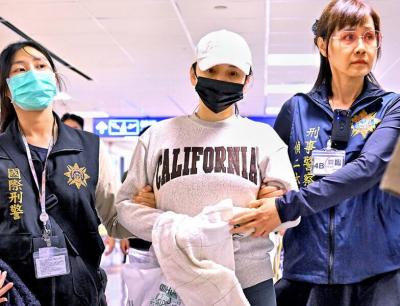
Johanne Liou (劉喬安), a Taiwanese woman who shot to unwanted fame during the Sunflower movement protests in 2014, returned to Taiwan last night after being deported from the US. She is to stand trial in Taiwan for charges involving embezzlement, fraud and drug crimes. The Criminal Investigation Bureau (CIB) said it took her into custody at Taiwan Taoyuan International Airport and would first question her before transferring her to the New Taipei District Prosecutors’ Office. She was arrested upon disembarking a flight from San Francisco that landed shortly before 7pm. Liou absconded to the US in 2019 after jumping bail
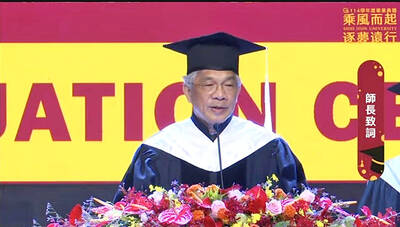
Shih Hsin University President Chen Ching-he (陳清河) yesterday issued a public apology for comments made in his commencement speech last week, stating that he has asked the school to suspend his duties and halt his wages for two months as a show of contrition. At the commencement ceremony on May 30, Chen said, “If you don’t manage your time well, or your own emotions, or your health, then I am telling every one of you — put a quick end to ‘you,’ because the world has no need for ‘you.’” The comments have sparked significant controversy online, and Chen through an open


 RSS
RSS