


A Canadian biker who posted footage of himself racing his motorbike on the streets of Chungli (中壢) on YouTube has come under fire from local bikers, who said his antics could harm the cause of riders of large motorcycles.
The clip showed the man riding a Ninja 650 and another person on a Honda NSR150 taking off from opposite Tien-Chen Hospital (天晟醫院) in Chungli. Both riders accelerated to high speeds after making a left turn. They swerved across lanes, turned right on red lights and exceeded the speed limit painted clearly painted on the road.
In Taiwan, a right turn on a red light is illegal, unless there is a right-turn green arrow.
The identity and nationality of the other rider is unclear.
The Canadian biker videotaped the entire process and commented on the functional differences between the two motorcycles.
“I know how fast a 150cc is, and even I’m shocked how difficult it is to keep up with him,” the Canadian biker said, with the statement appearing as subtitles.
The Liberty Times (the Taipei Times’ sister newspaper) reported that a link to the clip had been sent to the police department in Chungli. The police, however, said they could not process the violation because the clip did not show when the violation occurred, nor did it show the license plate numbers of the vehicles.
In the user profile section on the Web site, the motorcyclist wrote in Chinese that he holds an international motorcycle-racing license. He also said he made the videos because he has many fans overseas who want to know more about Taiwan, adding that he does not want to hurt anybody nor does he want to upset anyone.
Some Taiwanese, however, left critical notes in the message section of the clip after it was widely reported by the local media.
“The Taiwanese are friendly and hospitable people, but we don’t welcome foreigners who are garbage. Go back to Canada!” said one viewer of the clip who used the name “Samujess.”
Another, “MrDALE0203,” said the clip would only give the public a bad impression of large motorcycles and their riders.
“The government could gradually withdraw the rights of large motorcycle riders, which explains why the government still does not allow people with large motorcycles to ride on freeways,” MrDALE0203 said.
Others on the message board said that since the rider has a license to compete in motorcycle races, he should compete on tracks, not on roads.
The Ministry of Transportation and Communications in November 2006 began allowing large motorcycle riders to travel on expressways. However, they must follow the regulations that govern small cars and face the same penalties for violations.
Within seven months of implementing the policy, the ministry reported about 900 violations.
Speeding ranked first with 651 violations. Meanwhile, five people died during the same period and 109 people were injured.
The Department of Railways and Highways said it may consider withdrawing the rights of large motorcycle riders if the situation worsens.

Fast food chain McDonald's is to raise prices by up to NT$5 on some products at its restaurants across Taiwan, starting on Wednesday next week, the company announced today. The prices of all extra value meals and sharing boxes are to increase by NT$5, while breakfast combos and creamy corn soup would go up by NT$3, the company said in a statement. The price of the main items of those meals, if ordered individually, would remain the same. Meanwhile, the price of a medium-sized lemon iced tea and hot cappuccino would rise by NT$3, extra dipping sauces for chicken nuggets would go up
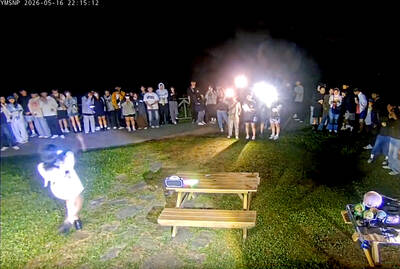
Yangmingshan National Park’s Qingtiangang (擎天崗) nature area has gone viral after a park livestream camera observed a couple in the throes of intimate congress, which was broadcast live on YouTube, drawing large late-night crowds and sparking a backlash over noise, bright lights and disruption to wildlife habitat. The area’s livestream footage appeared to show a couple engaging in sexual activity on a picnic table in the park on Friday last week, with the uncensored footage streamed publicly online. The footage quickly spread across social media, prompting a tide of visitors to travel to the site to “check in” and recreate the

Minister of Digital Affairs Lin Yi-ching (林宜敬) yesterday cited regulatory issues and national security concerns as an expert said that Taiwan is among the few Asian regions without Starlink. Lin made the remarks on Facebook after funP Innovation Group chief executive officer Nathan Chiu (邱繼弘) on Friday said Taiwan and four other countries in Asia — China, North Korea, Afghanistan and Syria — have no access to Starlink. Starlink has become available in 166 countries worldwide, including Ukraine, Malaysia, the Philippines and Vietnam, in the six years since it became commercial, he said. While China and North Korea block Starlink, Syria is not
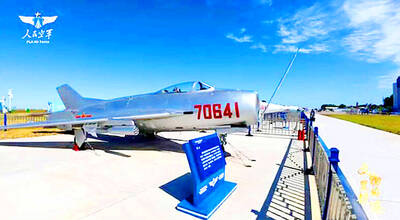
GROUNDED: A KMT lawmaker proposed eliminating drone development programs and freezing funding for counterdrone systems, despite China’s adoption of the technology China has deployed attack drones at air bases near the Taiwan Strait in a strategy aimed at overwhelming Taiwan’s air defense systems through saturation attacks, the Mainland Affairs Council (MAC) said. The council’s latest quarterly report on China said that satellite imagery and open-source intelligence indicate that the Chinese People’s Liberation Army (PLA) had converted retired J-6 fighter jets into J-6W drones, which the PLA has stationed at six air bases near Taiwan, five in China’s Fujian Province and one in Guangdong Province. The report cited J. Michael Dahm, a senior fellow at the US-based Mitchell Institute, as saying that China has


 RSS
RSS