


Gender rights activists yesterday called on adoption agencies and the government to relax regulations on adoption and artificial insemination so that unmarried women and homosexual couples could also have children.
“The definition of ‘family’ is quickly changing in society. However, while the government recognizes that there’s a growing number of single-parent families, it’s still quite narrow-minded about what a family is,” Huang Chang-ling (黃長玲), a representative of the Awakening Foundation, told a news conference yesterday.
“Somehow, the government and adoption agencies think that a woman can still be a good mother after getting divorced, but an unmarried woman cannot become a good mother,” Huang said.
She said that some women were just not made for marriage, but they would still be good mothers.
Right now, most adoption agencies in the country require adoptive parents to be a husband and wife.
Although the Civil Code (民法) and the Children and Juveniles Welfare Act (兒童及青少年福利法) only stipulate that a court rule on an adoption case based on an evaluation of an adoptive parent’s personal character, economic status, family condition and childcare experience in the past, many of the rulings are still made based on marriage status or sexual orientation.
A lesbian’s application to adopt her sister’s child was rejected by a court in Taoyuan County two years ago because of her sexual orientation, Les Hand Association vice-chairwoman, who is nicknamed Hsiao Yi (小逸), said during the press conference.
“The two sisters had already agreed on the adoption, but it was blocked during the legal process because the judge worried that the child may have a ‘confused sexual orientation’ if he or she were brought up by a lesbian,” Hsiao Yi said.
Because adoption is ruled out, many homosexual couples and unmarried women turn to technology for a solution.
“Unfortunately, the Artificial Reproduction Act (人工生殖法) says that only a married man and woman are qualified to use the option [of artificial insemination],” said Chen Chao-ju (陳昭如), another Awakening Foundation member.
A representative from the Taiwan Gay, Lesbian, Bisexual and Transgender Family Rights Advocacy Association nicknamed Hsiang (祥) said the law has created social injustice along with other problems.
“A lot of unmarried celebrities go to other countries for artificial insemination, but most of us don’t have the money to do that — it’s not fair,” she said. “So in order to have a child, many lesbians enter into fake unions, and a lot of problems occur for lesbians in fake marriages.”

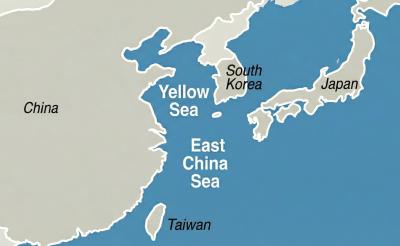
China has reserved offshore airspace in the Yellow Sea and East China Sea from March 27 to May 6, issuing alerts usually used to warn of military exercises, although no such exercises have been announced, the Wall Street Journal (WSJ) reported yesterday. Reserving such a large area for 40 days without explanation is an “unusual step,” as military exercises normally only last a few days, the paper said. These alerts, known as Notice to Air Missions (Notams), “are intended to inform pilots and aviation authorities of temporary airspace hazards or restrictions,” the article said. The airspace reserved in the alert is

South Korea is planning to revise its controversial electronic arrival card, a step Taiwanese officials said prompted them to hold off on planned retaliatory measures, a South Korean media report said yesterday. A Yonhap News Agency report said that the South Korean Ministry of Foreign Affairs is planning to remove the “previous departure place” and “next destination” fields from its e-arrival card system. The plan, reached after interagency consultations, is under review and aims to simplify entry procedures and align the electronic form with the paper version, a South Korean ministry official said. The fields — which appeared only on the electronic form

A bipartisan group of US senators has introduced a bill to enhance cooperation with Taiwan on drone development and to reduce reliance on supply chains linked to China. The proposed Blue Skies for Taiwan Act of 2026 was introduced by Republican US senators Ted Cruz and John Curtis, and Democratic US senators Jeff Merkley and Andy Kim. The legislation seeks to ease constraints on Taiwan-US cooperation in uncrewed aerial systems (UAS), including dependence on China-sourced components, limited access to capital and regulatory barriers under US export controls, a news release issued by Cruz on Wednesday said. The bill would establish a "Blue UAS
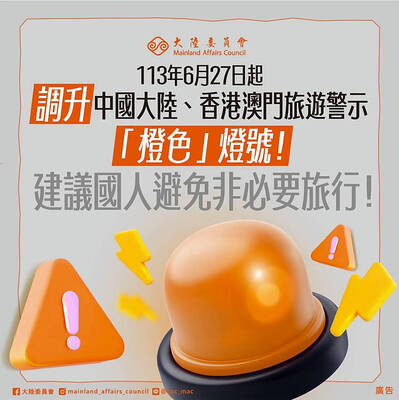
More than 6,000 Taiwanese students have participated in exchange programs in China over the past two years, despite the Mainland Affairs Council’s (MAC) “orange light” travel advisory, government records showed. The MAC’s publicly available registry showed that Taiwanese college and university students who went on exchange programs across the Strait numbered 3,592 and 2,966 people respectively. The National Immigration Agency data revealed that 2,296 and 2,551 Chinese students visited Taiwan for study in the same two years. A review of the Web sites of publicly-run universities and colleges showed that Taiwanese higher education institutions continued to recruit students for Chinese educational programs without


 RSS
RSS