


Controversy sparked by Hong Kong action star Jackie Chan’s (成龍) remarks last month have cast a shadow over what is scheduled to be the biggest sporting event ever hosted by Taipei City — the Summer Deaflympics, scheduled to run from Sept. 5 to Sept. 15.
Speaking at a panel discussion during the annual Boao Forum in China, Chan, who formerly served as an ambassador for the event, said Taiwan’s freedom made it “chaotic.”
Taipei city councilors from across party lines criticized the city government’s reliance on celebrities to generate publicity for the event, saying the government had failed to spend its budget wisely.
The budget plan approved by the Taipei City Council allocated around NT$7 billion (US$210 million) for the event, with more than NT$1.1 billion set aside for advertising and marketing.
The city invited more than 10 celebrities, including Chan, singer A-Mei (張惠妹), actress Brigitte Lin (林青霞) and former NBA star Scottie Pippen to promote the Deaflympics as spokespeople, paying more than NT$80 million for their endorsements.
Chan came to Taiwan last September for the Deaflympics countdown ceremony and to shoot a TV ad for the event. He did not charge an endorsement fee, but the city government spent more than NT$100,000 for transportation and hotel fees.
“We had voiced concerns about inviting Chinese stars like Jackie Chan to serve as spokespeople, but the city government ignored our warning. What he brings to the event is nothing but negative publicity,” Democratic Progressive Party (DPP) Taipei City Councilor Hsu Chia-ching (徐佳青) said.
Taipei City Councilor Chien Yu-yen (簡余晏), also of the DPP, joined Hsu in challenging the city government’s choice of a Chinese star, urging it to return the money it spent on Chan.
Emile Sheng (盛治仁), chairman of the Taipei Deaflympics Organizing Committee said the committee had invited Chan because he had suffered hearing damage from an accident when shooting a film and therefore might understand the feelings of the hearing impaired, Sheng said.
Sheng dismissed the councilors?criticism about the big budget, and said the budget for the committee was only about NT$1.1 billion, with about 10% allocated to advertising and marketing. So far the city government paid less than NT$5 million for event ambassadors and
spokespeople.
Chinese Nationalist Party (KMT) Taipei City Councilor Chen Yu-mei (陳玉梅) said inviting celebrities to promote the event via commercials or promotional activities was not enough. She urged the city government to learn from the Kaohsiung City Government and not limit its marketing efforts to domestic promotional events and ads.
“The Kaohsiung City Government visited China, Hong Kong and Japan to promote the World Games. The Taipei City Government is treating the Deaflympics like a domestic event. I’m worried about the city government’s ability to host international sporting events,” she said.
To promote the World Games, which will be held in Kaohsiung City in July, the Kaohsiung City Government invited Yankee pitcher Wang Chien-ming (王建民) to endorse the event. It also held promotional activities in China, Singapore, South Korea, Japan and Hong Kong to introduce the Games to the international community, Chen said.
Noting that the Deaflympics was part of the Olympic Games family along with the Paralympic Games and Special Olympics, Chen said the Taipei City Government should expand its vision and put greater effort into increasing the international visibility of the event.
Chen and Chien also shared concerns about facilities for the event. Most of the competitions will be held in Taipei City, but some will be held at venues in Taipei, Taoyuan and Hsinchu counties.
“The city government spent several billion NT dollars on the facilities, but we cannot find a swimming pool that fits international criteria in the city and have to go all the way to Hsinchu County to hold the swimming contest there,” Chien said.
Sheng defended the city government? efforts to utilize venues for the events, and said National Taiwan University Stadium and the Taipei Arena are both qualified to host volleyball competition.

Fast food chain McDonald's is to raise prices by up to NT$5 on some products at its restaurants across Taiwan, starting on Wednesday next week, the company announced today. The prices of all extra value meals and sharing boxes are to increase by NT$5, while breakfast combos and creamy corn soup would go up by NT$3, the company said in a statement. The price of the main items of those meals, if ordered individually, would remain the same. Meanwhile, the price of a medium-sized lemon iced tea and hot cappuccino would rise by NT$3, extra dipping sauces for chicken nuggets would go up
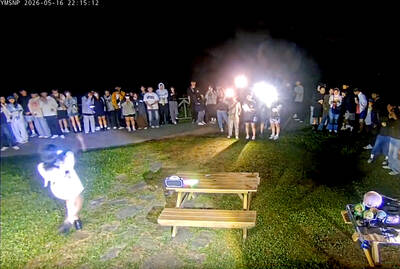
Yangmingshan National Park’s Qingtiangang (擎天崗) nature area has gone viral after a park livestream camera observed a couple in the throes of intimate congress, which was broadcast live on YouTube, drawing large late-night crowds and sparking a backlash over noise, bright lights and disruption to wildlife habitat. The area’s livestream footage appeared to show a couple engaging in sexual activity on a picnic table in the park on Friday last week, with the uncensored footage streamed publicly online. The footage quickly spread across social media, prompting a tide of visitors to travel to the site to “check in” and recreate the

Minister of Digital Affairs Lin Yi-ching (林宜敬) yesterday cited regulatory issues and national security concerns as an expert said that Taiwan is among the few Asian regions without Starlink. Lin made the remarks on Facebook after funP Innovation Group chief executive officer Nathan Chiu (邱繼弘) on Friday said Taiwan and four other countries in Asia — China, North Korea, Afghanistan and Syria — have no access to Starlink. Starlink has become available in 166 countries worldwide, including Ukraine, Malaysia, the Philippines and Vietnam, in the six years since it became commercial, he said. While China and North Korea block Starlink, Syria is not
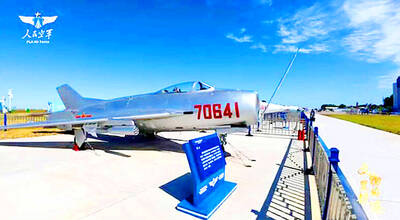
GROUNDED: A KMT lawmaker proposed eliminating drone development programs and freezing funding for counterdrone systems, despite China’s adoption of the technology China has deployed attack drones at air bases near the Taiwan Strait in a strategy aimed at overwhelming Taiwan’s air defense systems through saturation attacks, the Mainland Affairs Council (MAC) said. The council’s latest quarterly report on China said that satellite imagery and open-source intelligence indicate that the Chinese People’s Liberation Army (PLA) had converted retired J-6 fighter jets into J-6W drones, which the PLA has stationed at six air bases near Taiwan, five in China’s Fujian Province and one in Guangdong Province. The report cited J. Michael Dahm, a senior fellow at the US-based Mitchell Institute, as saying that China has


 RSS
RSS