


Members of Animal Rescue Team Taiwan managed to catch six seriously ill stray dogs in Taichung City after a marathon effort that lasted more than 18 hours.
The dogs were transported to Kaohsiung City yesterday for emergency treatment.
The operation, which involved transporting the dogs 200km, was launched after the non-profit organization was informed that a pack of stray dogs sheltered by a vagrant living in an abandoned property in Taichung were suffering from severe skin disease, had lost almost all their hair and were covered in bleeding sores.
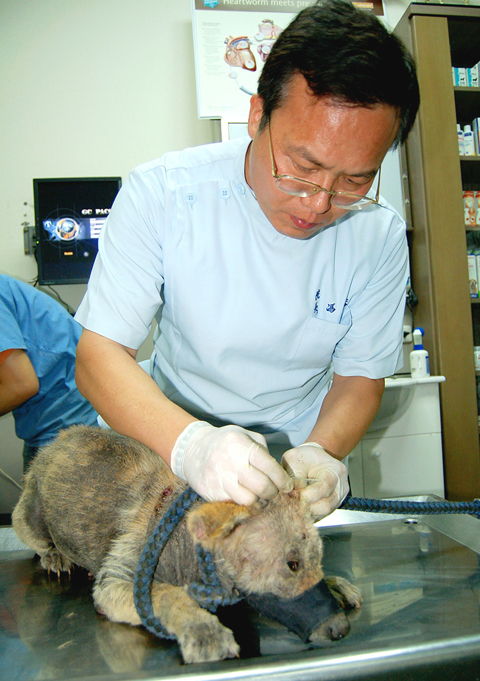
PHOTO: CNA
In preparation for the rescue operation, volunteers were dispatched one week in advance to inspect the location and wooden planks and cardboard were used to block off all possible exits.
Tranquilizer darts were used to sedate the animals and local residents and volunteers from northern and central Taiwan helped out.
The team eventually captured the animals and delivered them to the Hung-Li Animal Hospital in Kaohsiung for treatment.
Veterinarian Feng Tzung-hung (馮宗宏) said that all six dogs were suffering from a type of mange called demodicosis, scabies and chronic dermatitis and were infested with fleas and ticks.
Two of the dogs suffered from a bacterial infection called canine ehrlichiosis and coagulation disorders, while two others had festering wounds all over their bodies, Feng said.
He said that the animals would require up to two months of treatment to recover fully.
The rescue team, meanwhile, promised that it would help find people to adopt the dogs when they recover.
Since its establishment in 1995, Animal Rescue Team Taiwan has saved thousands of abused and injured stray dogs and helped find homes abroad for more than 100 animals.
The organization, run by retired math teacher Joseph Nee (倪兆成) and his family, rescues strays mainly in southern Taiwan.
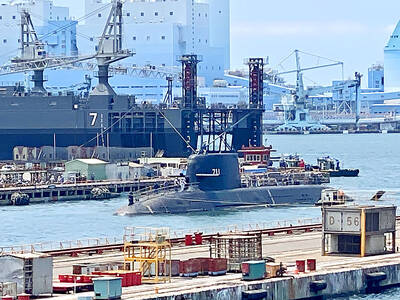
AGING: While Japan has 22 submarines, Taiwan only operates four, two of which were commissioned by the US in 1945 and 1946, and transferred to Taiwan in 1973 Taiwan would need at least 12 submarines to reach modern fleet capabilities, CSBC Corp, Taiwan chairman Chen Cheng-hung (陳政宏) said in an interview broadcast on Friday, citing a US assessment. CSBC is testing the nation’s first indigenous defense submarine, the Hai Kun (海鯤, Narwhal), which is scheduled to be delivered to the navy next month or in July. The Hai Kun has completed torpedo-firing tests and is scheduled to undergo overnight sea trials, Chen said on an SET TV military affairs program. Taiwan would require at least 12 submarines to establish a modern submarine force after assessing the nation’s operational environment and defense

A white king snake that frightened passengers and caused a stir on a Taipei MRT train on Friday evening has been claimed by its owner, who would be fined, Taipei Rapid Transit Corp (TRTC) said yesterday. A person on Threads posted that he thought he was lucky to find an empty row of seats on Friday after boarding a train on the Bannan (Blue) Line, only to spot a white snake with black stripes after sitting down. Startled, he jumped up, he wrote, describing the encounter as “terrifying.” “Taipei’s rat control plan: Release snakes on the metro,” one person wrote in reply, referring
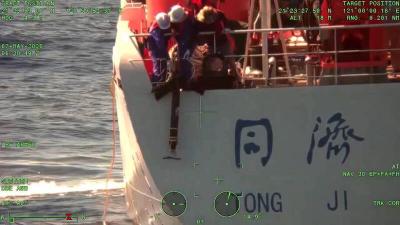
The coast guard today said that it had disrupted "illegal" operations by a Chinese research ship in waters close to the nation and driven it away, part of what Taipei sees a provocative pattern of China's stepped up maritime activities. The coast guard said that it on Thursday last week detected the Chinese ship Tongji (同濟號), which was commissioned only last year, 29 nautical miles (54km) southeast of the southern tip of Taiwan, although just outside restricted waters. The ship was observed lowering ropes into the water, suspected to be the deployment of scientific instruments for "illegal" survey operations, and the coast
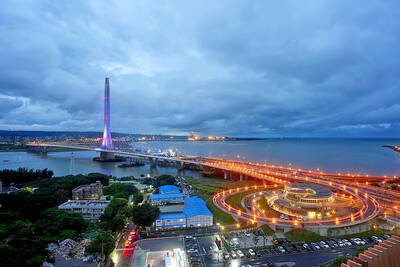
An inauguration ceremony was held yesterday for the Danjiang Bridge, the world’s longest single-mast asymmetric cable-stayed bridge, ahead of its official opening to traffic on Tuesday, marking a major milestone after nearly three decades of planning and construction. At the ceremony in New Taipei City attended by President William Lai (賴清德), Premier Cho Jung-tai (卓榮泰), Minister of Transportation and Communications Chen Shih-kai (陳世凱) and New Taipei City Mayor Hou Yu-ih (侯友宜), the bridge was hailed as both an engineering landmark and a long-awaited regional transport link connecting Tamsui (淡水) and Bali (八里)


 RSS
RSS