


Minister of Transportation and Communications Mao Chi-kuo (毛治國) said yesterday that the ministry would spend two months reviewing the government contract for the freeway electronic toll collection (ETC) system before deciding whether to charge motorists for on-board units (OBU).
“This is one of the toughest issues I’ve had to deal with since I took office,” Mao said. “It involves a lot of technical issues.”
Mao said despite controversies over the terms of the contract, the ministry would “just have to accept them as they are,” while striving to adjust them to “help the ministry meet the 2012 goal of charging the motorists by the distance they travel while protecting the interests of motorists at the same time.”
“We will discuss the possibility of making the OBU free of charge in our review and it is one of the directions we are working on,” Mao said.
The ETC system is now operated by Far Eastern Electronic Toll Collection Co (遠通電收) under the build-operate-transfer business model. Each of the OBUs costs NT$1,199.
About 750,000 motorists have installed OBUs in their vehicles. The nation has 6 million registered motorists.
Meanwhile, ministry policy requires that 65 percent of the nation’s motorists must use the ETC system before the nation can start charging motorists by distance, rather than by the number of toll gates they pass.
The company has tried to encourage the purchase of OBUs through various package deals. However, the price of OBUs remained the focus of a question-and-answer session at yesterday’s legislative Transportation Committee, where lawmakers were briefed by the ministry about the ETC system.
Democratic Progressive Party Legislator Yeh Yi-ching (葉宜津) and several other lawmakers proposed a resolution demanding the ministry charge motorists for installing OBUs.
“The contract itself is an embarrassment to the government and the people,” Yeh said. “People are the ultimate victims in this case.”
Chinese Nationalist Party (KMT) Legislator Chu Fong-chi (朱鳳芝) supported the ministry’s decision to fix what she said was an unjust bill.
“You have to say no to this corporate fat cat,” she said.
Yeh also said that the ministry cannot possibly start charging by travel distance by 2012 with a contract like this.
The government cannot ask every motorist to use the ETC system to pay freeway toll fees either, she said.
Yeh quoted Taiwan Area National Freeway Bureau director Lee Tai-ming (李泰明) as saying those without OBUs could choose to pay before they hit the road or to pay after they receive a photo and a bill, so those measures would generate a new set of issues.
“Motorists figure they shouldn’t have to pay for OBUs, nor pay in advance. They can just sit at home and wait to get the photo and the bill,” she said.

FUKUOKA SITUATION: Japanese media reported that the pathogen is expected to be identified by the summer, while the CDC downplayed the idea that it was hMPV A “mysterious cold-like illness” reported in Japan’s Fukuoka Prefecture does not seem to be a new disease, but Japanese authorities have been asked about the situation, the Centers for Disease Control (CDC) said yesterday. The Fukuoka Prefectural Medical Association on Wednesday told a news conference that a “mystery cold” that has become a hot topic on social media is “highly likely to be caused by some kind of viral infection,” Japan’s KBC News reported. “Many people are experiencing symptoms starting with a sore throat, followed by a runny nose, phlegm and a severe cough,” KBC News reported, citing association officials. Health authorities are

Nvidia Corp CEO Jensen Huang (黃仁勳) arrived in Taiwan yesterday ahead of upcoming AI and technology events, saying he plans to meet with clients and Taiwan Semiconductor Manufacturing Co Chairman C.C. Wei (魏哲家) during his visit. After landing at Taipei Songshan Airport, Huang posed for photos with fans and handed out Yakult drinks to reporters and supporters waiting at the scene, saying he has “a lot to do” during the trip. Asked about reports that Nvidia’s planned headquarters site in Taipei’s Beitou Shilin Technology Park could break ground on May 27, Huang said that if the company holds an event, he would

Carrefour Taiwan is to begin using a new name from the start of July, but it cannot divulge the name until then, the chairman of the supermarket chain's parent company said today. President Chain Store Co chairman Lo Chih-hsien (羅智先) was asked by reporters after a shareholders' meeting to confirm whether the company has settled on a new name for the supermarket brand. In March, the government-registered name of two Carrefour Taiwan branches was quietly changed to "Le Chia Kang" (樂家康) in Chinese, raising speculation that has been selected as the name. Lo said that because of local regulations and contractual obligations, the
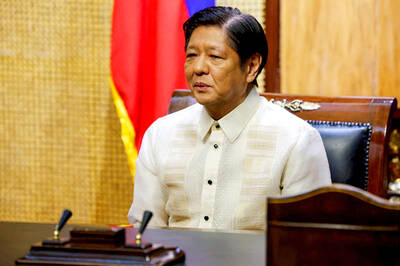
The Philippines would likely be involved in any conflict over Taiwan due to its proximity to the democracy claimed by China, President Ferdinand Marcos Jr said, reiterating a stance that risks angering Beijing. “In the Philippines, we do not have a choice because Taiwan is so close to the Philippines and we have almost 200,000 Filipino nationals living and working in Taiwan,” Marcos said in an interview with Japanese media in Manila on Monday. The Philippine leader’s comments come ahead of a state visit to Japan next week, where he is to meet with Japanese Prime Minister Sanae Takaichi to discuss security


 RSS
RSS