


The Taiwan Railway Administration (TRA) may have problems increasing the number of trains operating along the east coast as the manufacturer of the tilting Taroko Express (太魯閣號) trains has yet to quote a price for a second batch of train cars, a TRA official said yesterday.
The nation’s largest railway service had previously placed an order for 96 tilting train cars made by Hitachi Appliances, with the purchase expected to cost approximately NT$5.6 billion (US$166 million).
TRA deputy director-general Chang Ying-huei (張應輝) said that the tilting train system has been in operation in Japan for more than twenty years and was reliable. However, there were concerns that some passengers may feel uncomfortable when riding on the tilting trains.
As the tilting train system had never been used in Taiwan, the Council of Economic Planning and Development, the agency in charge of reviewing purchases by government organizations, suggested the deal be carried out in two stages.
The TRA initially purchased 48 train cars — six sets of trains — and purchased more after the initial batch had been in operation for about a year.
“You need at least six sets as a basic scale for operation,” Chang said. “They include the trains that are in operation as well as the backup ones when they need to go for maintenance.”
Chang said there had been no problems with the first batch of tilting train cars.
“We have utilized the capacity of these trains to the fullest,” he said.
Chang said he did not know why Hitachi was late in providing the quote.
While the TRA has other types of trains that could be used along the east coast, Chang said passengers would be better served with more tilting trains.
TRA director-general Frank Fan (范植谷) was quoted by the United Evening News as saying in a recent interview that the TRA may consider opening the bid to other interested manufacturers if it does not receive a quote from Hitachi by the end of this month.
Chang said the TRA can still wait until next week before making a final decision.
While Japan is experienced in making tilting trains for the TRA’s narrow gauge railway system, there are other countries that have the ability to do so, he said.

The military has spotted two Chinese warships operating in waters near Penghu County in the Taiwan Strait and sent its own naval and air forces to monitor the vessels, the Ministry of National Defense (MND) said. Beijing sends warships and warplanes into the waters and skies around Taiwan on an almost daily basis, drawing condemnation from Taipei. While the ministry offers daily updates on the locations of Chinese military aircraft, it only rarely gives details of where Chinese warships are operating, generally only when it detects aircraft carriers, as happened last week. A Chinese destroyer and a frigate entered waters to the southwest

A magnitude 6.1 earthquake struck off the coast of Yilan County at 8:39pm tonight, the Central Weather Administration (CWA) said, with no immediate reports of damage or injuries. The epicenter was 38.7km east-northeast of Yilan County Hall at a focal depth of 98.3km, the CWA’s Seismological Center said. The quake’s maximum intensity, which gauges the actual physical effect of a seismic event, was a level 4 on Taiwan’s 7-tier intensity scale, the center said. That intensity level was recorded in Yilan County’s Nanao Township (南澳), Hsinchu County’s Guansi Township (關西), Nantou County’s Hehuanshan (合歡山) and Hualien County’s Yanliao (鹽寮). An intensity of 3 was

Japanese Prime Minister Sanae Takaichi’s comment last year on Tokyo’s potential reaction to a Taiwan-China conflict has forced Beijing to rewrite its invasion plans, a retired Japanese general said. Takaichi told the Diet on Nov. 7 last year that a Chinese naval blockade or military attack on Taiwan could constitute a “survival-threatening situation” for Japan, potentially allowing Tokyo to exercise its right to collective self-defense. Former Japan Ground Self-Defense Force general Kiyofumi Ogawa said in a recent speech that the remark has been interpreted as meaning Japan could intervene in the early stages of a Taiwan Strait conflict, undermining China’s previous assumptions
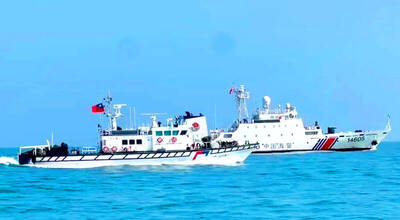
Instead of focusing solely on the threat of a full-scale military invasion, the US and its allies must prepare for a potential Chinese “quarantine” of Taiwan enforced through customs inspections, Stanford University Hoover fellow Eyck Freymann said in a Foreign Affairs article published on Wednesday. China could use various “gray zone” tactics in “reconfiguring the regional and ultimately the global economic order without a war,” said Freymann, who is also a nonresident research fellow at the US Naval War College. China might seize control of Taiwan’s links to the outside world by requiring all flights and ships entering or leaving Taiwan


 RSS
RSS