


When Hsu Feng-yuan (許峰源) was growing up in Sanchong City (三重市), Taipei County, he didn’t know what it was like to have pocket change, eat at a restaurant or sleep in his own room.
Today, aged 27, he is a successful lawyer who lives in a luxury apartment and owns two companies.
But while he is proud of his rise to wealth, it is not the focus of his life. Hsu has turned his attention to motivating young people to reach for success through hard work and determination, drawing on his own story to inspire others.
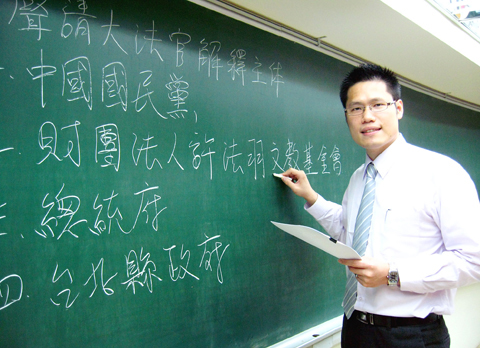
PHOTO: CNA
Hsu was born into a family of eight that lived in an illegal one-room rooftop apartment. His father was a stinky tofu vendor and made his fried tofu at home.
“In our one-room quarters, my father had to find space among the beds to store his jars of pickles, which were sold along with stinky tofu,” Hsu said.
Despite his circumstances, Hsu did not see himself as deprived. He said he was a cheerful child who learned to make the best of things and to work to excel at whatever he attempted, including extracurricular activities.
In elementary school, he was selected to play on the badminton team and he practiced with the same determination and dedication that he brought to his studies.
By the time he got to junior high school, he was the top-ranked player in his age group in Taipei County, which earned him scholarship offers from top-notch senior high schools in Taipei City.
But he chose to attend Sanchong Senior High School to stay near home, dividing his time between 6am badminton practices and studies that often kept him up well past midnight.
Hsu said the many tournaments he played taught him how to focus under intense pressure and face challenges with composure.
He thrived on challenges, passing the national college entrance exams with flying colors to become the first Sanchong Senior High School student to gain entry to National Taiwan University’s (NTU) law department, the top college department in the country.
“I learned from the books that I read that all the great men who achieved success did so because of hard work and dedication,” he said.
In law school, he worked three jobs: coaching badminton, tutoring junior high school students and teaching at cram schools. It was during this time that he learned of the gratification that comes from helping to shape young minds.
Within months of graduating from NTU, Hsu passed the national bar exam and launched his career as a lawyer. But he continued to teach and soon established a reputation as a top lecturer at adult cram schools that prepare candidates for civil service entry exams.
It was, however, a time of mixed emotions for Hsu, as his father developed oral cancer and died, leaving behind a son who craved his parents’ recognition of his success.
“My father didn’t stay to see what I had achieved,” he said.
The one silver lining of this time was that it was at his father’s bedside that Hsu met the doctor who would later become his wife.
Turning his attention to his career and maintaining his penchant for versatility, Hsu obtained a license from the International Association of Registered Financial Consultants and set up a financial consulting company. Shortly after that, he established his own law firm, just three years after graduating from law school
He bought a spacious apartment in a luxury building and set up his mother there, realizing his dream of making her comfortable after her years of drudgery.
But weeks later, she was diagnosed with terminal lung cancer and hospitalized.
After learning of the diagnosis, he pulled his car to the side of the road and cried for an hour, Hsu said.
“The trees may prefer to be still, but the wind will not subside; the son wants to show his filial love, but his parents have gone,” he said, paraphrasing an old Chinese verse.
Hsu drew on his inner strength and turned his energies toward inspiring young people to make the most of their opportunities and to fight for their dreams.
“The pain you are experiencing now will become your greatest asset in facing the world in the future, “ he tells his students
Many young people have become disillusioned about their future because of the global economic crisis, but he has urged them to be ready to pounce on opportunities, he said.
“Crisis often means opportunity,” he said. “It is an advantageous time for young people who are prepared.”

Fast food chain McDonald's is to raise prices by up to NT$5 on some products at its restaurants across Taiwan, starting on Wednesday next week, the company announced today. The prices of all extra value meals and sharing boxes are to increase by NT$5, while breakfast combos and creamy corn soup would go up by NT$3, the company said in a statement. The price of the main items of those meals, if ordered individually, would remain the same. Meanwhile, the price of a medium-sized lemon iced tea and hot cappuccino would rise by NT$3, extra dipping sauces for chicken nuggets would go up
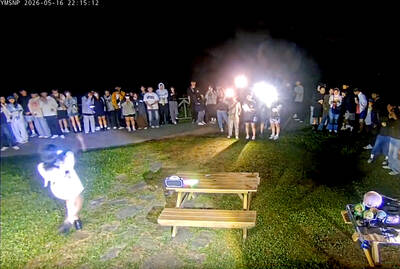
Yangmingshan National Park’s Qingtiangang (擎天崗) nature area has gone viral after a park livestream camera observed a couple in the throes of intimate congress, which was broadcast live on YouTube, drawing large late-night crowds and sparking a backlash over noise, bright lights and disruption to wildlife habitat. The area’s livestream footage appeared to show a couple engaging in sexual activity on a picnic table in the park on Friday last week, with the uncensored footage streamed publicly online. The footage quickly spread across social media, prompting a tide of visitors to travel to the site to “check in” and recreate the

GROUNDED: A KMT lawmaker proposed eliminating drone development programs and freezing funding for counterdrone systems, despite China’s adoption of the technology China has deployed attack drones at air bases near the Taiwan Strait in a strategy aimed at overwhelming Taiwan’s air defense systems through saturation attacks, the Mainland Affairs Council (MAC) said. The council’s latest quarterly report on China said that satellite imagery and open-source intelligence indicate that the Chinese People’s Liberation Army (PLA) had converted retired J-6 fighter jets into J-6W drones, which the PLA has stationed at six air bases near Taiwan, five in China’s Fujian Province and one in Guangdong Province. The report cited J. Michael Dahm, a senior fellow at the US-based Mitchell Institute, as saying that China has

Carrefour Taiwan is to begin using a new name from the start of July, but it cannot divulge the name until then, the chairman of the supermarket chain's parent company said today. President Chain Store Co chairman Lo Chih-hsien (羅智先) was asked by reporters after a shareholders' meeting to confirm whether the company has settled on a new name for the supermarket brand. In March, the government-registered name of two Carrefour Taiwan branches was quietly changed to "Le Chia Kang" (樂家康) in Chinese, raising speculation that has been selected as the name. Lo said that because of local regulations and contractual obligations, the


 RSS
RSS