


The unemployment problem is even more severe among people with mental health problems, civic groups and doctors said yesterday, with almost 66 percent of those afflicted unable to find a job in the past year.
For people with schizophrenia, the most important thing they hope medication can do for them is to “be able to go to work or school,” a survey by the Alliance for the Mentally Ill found.
The survey of schizophrenics and their families was conducted by the alliance’s centers nationwide and a total of 233 effective samples were collected out of the 300 surveys handed out.
“The survey showed that about 90 percent of schizophrenia patients live with their families or friends, and almost 70 percent of them are not in school or employed. We can imagine how much of a burden this puts on their families,” project director Eva Teng (滕西華) said.
“Twenty percent say they are not satisfied with their current medication,” Teng said.
The main reasons cited for dissatisfaction with medication was that the drugs “do not make me feel well” (50 percent), “affect daily activities” (37 percent), “prevent me from holding a job” (34 percent) and “affect my social life” (28 percent).
“Aside from hallucinations, schizophrenia patients also have difficulty registering facial expressions, lack motivation and have a tendency to avoid social engagements. These are often the reasons why many people with schizophrenia have difficulty finding employment or developing relationships,” said Chou Yuan-hwa (周元華), a psychiatrist at the Taipei Veterans General Hospital.
Although the unemployment problem nationwide has worsened, it is an even greater problem for the mentally ill, Teng said.
“About 20 to 30 percent of the mentally ill are [involuntarily] unemployed,” she said.
“If more doctors cared about their patients’ social skills instead of only prescribing medications, then more patients could become active members of society,” she said.

The military has spotted two Chinese warships operating in waters near Penghu County in the Taiwan Strait and sent its own naval and air forces to monitor the vessels, the Ministry of National Defense (MND) said. Beijing sends warships and warplanes into the waters and skies around Taiwan on an almost daily basis, drawing condemnation from Taipei. While the ministry offers daily updates on the locations of Chinese military aircraft, it only rarely gives details of where Chinese warships are operating, generally only when it detects aircraft carriers, as happened last week. A Chinese destroyer and a frigate entered waters to the southwest
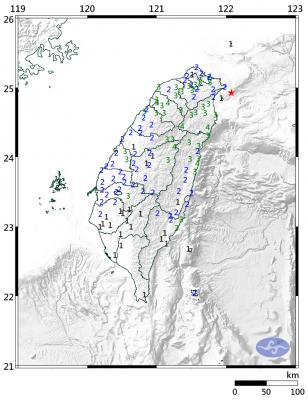
A magnitude 6.1 earthquake struck off the coast of Yilan County at 8:39pm tonight, the Central Weather Administration (CWA) said, with no immediate reports of damage or injuries. The epicenter was 38.7km east-northeast of Yilan County Hall at a focal depth of 98.3km, the CWA’s Seismological Center said. The quake’s maximum intensity, which gauges the actual physical effect of a seismic event, was a level 4 on Taiwan’s 7-tier intensity scale, the center said. That intensity level was recorded in Yilan County’s Nanao Township (南澳), Hsinchu County’s Guansi Township (關西), Nantou County’s Hehuanshan (合歡山) and Hualien County’s Yanliao (鹽寮). An intensity of 3 was

Japanese Prime Minister Sanae Takaichi’s comment last year on Tokyo’s potential reaction to a Taiwan-China conflict has forced Beijing to rewrite its invasion plans, a retired Japanese general said. Takaichi told the Diet on Nov. 7 last year that a Chinese naval blockade or military attack on Taiwan could constitute a “survival-threatening situation” for Japan, potentially allowing Tokyo to exercise its right to collective self-defense. Former Japan Ground Self-Defense Force general Kiyofumi Ogawa said in a recent speech that the remark has been interpreted as meaning Japan could intervene in the early stages of a Taiwan Strait conflict, undermining China’s previous assumptions
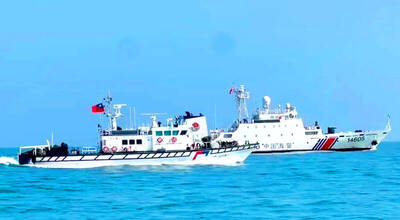
Instead of focusing solely on the threat of a full-scale military invasion, the US and its allies must prepare for a potential Chinese “quarantine” of Taiwan enforced through customs inspections, Stanford University Hoover fellow Eyck Freymann said in a Foreign Affairs article published on Wednesday. China could use various “gray zone” tactics in “reconfiguring the regional and ultimately the global economic order without a war,” said Freymann, who is also a nonresident research fellow at the US Naval War College. China might seize control of Taiwan’s links to the outside world by requiring all flights and ships entering or leaving Taiwan


 RSS
RSS