


The government has decided to maintain the Financial Supervisory Commission (FSC) as a subordinate agency under the Executive Yuan instead of making it an independent institution, a government official said yesterday.
Jiang Yi-huah (江宜樺), chairman of the Cabinet's Research, Development and Evaluation Commission (RDEC), made the comments at a press conference held after a meeting by the task force charged with reviewing the Organic Act of the Executive Yuan (行政院組織法) to promote government restructuring.
“The decision was made amid concern that the FSC needs to cooperate with the Executive Yuan in drafting financial policies, but the Executive Yuan will respect the independent operation of the commission in overseeing financial regulation,” Jiang said.
The Organic Standard Act of Central Government Agencies (中央行政機關組織基準法) states that commissions shall independently exercise their authority and shall not be subject to any government agency's command, supervision or interference.
The heads of these commissions are nominated by the premier, confirmed by the legislature and must serve full time during their tenure.
Based on these standards, the National Communications Commission — the agency responsible for regulating developments in the communications and information industry — is the sole independent establishment, Jiang said.
Whether the central bank, the Fair Trade Commission and the Central Election Commission will be accorded the same position is still under discussion, he said.
Other conclusions reached at the fourth meeting of the task force included setting up a commission on ocean policy under the Cabinet to coordinate ocean-related activities involving central government agencies and to establish an office under the Executive Yuan to handle gender-equality issues, Jiang said.
The commission on ocean policy will be charged with affairs in connection with national maritime security and the development of marine resources and the marine industry, he said.
Jiang said the task force dropped a proposal to set up a standing commission on gender equality under the Cabinet and decided to maintain the ad hoc commission on the protection of rights and interests of women led by Premier Liu Chao-shiuan (劉兆玄).
“The decision was made as women's rights activists preferred the ad hoc commission, which was regarded a more effective mechanism to make sure each government agency would embrace the concept of gender equality in its policies under the leadership of Liu,” Jiang said.
He said the RDEC would suggest the Cabinet downsize about one-third of its subordinate agencies in its proposed amendment, expected by Feb. 20.

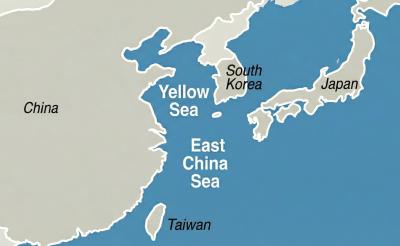
China has reserved offshore airspace in the Yellow Sea and East China Sea from March 27 to May 6, issuing alerts usually used to warn of military exercises, although no such exercises have been announced, the Wall Street Journal (WSJ) reported yesterday. Reserving such a large area for 40 days without explanation is an “unusual step,” as military exercises normally only last a few days, the paper said. These alerts, known as Notice to Air Missions (Notams), “are intended to inform pilots and aviation authorities of temporary airspace hazards or restrictions,” the article said. The airspace reserved in the alert is

South Korea is planning to revise its controversial electronic arrival card, a step Taiwanese officials said prompted them to hold off on planned retaliatory measures, a South Korean media report said yesterday. A Yonhap News Agency report said that the South Korean Ministry of Foreign Affairs is planning to remove the “previous departure place” and “next destination” fields from its e-arrival card system. The plan, reached after interagency consultations, is under review and aims to simplify entry procedures and align the electronic form with the paper version, a South Korean ministry official said. The fields — which appeared only on the electronic form

A bipartisan group of US senators has introduced a bill to enhance cooperation with Taiwan on drone development and to reduce reliance on supply chains linked to China. The proposed Blue Skies for Taiwan Act of 2026 was introduced by Republican US senators Ted Cruz and John Curtis, and Democratic US senators Jeff Merkley and Andy Kim. The legislation seeks to ease constraints on Taiwan-US cooperation in uncrewed aerial systems (UAS), including dependence on China-sourced components, limited access to capital and regulatory barriers under US export controls, a news release issued by Cruz on Wednesday said. The bill would establish a "Blue UAS

More than 6,000 Taiwanese students have participated in exchange programs in China over the past two years, despite the Mainland Affairs Council’s (MAC) “orange light” travel advisory, government records showed. The MAC’s publicly available registry showed that Taiwanese college and university students who went on exchange programs across the Strait numbered 3,592 and 2,966 people respectively. The National Immigration Agency data revealed that 2,296 and 2,551 Chinese students visited Taiwan for study in the same two years. A review of the Web sites of publicly-run universities and colleges showed that Taiwanese higher education institutions continued to recruit students for Chinese educational programs without


 RSS
RSS