


With bowed heads and teary eyes, descendants of the victims in the Taiping steamer shipwreck 60 years ago appealed to the government yesterday to pay more respect to the incident by designating a national holiday to commemorate the tragedy.
More than 1,000 people, including the father of forensic scientist Henry Lee (李昌鈺), died when the vessel — with a capacity of only 580 passengers — sunk off the coast of Shanghai, China, after colliding with a small cargo ship on a dark night in 1949.
Only 36 people were rescued and the bodies of the victims were never found.
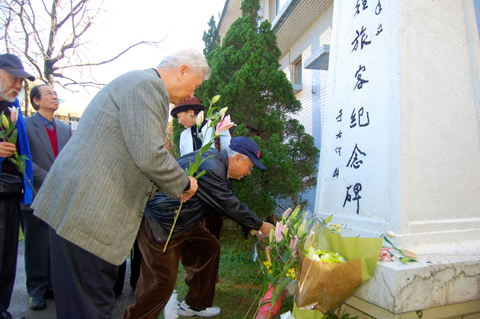
PHOTO: LU HSIEN-HSIU, TAIPEI TIMES
The journey was part of the massive wave of Chinese emigration to Taiwan after it became clear the Chinese Communist Party was winning the civil war against the Chinese Nationalist Party (KMT).
“The passengers came from different places in China but had the same dream, which was to escape the claws of the communist regime and build up a home of prosperity and cultures,” said Sun Mu-shan (孫木山), 76, who sailed across the Taiwan Strait on the Taiping’s third journey.
His friends and relatives, however, were not so blessed when they boarded the Taiping the fourth and last time it embarked from a Shanghai berth.
Sun, holding pink lilies, was one of 13 people who gathered around a small white monument yesterday to pay tribute to the victims. The 2m monument is tucked away in a corner of a Keelung Harbor naval base.
Naval Warfare Division Director Lin Wen-chao (林溫超) said visitors, including family members, must receive approval before being permitted to see the monument because of its location inside the naval compound.
For many years, the families of the victims have pleaded with the government to erect a more appropriate memorial — with the names of the victims and the story of Taiping engraved onto it — in remembrance of the immigrants’ sacrifice.
“This is a crucial chapter in the history of Taiwan. Our posterity needs to know the hardships earlier settlers had to endure to make Taiwan what it is today. There should be a bipartisan effort to raise public awareness of the sacrifice of the early immigrants,” said Yang Chang-cheng (楊長鎮), director of the Deng Liberty Foundation, calling for a national day to be designated to teach more people about the Taiping and the era, which he dubs the “great migration” in Chinese history.
Chang Ho-ping (張和平), the daughter of a victim, suggested the descendants retrace the journey and perform Buddhist rituals to call the spirits of victims home.
The Taiping is often likened to the Mayflower, which transported many English separatists in 1620 to settle the New World in what is now the US.
A 20-episode TV drama based on the shipwreck is in production and is expected to be released later this year. Oscar-winning Hong Kong-born director John Woo (吳宇森) is also shooting a love story inspired by the event.

FUKUOKA SITUATION: Japanese media reported that the pathogen is expected to be identified by the summer, while the CDC downplayed the idea that it was hMPV A “mysterious cold-like illness” reported in Japan’s Fukuoka Prefecture does not seem to be a new disease, but Japanese authorities have been asked about the situation, the Centers for Disease Control (CDC) said yesterday. The Fukuoka Prefectural Medical Association on Wednesday told a news conference that a “mystery cold” that has become a hot topic on social media is “highly likely to be caused by some kind of viral infection,” Japan’s KBC News reported. “Many people are experiencing symptoms starting with a sore throat, followed by a runny nose, phlegm and a severe cough,” KBC News reported, citing association officials. Health authorities are

Nvidia Corp CEO Jensen Huang (黃仁勳) arrived in Taiwan yesterday ahead of upcoming AI and technology events, saying he plans to meet with clients and Taiwan Semiconductor Manufacturing Co Chairman C.C. Wei (魏哲家) during his visit. After landing at Taipei Songshan Airport, Huang posed for photos with fans and handed out Yakult drinks to reporters and supporters waiting at the scene, saying he has “a lot to do” during the trip. Asked about reports that Nvidia’s planned headquarters site in Taipei’s Beitou Shilin Technology Park could break ground on May 27, Huang said that if the company holds an event, he would

Carrefour Taiwan is to begin using a new name from the start of July, but it cannot divulge the name until then, the chairman of the supermarket chain's parent company said today. President Chain Store Co chairman Lo Chih-hsien (羅智先) was asked by reporters after a shareholders' meeting to confirm whether the company has settled on a new name for the supermarket brand. In March, the government-registered name of two Carrefour Taiwan branches was quietly changed to "Le Chia Kang" (樂家康) in Chinese, raising speculation that has been selected as the name. Lo said that because of local regulations and contractual obligations, the

The Philippines would likely be involved in any conflict over Taiwan due to its proximity to the democracy claimed by China, President Ferdinand Marcos Jr said, reiterating a stance that risks angering Beijing. “In the Philippines, we do not have a choice because Taiwan is so close to the Philippines and we have almost 200,000 Filipino nationals living and working in Taiwan,” Marcos said in an interview with Japanese media in Manila on Monday. The Philippine leader’s comments come ahead of a state visit to Japan next week, where he is to meet with Japanese Prime Minister Sanae Takaichi to discuss security


 RSS
RSS