


The long-time practice by lawmakers of asking for year-end party gifts from state-run companies has come under attack from Democratic Progressive Party (DPP) lawmakers, who called it unethical behavior that could damage lawmakers’ impartiality.
The DPP legislative caucus recently singled out Chinese Nationalist Party (KMT) legislators Lu Shiow-yen (盧秀燕) and Lee Chia-chin (李嘉進) for asking state-owned businesses to provide gifts for draws at their year-end gatherings, while KMT Legislator Lin Tsang-min (林滄敏) twice last year asked state-run companies to provide presents and souvenirs for participants for activities he organized in October and last month.
A senior legislative office aide who spoke on condition of anonymity said that the practice has been in place for a long time and that it was normal for lawmakers across party lines to ask for sponsoring from government institutions and state-run businesses.
The aide said that in the past there were even cases in which lawmakers asked state-owned businesses to cover their trips abroad.
Another official who asked not to be named said that some government institutions took the initiative by asking lawmakers if they needed sponsoring.
DPP Legislator Yeh Yi-ching (葉宜津) said she would not ask government offices to provide souvenirs, adding that compared with government corruption or the revision of laws benefiting certain groups or individuals, the practice was a “small evil.”
DPP Legislator Kuan Bi-ling (管碧玲) voiced concern that while lawmakers are supposed to keep the government in check, asking for souvenirs and gifts from the government could raise public doubts about lawmakers’ impartiality.
The KMT legislators named by the DPP caucus, however, argued that the exchange of gifts was not a big deal.
Lu said she had asked state-run businesses to sponsor year-end parties she had organized, but added that she would also sponsor year-end banquets held by government-owned businesses.
Lu said sponsoring requests was not mandatory.
Lin said all the gifts he asked for were given to charity and volunteer groups for their banquets, not to his own.
“I don’t know what this controversy is all about,” he said.
Lee, on the other hand, said the exchange of gifts between legislators’ offices and state-run businesses was an old practice and that there was nothing wrong with it.
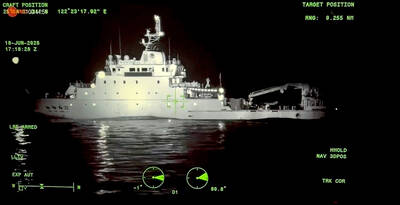
EXCUSES: Beijing is using government and research vessels as a pretext to harass the nation and enter its EEZ, and engage in ‘hegemonic expansion,’ the coast guard said The Coast Guard Administration yesterday said it drove away Chinese oceanographic research vessel Xiang Yang Hong 22 (向陽紅33) from restricted waters after warning it that it was in Taiwan’s exclusive economic zone (EEZ). The Chinese vessel entered restricted waters off the coast of Yilan County’s Suao (蘇澳) at 11:35pm on Thursday, the coast guard said, adding that it dispatched the Lanyu patrol vessel and the boat PP-10077 to shadow the Chinese ship and issue radio warnings ordering it to leave. China has no sovereignty over waters off Taiwan’s east coast, Lanyu’s crew told Xiang Yang Hong 22 over the radio, and demanded
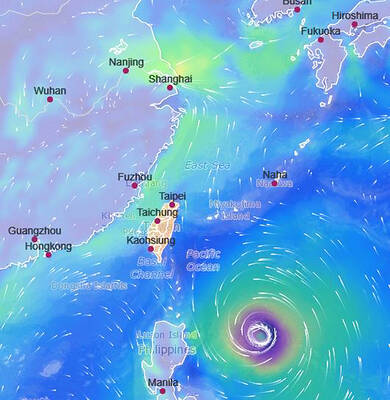
Typhoon Mekkhala is likely to come closest to Taiwan on Thursday, according to the Central Weather Administration (CWA), which forecast localized rain or thundershowers in western and northeastern parts of the country for that day. As of 2pm yesterday, the eye of the storm was 770km southeast of Oluanpi (鵝鑾鼻), the southernmost point of Taiwan, as it continued to move toward waters east of the Philippines, the agency said. Mekkhala was expected to become a severe typhoon last night, CWA forecaster Lai Hsin-kuo (賴欣國) said. A severe typhoon has maximum wind speeds of more than 184kph, compared with 118kph to 183kph for a
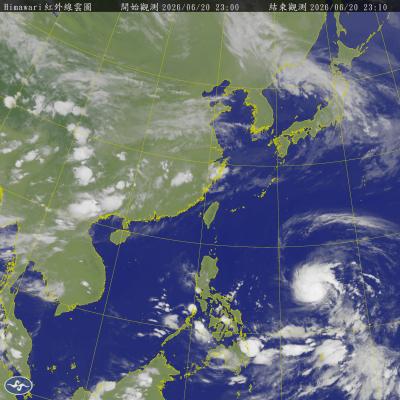
Tropical Storm Mekkhala is forecast to strengthen into a typhoon tomorrow and could come close enough to Taiwan later in the week to prompt a sea warning, the Central Weather Administration (CWA) said yesterday. As of 2 pm, the storm was located 1,870 kilometers southeast of Taiwan's southern tip and moving west- northwest at 23 km per hour. CWA forecaster Cheng Chieh-jen (鄭傑仁) said Mekkhala is expected to continue moving west-northwest through Tuesday under the influence of the Pacific high- pressure system before gradually turning north toward waters east of Taiwan or south of the Ryukyu Islands. The timing and angle of the

RISING POPULARITY: Enhanced flight connectivity and a visa waiver trial program are among the motivations that have boosted travel to Taiwan by Filipinos, the agency said The Tourism Administration said yesterday that it is stepping up efforts to attract tourists from the Philippines following strong growth during the first quarter. The agency’s data showed the nation welcomed 210,000 Filipino visitors from January to March, marking a 43 percent increase compared with the same period last year. The Philippines is Taiwan’s top source of inbound tourists among the Southeast Asian nations, data showed. With a population of 116 million and national median age of 26, the Philippines boasts a young demographic with strong travel potential, the Tourism Administration said. Outbound travel demand in the Philippines continues to rise amid robust


 RSS
RSS