


Yuanta Securities (元大證券) board director Tu Li-ping (杜麗萍) was released on NT$1 million (US$30,000) bail yesterday after the court rejected a request that she be detained by prosecutors investigating alleged corruption involving the first family.
In denying the Supreme Prosecutors’ Office’s Special Investigation Panel’s (SIP) detention request, the Taipei District Court said there was little chance that Tu would collude with other witnesses as prosecutors claimed and that prosecutors had already conducted repeated searches of her offices and other locations related to the case.
Tu was summoned for questioning on Thursday evening and SIP prosecutors decided to detain her around midnight. The Taipei District Court took until early yesterday morning to reach its decision.
Prosecutors suspect Tu of helping former first lady Wu Shu-jen (吳淑珍) wire as much as NT$740 million through Yuanta Financial Holdings into overseas bank accounts that were opened by Wu’s children or proxies.
Tu’s lawyer Tan Hu (談虎) said that prosecutors wanted to detain her because she told them that she once took NT$200 million from Yuanta to the Presidential Office — money that prosecutors believed was a bribe from the company to ensure that the first family would not intervene in a buyout project in which Yuanta was involved in 2005.
“She told prosecutors that it was not a bribe, but they did not believe her,” Tan said.
Tan, however, did not say what that money was for.
Meanwhile, Wu Shu-jen’s brother, Wu Ching-mao (吳景茂), who has been in detention for 53 days, was released yesterday on NT$2 million bail. SIP prosecutors decided to file a bail request after questioning him yesterday morning, which the Taipei District Court granted.
Both Tu and Wu Ching-mao were barred from leaving the country.
Prosecutors yesterday also questioned former Chinatrust Financial Holding Corp vice president Jeffrey Koo Jr (辜仲諒) and former Democratic Progressive Party legislator Luo Wen-chia (羅文嘉).
“They simply wanted me to confirm statements from other witnesses,” Luo said.
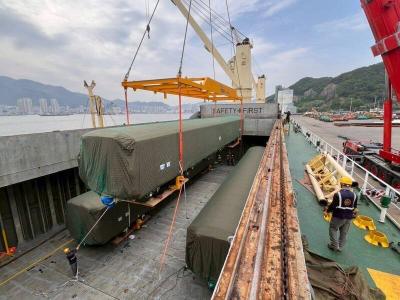
The first of 10 new high-capacity trains purchased from South Korea’s Hyundai Rotem arrived at the Port of Taipei yesterday to meet the demands of an expanding metro network, Taipei Rapid Transit Corp (TRTC) said yesterday. The train completed a three-day, 1,200km voyage from the Port of Masan in South Korea, the company said. Costing NT$590 million (US$18.79 million) each, the new six-carriage trains feature a redesigned interior based on "human-centric" transportation concepts, TRTC said. The design utilizes continuous longitudinal seating to widen the aisles and optimize passenger flow, while also upgrading passenger information displays and driving control systems for a more comfortable
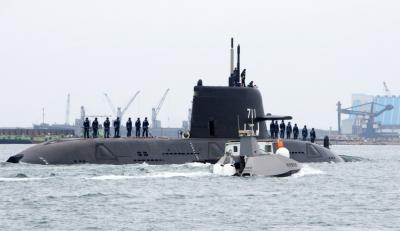
Taiwan's first indigenous defense submarine, the SS-711 Hai Kun (海鯤, or Narwhal), departed for its 13th sea trial at 7am today, marking its seventh submerged test, with delivery to the navy scheduled for July. The outing also marked its first sea deployment since President William Lai (賴清德) boarded the submarine for an inspection on March 19, drawing a crowd of military enthusiasts who gathered to show support. The submarine this morning departed port accompanied by CSBC Corp’s Endeavor Manta (奮進魔鬼魚號) uncrewed surface vessel and a navy M109 assault boat. Amid public interest in key milestones such as torpedo-launching operations and overnight submerged trials,
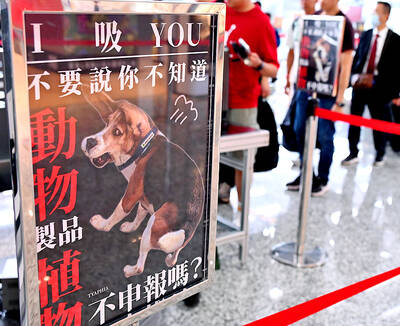
Quarantine awareness posters at Taiwan Taoyuan International Airport have gone viral for their use of wordplay. Issued by the airport branch of the Animal and Plant Health Inspection Agency, the posters feature sniffer dogs making a range of facial expressions, paired with advisory messages built around homophones. “We update the messages for holidays and campaign needs, periodically refreshing materials to attract people’s attention,” quarantine officials said. “The aim is to use the dogs’ appeal to draw focus to quarantine regulations.” A Japanese traveler visiting Taiwan has posted a photo on X of a poster showing a quarantine dog with a
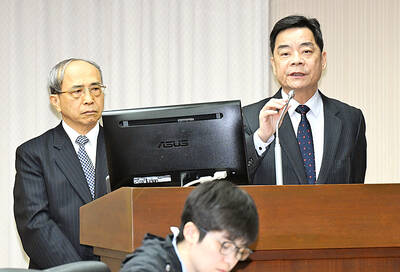
SECURITY RISK: A university student sent a general alarm signal to THSRC’s control center on April 5, causing four operating trains to temporarily halt services The Ministry of Transportation and Communications yesterday pledged to submit a report on ways to harden the communication security of railway systems after a university student hacked into Taiwan High Speed Rail Corp’s (THSRC) radio communications system and disrupted operations of four high-speed rail trains last month. Investigation by the police and prosecutors found that the university student and radio enthusiast, surnamed Lin (林), first used a software-defined radio (SDR) filter to analyze THSRC signals, downloaded the data to a computer, cracked the parameters and then programmed the codes into his radio devices. Lin then sent a general alarm signal to


 RSS
RSS