


The Supreme Prosecutors’ Office’s Special Investigation Panel (SIP) prosecutors questioned former first lady Wu Shu-jen (吳淑珍) at her residence yesterday afternoon.
Three SIP prosecutors arrived at Wu’s residence at 1:30pm and left around 4pm, without giving details about their conversation with Wu.
After Wu was questioned, she called for the court to begin the trial process rather than holding her husband former president Chen Shui-bian (陳水扁) incommunicado without charge, criticizing the entire case as “political persecution,” Wu’s lawyer Lee Sheng-hsiung (李勝雄) said.
Wu said that all of the money from the “special state affairs” funds was used for public purposes. She said she did not claim or use such funds because she was not a civil servant and that she had her own money at her disposal.
The wheelchair-bound Wu was indicted on Nov. 3, 2006 for using fake receipts to claim NT$14.8 million (US$460,000) in reimbursements from the president’s “special state affairs” fund between 2002 and 2006 while her husband was president.
Chen is suspected of money laundering, taking bribes, forgery and embezzling NT$15 million during his two terms in office. Chen has admitted to using false receipts to claim money from a fund set aside for national affairs, but said the money was used for “secret diplomatic missions” that he could not publicly disclose.
Earlier yesterday, former premier Yu Shyi-kun was also summoned by the SIP for questioning on his possible role in a graft investigation involving Chen and Wu.
Yu was questioned over his Cabinet’s approval of Hsinchu Science Park’s purchase of a piece of land in Longtan (龍潭), Taoyuan County, at a higher-than-market price in 2004.
Chairman of Taiwan Cement Corporation Leslie Koo (辜成允) inherited the land from his brother, and investigators found that the company wired large sums to overseas bank accounts opened by two proxies of the first family after the land was sold to Hsinchu Science Park in February 2004.
The investigators suspect that the funds were kickbacks offered by the Koo’s firms for the land deal, which was finalized at what investigators claim to be an unreasonably high price.
Koo said recently he paid a total of NT$400 million to Wu as a “commission” for the land deal. Tsai Ming-che (蔡銘哲), who has claimed to be Wu’s special aide, confessed late last month to receiving NT$100 million and NT$420 million respectively on Wu’s behalf from the two Koos in 2003.
But in a recent interrogation, Wu told the prosecutors that she actually had received only NT$90 million and NT$200 million in “political contributions.”
Yu yesterday told prosecutors that he was the authority who approved the deal on behalf of the government, but the entire deal was legal and clean, he said.

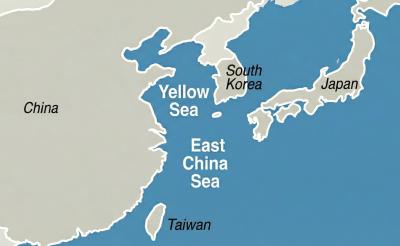
China has reserved offshore airspace in the Yellow Sea and East China Sea from March 27 to May 6, issuing alerts usually used to warn of military exercises, although no such exercises have been announced, the Wall Street Journal (WSJ) reported yesterday. Reserving such a large area for 40 days without explanation is an “unusual step,” as military exercises normally only last a few days, the paper said. These alerts, known as Notice to Air Missions (Notams), “are intended to inform pilots and aviation authorities of temporary airspace hazards or restrictions,” the article said. The airspace reserved in the alert is

South Korea is planning to revise its controversial electronic arrival card, a step Taiwanese officials said prompted them to hold off on planned retaliatory measures, a South Korean media report said yesterday. A Yonhap News Agency report said that the South Korean Ministry of Foreign Affairs is planning to remove the “previous departure place” and “next destination” fields from its e-arrival card system. The plan, reached after interagency consultations, is under review and aims to simplify entry procedures and align the electronic form with the paper version, a South Korean ministry official said. The fields — which appeared only on the electronic form
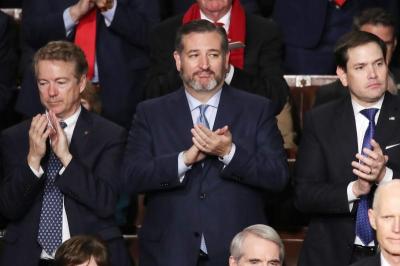
A bipartisan group of US senators has introduced a bill to enhance cooperation with Taiwan on drone development and to reduce reliance on supply chains linked to China. The proposed Blue Skies for Taiwan Act of 2026 was introduced by Republican US senators Ted Cruz and John Curtis, and Democratic US senators Jeff Merkley and Andy Kim. The legislation seeks to ease constraints on Taiwan-US cooperation in uncrewed aerial systems (UAS), including dependence on China-sourced components, limited access to capital and regulatory barriers under US export controls, a news release issued by Cruz on Wednesday said. The bill would establish a "Blue UAS
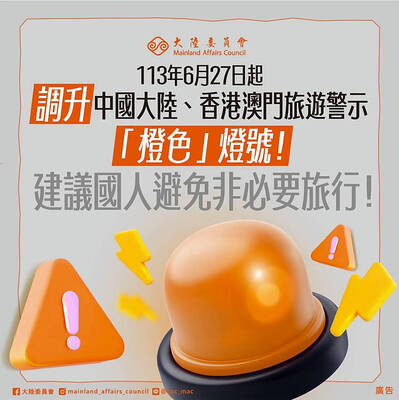
More than 6,000 Taiwanese students have participated in exchange programs in China over the past two years, despite the Mainland Affairs Council’s (MAC) “orange light” travel advisory, government records showed. The MAC’s publicly available registry showed that Taiwanese college and university students who went on exchange programs across the Strait numbered 3,592 and 2,966 people respectively. The National Immigration Agency data revealed that 2,296 and 2,551 Chinese students visited Taiwan for study in the same two years. A review of the Web sites of publicly-run universities and colleges showed that Taiwanese higher education institutions continued to recruit students for Chinese educational programs without


 RSS
RSS