

Publishing industries on both sides of the Taiwan Strait should collaborate more closely to tap into the booming Chinese language education market worldwide, said Liu Binjie (柳斌杰), head of China’s General Administration of Publications and Press at a forum in Taipei yesterday.
“More than 30 million people worldwide take up Chinese each year. We estimate the figure could rise to 100 million,” Liu said.
Liu is heading a delegation of Chinese publishing and printing companies to Taiwan to celebrate 20 years of exchanges between the literary industries on both sides.
“Despite conflict between China and Taiwan throughout the years, the publishing industries on both sides remained friendly to each other. It’s a testament to culture and literature as great ways to promote understanding and assuage hostilities,” he said.
Liu encouraged more Taiwanese and Chinese businesspeople to invest in each other’s distribution and printing companies.
Taiwanese companies are barred from setting up independent publishing houses in China. All investments must be a joint-ventures with China-based companies.
The rules on Chinese investment in Taiwan’s publishing industry are even stricter, said a member of the Chinese delegation who asked not to be named.
In his address, Liu said Taiwan and China should seek to promote Chinese culture and that the publishing industry was the best conduit to do so.
Liu, however, did not mention promoting Taiwan's culture and literature to China and the rest of the world.
In a speech, Government Information Office Chief Vanessa Shih (史亞平) urged the Chinese government to give Taiwanese publishing companies priority in reviewing applications for foreign investors as well as streamlining the application process to make it easier for Taiwanese publishing companies to do business in China.
Shih also advocated stronger bilateral cooperation on tackling intellectual property and copyright violations, saying that all publications, whether in print, digital, or audio-visual, must be given full respect.
Taiwan's experience in creating digital content, animation and video-games can greatly enhance related industries in China, she said.
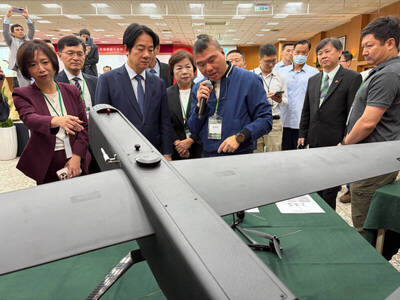
Two executives of drone supplier Jiin Ming Industry Co (錦明實業) have been detained and held incommunicado over the company's alleged use of prohibited China-made chips and camera lenses in drones supplied under recent military contracts, the Taoyuan District Prosecutors' Office said today. In a statement, prosecutors said they raided the offices of Jiin Ming — headquartered in Taoyuan — as well as those of its subsidiaries and its suppliers on Thursday last week. The raids followed a report that the company had breached its procurement contracts by putting the prohibited components into drones delivered to the military. During the raids, prosecutors summoned
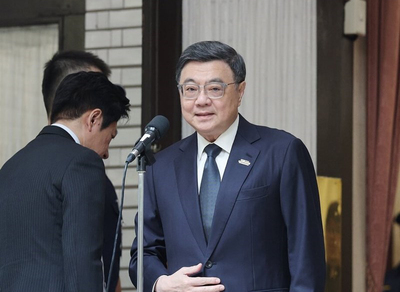
The government would continue monitoring online rumors that a pneumonic plague outbreak has spread from Russia into China and could enhance existing quarantine measures, Premier Cho Jung-tai (卓榮泰) said today. During a legislative meeting, Democratic Progressive Party Legislator Wang Ting-yu (王定宇) said rumors were circulating that the disease had spread across several Chinese provinces. He asked Cho whether the government was prepared to prevent the disease from spreading to Taiwan, given the frequent exchanges between Taiwan and China, and how concerned the government was about the alleged outbreak. The Ministry of Health and Welfare implemented border quarantine measures after briefing the Executive Yuan

South Korean boy band BigBang drew 120,000 fans to three concerts at Taipei Dome from Friday through yesterday, as the band thanked them for their support over their 20-year career. The Taipei Dome concerts were part of BigBang's "2026-2027 World Tour XX: Cosmos." Friday's concert was BigBang's first performance in Taiwan in 11 years. During the encore, group leader G-Dragon (GD) shouted "I love you" in Chinese and said he was especially happy to perform in Taiwan with bandmates Taeyang and Daesung. "Taipei, I'm very grateful to you all," GD said in Chinese, asking fans to wait for the band's return. Daesung thanked
A Chinese People's Liberation Army (PLA) Navy aircraft carrier group was being monitored after entering the western Pacific, the Ministry of National Defense said today, after Beijing yesterday criticized Taiwan for using a water cannon against a Chinese fishing boat near the Pratas Islands (Dongsha Islands, 東沙群島). A Chinese naval task group led by the aircraft carrier Liaoning (遼寧) yesterday sailed to the western Pacific for training, Chinese state-run Xinhua news agency quoted the PLA Navy as saying. “The drill is part of the annual routine training plan aimed at testing and improving the troops’ combat readiness and enhancing their ability to


 RSS
RSS