


Ma Han-chung (馬漢忠), a 15-year old Bunun Aborigine who has fought a 14-year battle against cancer, saw his dreams come true yesterday when an exhibition of his artwork opened in Taipei.
Ma, who was diagnosed with brain cancer at 11 months old, has long dreamed of becoming a writer and a poet and has documented his fight with the deadly disease through painting and writing poetry.
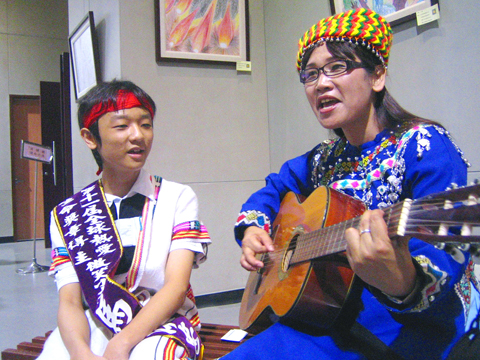
PHOTO: CHEN YI-YU, TAIPEI TIMES
Exhibition
The exhibition, which is sponsored by Chou Ta-kuan Cultural & Educational Foundation (周大觀文教基金會), opened yesterday at the National Taiwan Democracy Memorial Hall (台灣民主紀念館).
The foundation is a charity organization dedicated to helping young cancer patients and other severely ill children.
The foundation’s chief executive, Chao Tsui-hui (趙翠慧), said at a press conference yesterday that the foundation had nicknamed Ma “smiling sunshine” because he remained optimistic even during the worst moments of his illness.
Poetry
Chao said the foundation would soon publish Ma’s poetry. Ma was also one of the recipients of the foundation’s Love of Life Awards (全球熱愛生命獎章) this year.
Ma said: “When sand gets into an oyster shell, it irritates the oyster at first, but the grain of sand eventually becomes a beautiful pearl. I think my cancer is similar to a grain of sand. Although it caused me a lot of emotional and physical pain, I had to overcome it and become stronger.”
He added that his parent’s positive outlook on life gave him the strength to fight the cancer.
The art exhibition runs through next Thursday and will also feature the calligraphy and poetry of the late Chou Ta-kuan (周大觀), in whose memory the foundation was created.
Born in Taitung to a Korean pastor father, Sun Chang-wu (孫昶吾), and Bunun Aboriginal mother, Ma Chiu-chin (馬秋琴), Ma has just passed the high school entrance exam and will attend National Taitung Senior High School.

LOUD AND PROUD Taiwan might have taken a drubbing against Australia and Japan, but you might not know it from the enthusiasm and numbers of the fans Taiwan might not be expected to win the World Baseball Classic (WBC) but their fans are making their presence felt in Tokyo, with tens of thousands decked out in the team’s blue, blowing horns and singing songs. Taiwanese fans have packed out the Tokyo Dome for all three of their games so far and even threatened to drown out home team supporters when their team played Japan on Friday. They blew trumpets, chanted for their favorite players and had their own cheerleading squad who dance on a stage during the game. The team struggled to match that exuberance on the field, with
Taiwanese paleontologists have discovered fossil evidence that pythons up to 4m long inhabited Taiwan during the Pleistocene epoch, reporting their findings in the international scientific journal Historical Biology. National Taiwan University (NTU) Institute of Ecology and Evolutionary Biology associate professor Tsai Cheng-hsiu (蔡政修) led the team that discovered the largest snake fossil ever found in Taiwan. The single trunk vertebra was discovered in Tainan at the Chiting Formation, dated to between 400,000 and 800,000 years ago in the Middle Pleistocene, the paper said. The area also produced Taiwan’s first avian fossil, as well as crocodile, mammoth, saber-toothed cat and rhinoceros fossils, it said. Discoveries

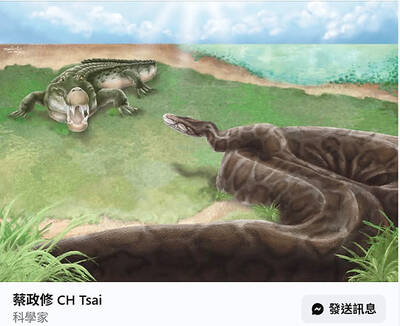
Taiwanese paleontologists have discovered fossil evidence that pythons up to 4m long inhabited Taiwan during the Pleistocene epoch, reporting their findings in the international scientific journal Historical Biology. National Taiwan University (NTU) Institute of Ecology and Evolutionary Biology associate professor Tsai Cheng-hsiu (蔡政修) led the team that discovered the largest snake fossil ever found in Taiwan. A single trunk vertebra was discovered in Tainan at the Chiting Formation, dated to between 800,000 to 400,000 years ago in the Middle Pleistocene, the paper said. The area also produced Taiwan’s first avian fossil, as well as crocodile, mammoth, sabre-toothed cat and rhinoceros fossils, it said. Discoveries
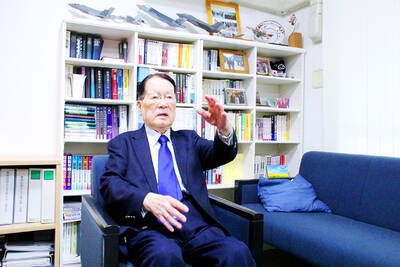
Whether Japan would help defend Taiwan in case of a cross-strait conflict would depend on the US and the extent to which Japan would be allowed to act under the US-Japan Security Treaty, former Japanese minister of defense Satoshi Morimoto said. As China has not given up on the idea of invading Taiwan by force, to what extent Japan could support US military action would hinge on Washington’s intention and its negotiation with Tokyo, Morimoto said in an interview with the Liberty Times (sister paper of the Taipei Times) yesterday. There has to be sufficient mutual recognition of how Japan could provide


 RSS
RSS