


Taiwan does not necessarily need to export its democracy, but it can share the experience it gained in overcoming obstacles on its way to democracy with other countries, including China, President Ma Ying-jeou (馬英九) said yesterday,
“We are praised as a beacon of democracy in Asia and the world, but there is so much room for improvement and we have no right to tell other countries what to do,” Ma said in Taipei yesterday morning at an event marking the fifth anniversary of the creation of the Ministry of Foreign Affairs-affiliated Taiwan Foundation for Democracy.
However, Ma said, Taiwan is happy to share with other countries its experience in resolving problems encountered during the democratization process, including state suppression of religions, the White Terror era, the 228 Incident and the Kaohsiung Incident.
The 228 Incident refers to an anti-government uprising in 1947 that was violently suppressed by the then Chinese Nationalist Party (KMT) government and resulted in the deaths of 20,000 people.
The White Terror era included the suppression of political dissidents and public discussion of the 228 Incident from 1949 to 1987, when Taiwan was under martial law. The Kaohsiung Incident of 1979 followed pro-democracy demonstrations, to which KMT authorities responded by arresting many opposition leaders.
“It was suppression then, but it is precious experience now,” Ma said. “Neighboring countries, including China, are welcome to share in our experience so they are better prepared.”
Ma said that while about 60 percent of countries, or 120 countries, had regular elections, that did not necessarily make them democracies, because a true democracy required additional elements, such as a constitutional democracy and liberal democracy.
There are several countries that, despite having regular elections and popular leaders, are ruled through executive orders and nationalism, Ma said.
In the case of the Republic of China, Ma said, the country became the first republic in Asia 97 years ago.
But it did not enact and implement its Constitution until 61 years ago, its first president was elected by the National Assembly 60 years ago and the first popularly elected president was inaugurated just 12 years ago, he said, adding that martial law had not been lifted until 21 years ago.
ADDITIONAL REPORTING BY CNA

Yangmingshan National Park authorities yesterday urged visitors to respect public spaces and obey the law after a couple was caught on a camera livestream having sex at the park’s Qingtiangang (擎天崗) earlier in the day. The Shilin Police Precinct in Taipei said it has identified a suspect and his vehicle registration number, and would summon him for questioning. The case would be handled in accordance with public indecency charges, it added. The couple entered the park at about 11pm on Thursday and began fooling around by 1am yesterday, the police said, adding that the two were unaware of the park’s all-day live
Fast food chain McDonald's is to raise prices by up to NT$5 on some products at its restaurants across Taiwan, starting on Wednesday next week, the company announced today. The prices of all extra value meals and sharing boxes are to increase by NT$5, while breakfast combos and creamy corn soup would go up by NT$3, the company said in a statement. The price of the main items of those meals, if ordered individually, would remain the same. Meanwhile, the price of a medium-sized lemon iced tea and hot cappuccino would rise by NT$3, extra dipping sauces for chicken nuggets would go up
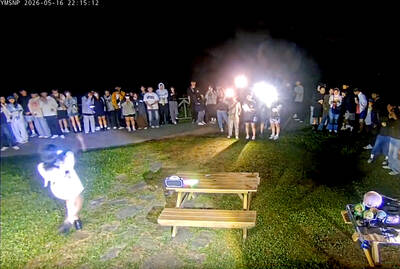
Yangmingshan National Park’s Qingtiangang (擎天崗) nature area has gone viral after a park livestream camera observed a couple in the throes of intimate congress, which was broadcast live on YouTube, drawing large late-night crowds and sparking a backlash over noise, bright lights and disruption to wildlife habitat. The area’s livestream footage appeared to show a couple engaging in sexual activity on a picnic table in the park on Friday last week, with the uncensored footage streamed publicly online. The footage quickly spread across social media, prompting a tide of visitors to travel to the site to “check in” and recreate the

Minister of Digital Affairs Lin Yi-ching (林宜敬) yesterday cited regulatory issues and national security concerns as an expert said that Taiwan is among the few Asian regions without Starlink. Lin made the remarks on Facebook after funP Innovation Group chief executive officer Nathan Chiu (邱繼弘) on Friday said Taiwan and four other countries in Asia — China, North Korea, Afghanistan and Syria — have no access to Starlink. Starlink has become available in 166 countries worldwide, including Ukraine, Malaysia, the Philippines and Vietnam, in the six years since it became commercial, he said. While China and North Korea block Starlink, Syria is not


 RSS
RSS