


President Ma Ying-jeou (馬英九) described yesterday the meeting between Chinese Nationalist Party (KMT) Chairman Wu Poh-hsiung (吳伯雄) and Chinese President Hu Jintao (胡錦濤) as "satisfactory" and "successful," adding it was a demonstration of Taiwan's "soft power."
Ma said Wu and his entourage deserved acknowledgment for their efforts in the past six days.
“The success of the KMT is everybody’s success,” Ma said.
Wu, who met Hu in Beijing on Wednesday, visited Ma at the Presidential Office shortly after returning from China yesterday evening.
Wu and his entourage set off for Nanjing, China, last Monday, where he visited the mausoleum of Sun Yat-sen (孫逸仙), the founding chairman of the KMT.
The meeting marked the first talks between high-level officials from China and Taiwan since the KMT regime fled to Taiwan following its defeat in the Chinese civil war in 1949.
Hu met Wu in his capacity as head of the Chinese Communist Party, following the “party-to-party” protocol of previous meetings between Chinese leaders and KMT officials.
Both mentioned the weekend charter flights and more Chinese tourists traveling to Taiwan, but left details to Taiwan’s Straits Exchange Foundation (SEF) and its Chinese counterpart, the Association for Relations Across the Taiwan Strait (ARATS) to negotiate.
Wu said yesterday that Hu had promised to discuss Taiwan’s participation in international organizations, including the WHO, in future talks.
On weekend charter flights and Chinese tourists, Wu told Ma that although he could not make any promises on behalf of the government, his feeling was that Beijing would do its best to help make the two projects a reality.
Wu said he would leave the rest to the SEF-ARATS talks.
Wu told Ma that in light of the more amiable atmosphere in the Taiwan Strait, he felt it was unlikely that Beijing would launch a missile assault against Taiwan. Wu was referring to the more than 1,300 tactical ballistic missiles China is aiming at Taiwan.
Wu said he had told Beijing that Taiwanese want safety, dignity and international space and that he received a “positive response” from his Chinese counterpart.
Wu, however, said that in response, Beijing had emphasized “the importance of mutual trust and asked Taiwan to make good on its words” before both sides could put aside differences and create a “win-win situation.”
The Chinese people were grateful for the assistance offered by Taiwanese in the aftermath of the devastating earthquake in Sichuan Province, Wu said.
SEF Chairman Chiang Pin-kung (江丙坤) is scheduled to depart for Beijing on June 11 to conduct talks with his ARATS counterpart.
In a letter from ARATS to the SEF on Thursday, Beijing said it accepted Taiwan’s invitation to hold cross-strait negotiations on weekend passenger charter flights and opening Taiwan to Chinese tourists. It invited SEF representatives to visit Beijing from June 11 to June 14.
The agreement to gather in Beijing in two weeks came a day after Hu and Wu made a verbal agreement on the talks during their meeting in Beijing.
Analysts from China said tensions had clearly eased since Ma’s election, but cautioned that many pitfalls remain on the road to reconciliation and that China’s military build-up near Taiwan would not be scaled down.
“The mainland is confident in Ma’s attitude toward [not seeking] Taiwanese independence. But there are still difficulties that need to be overcome,” said Zhang Wensheng, director of the Institute of Taiwan Studies at Xiamen University.
“As to the military build-up, it will continue because the military build-up is ... aimed at [preventing] Taiwanese independence,” he said.
ADDITIONAL REPORTING BY CNA AND AFP
Also See: Humble Wu’s humiliating journey
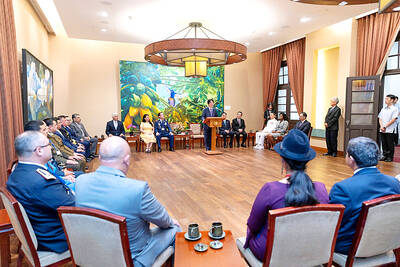
Costa Rica sent a group of intelligence officials to Taiwan for a short-term training program, the first time the Central American country has done so since the countries ended official diplomatic relations in 2007, a Costa Rican media outlet reported last week. Five officials from the Costa Rican Directorate of Intelligence and Security last month spent 23 days in Taipei undergoing a series of training sessions focused on national security, La Nacion reported on Friday, quoting unnamed sources. The Costa Rican government has not confirmed the report. The Chinese embassy in Costa Rica protested the news, saying in a statement issued the same
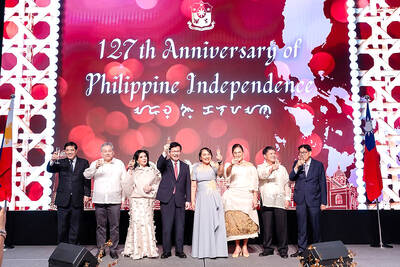
Taiwan is to extend its visa-waiver program for Philippine passport holders for another year, starting on Aug. 1, Minister of Foreign Affairs Lin Chia-lung (林佳龍) said on Friday. Lin made the announcement during a reception in Taipei marking the 127th anniversary of Philippine independence and the 50th anniversary of the establishment of the Manila Economic and Cultural Office (MECO) in Taiwan, the Ministry of Foreign Affairs said. The decision reflected Taiwan’s commitment to deepening exchanges with the Philippines, the statement cited Lin as saying, adding that it was a key partner under the New Southbound Policy launched in 2016. Lin also expressed hope
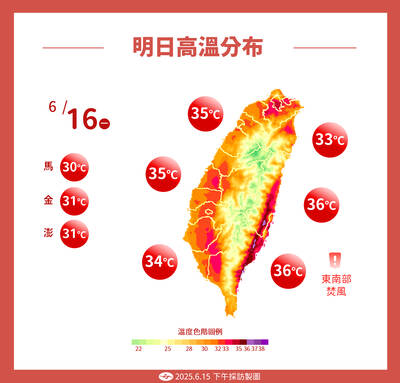
Temperatures in New Taipei City’s Sindian District (新店) climbed past 37°C yesterday, as the Central Weather Administration (CWA) issued heat alerts for 16 municipalities, warning the public of intense heat expected across Taiwan. The hottest location in Taiwan was in Sindian, where the mercury reached 37.5°C at about 2pm, according to CWA data. Taipei’s Shilin District (士林) recorded a temperature of 37.4°C at noon, Taitung County’s Jinfeng Township (金峰) at 12:50 pm logged a temperature of 37.4°C and Miaoli County’s Toufen Township (頭份) reached 36.7°C at 11:40am, the CWA said. The weather agency yesterday issued a yellow level information notice for Taipei, New
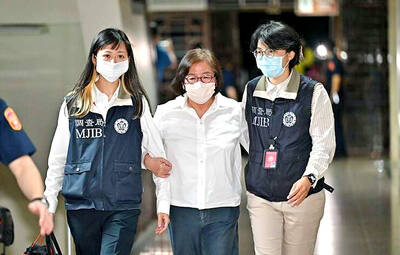
CASE: Prosecutors have requested heavy sentences, citing a lack of remorse and the defendants’ role in ‘undermining the country’s democratic foundations’ Five people affiliated with the Chinese Nationalist Party (KMT), including senior staff from the party’s Taipei branch, were indicted yesterday for allegedly forging thousands of signatures to recall two Democratic Progressive Party (DPP) lawmakers. Those indicted include KMT Taipei chapter director Huang Lu Chin-ru (黃呂錦茹), secretary-general Chu Wen-ching (初文卿) and secretary Yao Fu-wen (姚富文), the Taipei District Prosecutors’ Office said in a news release. Prosecutors said the three were responsible for fabricating 5,211 signature forms — 2,537 related to the recall of DPP Legislator Wu Pei-yi (吳沛憶) and 2,674 for DPP Legislator Rosalia Wu (吳思瑤) — with forged entries accounting for


 RSS
RSS