


Incoming Minister of Justice Wang Ching-feng (王清峰) said yesterday the ministry would consider the possibility of abolishing capital punishment, but that she must respect the law when dealing with the 29 individuals who remain on death row.
The last execution was more than two years ago.
“It is very, very difficult, but I will face it and try not to avoid it,” Wang told a press conference on her first day as minister.
“We must adhere to the law and deal with the individuals on death row,” she said.
But Wang said she had no idea how to address the matter.
The Democratic Progressive Party government said in 2000 it would abolish the death penalty, but the ministry said it was not able to do so because a majority of Taiwanese still believe that capital punishment is the most effective means of deterring serious crime.
As a former attorney and social activist, Wang said the abolishment of capital punishment was increasingly being pursued globally. She said, however, that close to 80 percent of people opposed abolishing the death penalty.
The opposition dropped to about 40 percent, however, if additional measures — such as setting sentence limits and a threshold on parole for life imprisonment — were put on the table.
She said the ministry would study the complementary measures along with the possibility of abolishing the death penalty.
Wang said that maintaining the death penalty also had repercussions for the nation’s image abroad.
Ministry figures showed that the number of executions has decreased for years. Thirty-two prisoners were executed in 1998, a number that shrank to 10 in 2001 and three each year between 2004 and 2006.
In related news, the Chinese-language Liberty Times, (the Taipei Times’ sister paper) reported yesterday that Prosecutor Wu Wen-chung (吳文忠) of the Supreme Court Prosecutors Office’s Special Investigation Panel had said on Tuesday that “[former president] Chen Shui-bian [陳水扁] should be executed” while chatting with reporters after a press conference.
Wang said yesterday it was very inappropriate for Wu to make such a remark and asked the Supreme Prosecutors Office to investigate the matter.
Wu denied the report yesterday, saying he was joking.
“I said the individuals on death row should be executed, not Chen,” he said.

FUKUOKA SITUATION: Japanese media reported that the pathogen is expected to be identified by the summer, while the CDC downplayed the idea that it was hMPV A “mysterious cold-like illness” reported in Japan’s Fukuoka Prefecture does not seem to be a new disease, but Japanese authorities have been asked about the situation, the Centers for Disease Control (CDC) said yesterday. The Fukuoka Prefectural Medical Association on Wednesday told a news conference that a “mystery cold” that has become a hot topic on social media is “highly likely to be caused by some kind of viral infection,” Japan’s KBC News reported. “Many people are experiencing symptoms starting with a sore throat, followed by a runny nose, phlegm and a severe cough,” KBC News reported, citing association officials. Health authorities are

Nvidia Corp CEO Jensen Huang (黃仁勳) arrived in Taiwan yesterday ahead of upcoming AI and technology events, saying he plans to meet with clients and Taiwan Semiconductor Manufacturing Co Chairman C.C. Wei (魏哲家) during his visit. After landing at Taipei Songshan Airport, Huang posed for photos with fans and handed out Yakult drinks to reporters and supporters waiting at the scene, saying he has “a lot to do” during the trip. Asked about reports that Nvidia’s planned headquarters site in Taipei’s Beitou Shilin Technology Park could break ground on May 27, Huang said that if the company holds an event, he would

Carrefour Taiwan is to begin using a new name from the start of July, but it cannot divulge the name until then, the chairman of the supermarket chain's parent company said today. President Chain Store Co chairman Lo Chih-hsien (羅智先) was asked by reporters after a shareholders' meeting to confirm whether the company has settled on a new name for the supermarket brand. In March, the government-registered name of two Carrefour Taiwan branches was quietly changed to "Le Chia Kang" (樂家康) in Chinese, raising speculation that has been selected as the name. Lo said that because of local regulations and contractual obligations, the
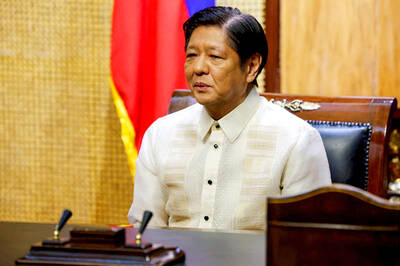
The Philippines would likely be involved in any conflict over Taiwan due to its proximity to the democracy claimed by China, President Ferdinand Marcos Jr said, reiterating a stance that risks angering Beijing. “In the Philippines, we do not have a choice because Taiwan is so close to the Philippines and we have almost 200,000 Filipino nationals living and working in Taiwan,” Marcos said in an interview with Japanese media in Manila on Monday. The Philippine leader’s comments come ahead of a state visit to Japan next week, where he is to meet with Japanese Prime Minister Sanae Takaichi to discuss security


 RSS
RSS