


President-elect Ma Ying-jeou’s (馬英九) plan to restore the appointment of senior advisers and national policy advisers to the president — a system that his Chinese Nationalist Party (KMT) strongly disapproved of during the Democratic Progressive Party (DPP) administration — has come under fire from the DPP.
Incoming Presidential Office secretary-general Chan Chun-po (詹春柏) visited Legislative Speaker Wang Jin-pyng (王金平) on Monday to discuss the plan, the Chinese-language Liberty Times (the Taipei Times’ sister newspaper) reported yesterday.
“Ma is considering restoring the appointments in accordance with the Organic Law of the Presidential Office (總統府組織法),” Wang said.
The KMT-dominated legislature last year passed a resolution freezing the fiscal 2008 budget for the president to appoint senior national policy advisers, saying the money could not be freed until the inauguration of a new government on May 20.
Based on the government’s fiscal 2008 budget statement, the budget for senior advisers, national policy advisers and strategic advisers amounted to NT$130 million (US$4.26 million).
“Ma is eligible to use the budget after his inauguration,” Wang said.
The DPP government suspended the annual appointment of senior advisers and national policy advisers in June 2006, a move President Chen Shui-bian (陳水扁) regarded as a step forward in promoting administrative reform.
Chen’s decision ended the half-century long system established by the former KMT regime and has saved the government about NT$140 million over the past two years.
The organic law states that the president is entitled to appoint up to 120 paid and unpaid senior advisers and national policy advisers, the report said.
“The KMT used to attack Chen for using the appointments of senior advisers and national policy advisers as rewards ... Why has the KMT allowed Ma to restore the system? The KMT keeps saying it wants to boost the economy. Why doesn’t it want to help the public save NT$70 million a year?” DPP caucus whip Yeh Yi-jin (葉宜津) said.
In response, KMT Legislator Shyu Jong-shyoung (徐中雄) said he was confident that Ma would select senior advisers and national policy advisers who can make a contribution to the country and not consider the positions as rewards or favors for his supporters.
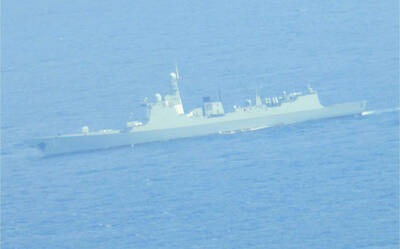
The military has spotted two Chinese warships operating in waters near Penghu County in the Taiwan Strait and sent its own naval and air forces to monitor the vessels, the Ministry of National Defense (MND) said. Beijing sends warships and warplanes into the waters and skies around Taiwan on an almost daily basis, drawing condemnation from Taipei. While the ministry offers daily updates on the locations of Chinese military aircraft, it only rarely gives details of where Chinese warships are operating, generally only when it detects aircraft carriers, as happened last week. A Chinese destroyer and a frigate entered waters to the southwest
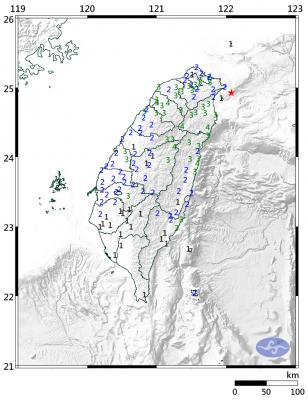
A magnitude 6.1 earthquake struck off the coast of Yilan County at 8:39pm tonight, the Central Weather Administration (CWA) said, with no immediate reports of damage or injuries. The epicenter was 38.7km east-northeast of Yilan County Hall at a focal depth of 98.3km, the CWA’s Seismological Center said. The quake’s maximum intensity, which gauges the actual physical effect of a seismic event, was a level 4 on Taiwan’s 7-tier intensity scale, the center said. That intensity level was recorded in Yilan County’s Nanao Township (南澳), Hsinchu County’s Guansi Township (關西), Nantou County’s Hehuanshan (合歡山) and Hualien County’s Yanliao (鹽寮). An intensity of 3 was
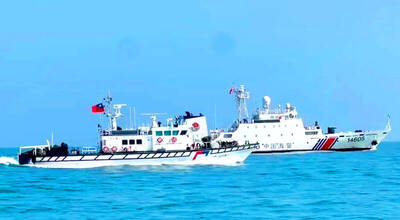
Instead of focusing solely on the threat of a full-scale military invasion, the US and its allies must prepare for a potential Chinese “quarantine” of Taiwan enforced through customs inspections, Stanford University Hoover fellow Eyck Freymann said in a Foreign Affairs article published on Wednesday. China could use various “gray zone” tactics in “reconfiguring the regional and ultimately the global economic order without a war,” said Freymann, who is also a nonresident research fellow at the US Naval War College. China might seize control of Taiwan’s links to the outside world by requiring all flights and ships entering or leaving Taiwan
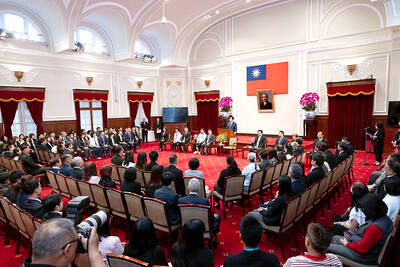
The next minimum wage hike is expected to exceed NT$30,000, President William Lai (賴清德) said yesterday during an award ceremony honoring “model workers,” including migrant workers, at the Presidential Office ahead of Workers’ Day today. Lai said he wished to thank the awardees on behalf of the nation and extend his most sincere respect for their hard work, on which Taiwan’s prosperity has been built. Lai specifically thanked 10 migrant workers selected for the award, saying that although they left their home countries to further their own goals, their efforts have benefited Taiwan as well. The nation’s industrial sector and small businesses lay


 RSS
RSS