


Chinese Nationalist Party (KMT) presidential candidate Ma Ying-jeou (馬英九) yesterday pledged to reduce the use of energy that causes carbon dioxide emissions to meet emissions targets set by the Kyoto Protocol and plant 60,000 hectares of new forest to help the nation's sustainable development if elected president next month.
In response to Green Party Taiwan Secretary-General Pan Han-shen's (潘翰聲) question on whether the candidates would sign up to the Kyoto Protocol if Taiwan became a member of the UN, as well as what their solutions to heavy pollution would be, Ma promised to draw up an energy-saving and emission-reducing plan and demand that heavy polluting companies meet energy-saving regulations to maintain a balance between development and environmental protection.
In response to the same question, Democratic Progressive Party (DPP) presidential candidate Frank Hsieh (謝長廷) proposed to control carbon dioxide emissions and levy taxes on fuel users.
Asked about the development of Hualien and Taitung counties and the construction of the Suhua Freeway, Ma said he remained cautious about the freeway and was concerned about the traffic and its possible impact on the local environment.
"I am very cautious about the construction. We should not proceed with it rashly before the result of the environmental impact review comes out and supplementary measures are drawn up," Ma said.
Hsieh, meanwhile, said that when he was premier in 2005, KMT legislators threatened to freeze the government budget if the Cabinet did not build the freeway. Ma was KMT chairman at the time.
"What Ma said just now did not correspond to what his party did back then," Hsieh said.
Hsieh said the freeway required careful assessment and thorough discussion. It is not necessary to hurry construction, he said, as the development of eastern Taiwan does not necessarily have to be the same as that for the west coast.
The NT$90 billion (US$2.87 billion) budget earmarked for the project must not be diverted elsewhere but could be used in a project he proposed to improve the transportation system on the east coast, Hsieh said.
"The policy to use development to drive up GDP is wrong," he said.
Asked about his policy on land conservation, Hsieh said the environment must be the top priority, adding that he would like to transform the country into an "ocean state."
All waterways should safe, clean and beautiful, he said, in reference to the concept he used to clean up the Love River when he was mayor of Kaohsiung.
Hsieh proposed keeping a certain percentage of natural coastline and strengthening the crackdown on ocean pollution. Education on environmental protection is equally important, he said, because it would be unfair to the next generation if the environment were destroyed.
Ma blamed the problem of land subsidence along the coastal areas in the south on the DPP government's poor land restoration and conservation policies, and vowed, if elected, to implement the eight-year, NT$80 billion package upgrading flood-prevention infrastructure proposed by Hsieh when he was premier.
In response, Hsieh blamed the opposition-controlled legislature for blocking his budget proposal for a year, during which time more flooding occurred in various areas.
Environmental activists yesterday said both hopefuls had failed to give satisfactory answers about their plans to boost environmental conservation.
Li Keng-cheng (李根政), a former member of the Environmental Impact Review Committee, said Ma and Hsieh failed to answer the "core questions" on how to transcend party politics to solve the nation's worsening environmental situation.
Instead, he said, both candidates shifted the blame review committee on the other for the stalemate on issues such as the building of the Suhua Freeway.
Liao Pen-chuan (廖本全) of the Taiwan Academy of Ecology panned both candidates, especially Ma, for not fully preparing for the debate.
"It is ridiculous that Ma proposed to fix the problems of floods and landslides through better infrastructure. It only shows that he still thinks man can overpower Mother Nature. Doesn't he realize that most of the environmental problems in Taiwan are caused by overdevelopment?" Liao said.
Additional reporting by staff writer


China has reserved offshore airspace in the Yellow Sea and East China Sea from March 27 to May 6, issuing alerts usually used to warn of military exercises, although no such exercises have been announced, the Wall Street Journal (WSJ) reported yesterday. Reserving such a large area for 40 days without explanation is an “unusual step,” as military exercises normally only last a few days, the paper said. These alerts, known as Notice to Air Missions (Notams), “are intended to inform pilots and aviation authorities of temporary airspace hazards or restrictions,” the article said. The airspace reserved in the alert is

South Korea is planning to revise its controversial electronic arrival card, a step Taiwanese officials said prompted them to hold off on planned retaliatory measures, a South Korean media report said yesterday. A Yonhap News Agency report said that the South Korean Ministry of Foreign Affairs is planning to remove the “previous departure place” and “next destination” fields from its e-arrival card system. The plan, reached after interagency consultations, is under review and aims to simplify entry procedures and align the electronic form with the paper version, a South Korean ministry official said. The fields — which appeared only on the electronic form

A bipartisan group of US senators has introduced a bill to enhance cooperation with Taiwan on drone development and to reduce reliance on supply chains linked to China. The proposed Blue Skies for Taiwan Act of 2026 was introduced by Republican US senators Ted Cruz and John Curtis, and Democratic US senators Jeff Merkley and Andy Kim. The legislation seeks to ease constraints on Taiwan-US cooperation in uncrewed aerial systems (UAS), including dependence on China-sourced components, limited access to capital and regulatory barriers under US export controls, a news release issued by Cruz on Wednesday said. The bill would establish a "Blue UAS
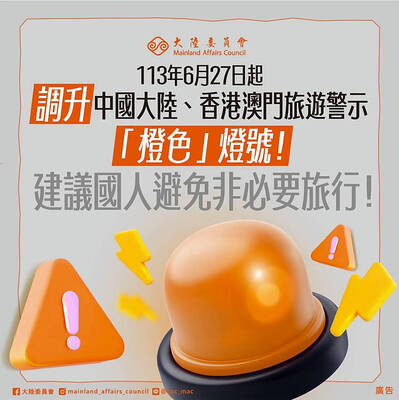
More than 6,000 Taiwanese students have participated in exchange programs in China over the past two years, despite the Mainland Affairs Council’s (MAC) “orange light” travel advisory, government records showed. The MAC’s publicly available registry showed that Taiwanese college and university students who went on exchange programs across the Strait numbered 3,592 and 2,966 people respectively. The National Immigration Agency data revealed that 2,296 and 2,551 Chinese students visited Taiwan for study in the same two years. A review of the Web sites of publicly-run universities and colleges showed that Taiwanese higher education institutions continued to recruit students for Chinese educational programs without


 RSS
RSS