


With only a few days left in the Lunar New Year break, those wishing to visit prime tourism destinations may be interested in ideas from the National Science Council (NSC) and the Environmental Protection Administration (EPA).
The NSC recently named the Eastern Rift Valley National Scenic Area (花東縱谷國家風景區) as the nation's most relaxing vacation hotspot, while the EPA named its 25 cleanest tourist destinations.
Yuan Shaw-ying (
Attractions in central Taiwan include the 17km coastline of Hsinchu City, Hsinchu County's Mangrove Ecosystem Reserve, Citizen Square in Miaoli County and Wenhsin Forest Park (文心) in Taichung City, Yuan said.
Southern gems include the Anping Tree House Ruin (安平樹屋) in Tainan City, the west bank of Kaohsiung City's Love River and South Bay Recreation Area in Kenting, Pingtung County, he added.
Travelers in eastern Taiwan may wish to visit Ilan County's Plum Blossom Lake, Chihpen (知本) hot springs in Taitung County, or Seven Star Basin (七星潭) in Hualien County, Yuan said.
"National parks in Taiwan all offer different geographic features and local culture," said National Taiwan University professor Lin Yan-chou (林晏州), who headed an NSC study on the use of national scenic areas.
"Taiwanese choose places for their vacations according to cost [time and money] -- the longer the travel time, the less likely they will visit; as well as the destination's image," he said.
Topping the list of national scenic areas was the Eastern Rift Valley National Scenic Area spanning Hualien and Taitung counties. It was found to have the "most relaxing" effect on people, Lin said, adding that its scenery, friendly communities and convenient transport contributed to its popularity.
The adjacent East Coast National Scenic Area (東海岸國家風景區) received similar reviews, but fell short in terms of cleanliness and was thought to be more expensive, Lin said.
In central Taiwan, the Sun Moon Lake National Scenic Area (日月潭國家風景區) was judged to offer pleasant weather, interesting Aboriginal festivals and local delicacies.
The Alishan National Scenic Area (阿里山國家風景區) won tourists' hearts with easy-to-obtain information, but this was spoiled by expensive accommodation and a lack of outdoor activities, Lin said.
The Matsu National Scenic Area offered fun nightlife, interesting architecture and a unique lifestyle, Lin said.
"But the unreliable weather and aloofness of locals may put some tourists off," he said.
A list of the EPA's recommendations is at ivy3.epa.gov.tw/cleanup_taiwan/index.html.
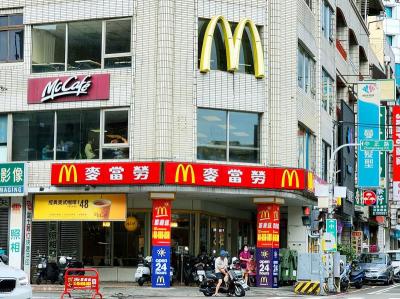
Fast food chain McDonald's is to raise prices by up to NT$5 on some products at its restaurants across Taiwan, starting on Wednesday next week, the company announced today. The prices of all extra value meals and sharing boxes are to increase by NT$5, while breakfast combos and creamy corn soup would go up by NT$3, the company said in a statement. The price of the main items of those meals, if ordered individually, would remain the same. Meanwhile, the price of a medium-sized lemon iced tea and hot cappuccino would rise by NT$3, extra dipping sauces for chicken nuggets would go up
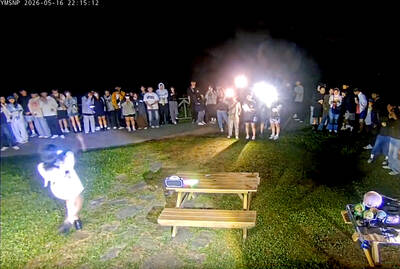
Yangmingshan National Park’s Qingtiangang (擎天崗) nature area has gone viral after a park livestream camera observed a couple in the throes of intimate congress, which was broadcast live on YouTube, drawing large late-night crowds and sparking a backlash over noise, bright lights and disruption to wildlife habitat. The area’s livestream footage appeared to show a couple engaging in sexual activity on a picnic table in the park on Friday last week, with the uncensored footage streamed publicly online. The footage quickly spread across social media, prompting a tide of visitors to travel to the site to “check in” and recreate the

Minister of Digital Affairs Lin Yi-ching (林宜敬) yesterday cited regulatory issues and national security concerns as an expert said that Taiwan is among the few Asian regions without Starlink. Lin made the remarks on Facebook after funP Innovation Group chief executive officer Nathan Chiu (邱繼弘) on Friday said Taiwan and four other countries in Asia — China, North Korea, Afghanistan and Syria — have no access to Starlink. Starlink has become available in 166 countries worldwide, including Ukraine, Malaysia, the Philippines and Vietnam, in the six years since it became commercial, he said. While China and North Korea block Starlink, Syria is not
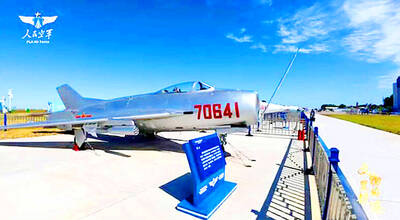
GROUNDED: A KMT lawmaker proposed eliminating drone development programs and freezing funding for counterdrone systems, despite China’s adoption of the technology China has deployed attack drones at air bases near the Taiwan Strait in a strategy aimed at overwhelming Taiwan’s air defense systems through saturation attacks, the Mainland Affairs Council (MAC) said. The council’s latest quarterly report on China said that satellite imagery and open-source intelligence indicate that the Chinese People’s Liberation Army (PLA) had converted retired J-6 fighter jets into J-6W drones, which the PLA has stationed at six air bases near Taiwan, five in China’s Fujian Province and one in Guangdong Province. The report cited J. Michael Dahm, a senior fellow at the US-based Mitchell Institute, as saying that China has


 RSS
RSS