


President Chen Shui-bian (
The "four noes" refer to the pledge Chen made as part of his inaugural speech in 2000. Chen promised that as long as China does not use military force against Taiwan, he would not declare independence, not change the national title, not enshrine the "state-to-state" model in the Constitution, or endorse a referendum on formal independence.
Chen, who is in Central America and the Caribbean on a five-day visit, made the remarks while meeting American Institute in Taiwan Chairman Raymond Burghardt in Anchorage, Alaska, where Chen and his delegation made a refueling stop.
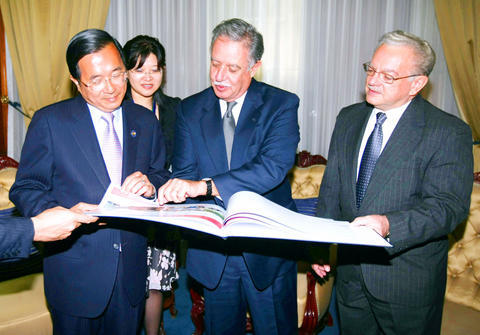
PHOTO: CNA
Government Information Office Minister Shieh Jhy-wey (
"I never went back on my promise," Chen said. "You [the US government] always focus on the `four noes,' but neglect the precondition."
Commenting on the referendum proposed by the Democratic Progressive Party (DPP) to seek UN membership under the name "Taiwan," Chen said the referendum was a good way of rejecting Beijing's assertion that Taiwan is part of the People's Republic of China.
While Burghardt reiterated US opposition to the UN referendum proposal, Chen expressed high hope for it, saying the attitude of voters would be different in the presidential election in March, when the referendum will be held.
Chen said the referendum on reclaiming the KMT's stolen assets failed in Saturday's legislative elections because of the KMT boycott, but the UN referendum in March would be different.
Shieh said Chen and Burghardt also exchanged views on the so-called "1992 consensus" and Burghardt said that his understanding was there was no such thing as a "1992 consensus."
Chen said Taiwan and China were on an equal footing and Taiwan deserved respect. Both sides could sit down and talk, but Taiwan could not accept the "1992 consensus" or the "one China" principle because they denigrated Taiwan's sovereignty, he said.
"That is the big difference between the DPP and the [Chinese Nationalist Party (KMT)]," Chen said. "As long as Taiwan's sovereignty is respected, we can talk about anything with China and we hope to see sustainable peace in the Taiwan Strait."
Commenting on the DPP's defeat on Saturday, Chen said that although the new electoral system put the DPP at a disadvantage, it was meaningless to discuss whether the party regretted pushing electoral reform. He said the DPP realized it had to pay a price for the reform initiative.
Meanwhile, Shieh said Burghardt told Chen that KMT vice presidential candidate Vincent Siew (蕭萬長) had brought up the subject of "dirty tricks" during their meeting last month.
The private meeting was not disclosed until Chinese-language newspapers revealed the "minutes" of their conversation. The minutes reportedly recorded Burghardt's concerns about DPP attempts to win the election using "dirty tricks."
Also See: Alvaro Colom sworn in as president of Guatemala, vows to empower Mayans

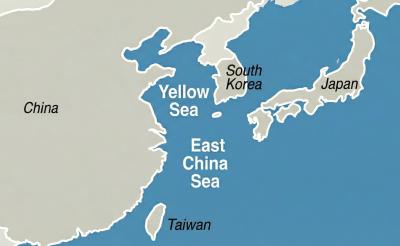
China has reserved offshore airspace in the Yellow Sea and East China Sea from March 27 to May 6, issuing alerts usually used to warn of military exercises, although no such exercises have been announced, the Wall Street Journal (WSJ) reported yesterday. Reserving such a large area for 40 days without explanation is an “unusual step,” as military exercises normally only last a few days, the paper said. These alerts, known as Notice to Air Missions (Notams), “are intended to inform pilots and aviation authorities of temporary airspace hazards or restrictions,” the article said. The airspace reserved in the alert is

South Korea is planning to revise its controversial electronic arrival card, a step Taiwanese officials said prompted them to hold off on planned retaliatory measures, a South Korean media report said yesterday. A Yonhap News Agency report said that the South Korean Ministry of Foreign Affairs is planning to remove the “previous departure place” and “next destination” fields from its e-arrival card system. The plan, reached after interagency consultations, is under review and aims to simplify entry procedures and align the electronic form with the paper version, a South Korean ministry official said. The fields — which appeared only on the electronic form

A bipartisan group of US senators has introduced a bill to enhance cooperation with Taiwan on drone development and to reduce reliance on supply chains linked to China. The proposed Blue Skies for Taiwan Act of 2026 was introduced by Republican US senators Ted Cruz and John Curtis, and Democratic US senators Jeff Merkley and Andy Kim. The legislation seeks to ease constraints on Taiwan-US cooperation in uncrewed aerial systems (UAS), including dependence on China-sourced components, limited access to capital and regulatory barriers under US export controls, a news release issued by Cruz on Wednesday said. The bill would establish a "Blue UAS
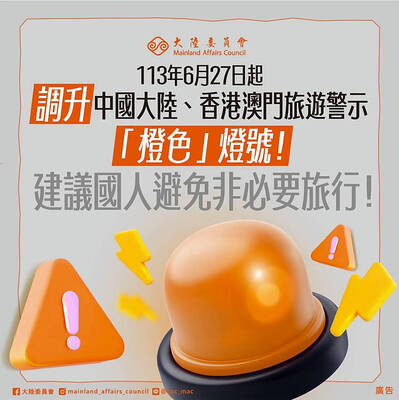
More than 6,000 Taiwanese students have participated in exchange programs in China over the past two years, despite the Mainland Affairs Council’s (MAC) “orange light” travel advisory, government records showed. The MAC’s publicly available registry showed that Taiwanese college and university students who went on exchange programs across the Strait numbered 3,592 and 2,966 people respectively. The National Immigration Agency data revealed that 2,296 and 2,551 Chinese students visited Taiwan for study in the same two years. A review of the Web sites of publicly-run universities and colleges showed that Taiwanese higher education institutions continued to recruit students for Chinese educational programs without


 RSS
RSS