


With less than three months to go before a ban against slaughtering live poultry in traditional markets goes into effect, the policy change is gathering opposition from poultry farmers who say their livelihoods are threatened by the move.
Cages full of live chickens continue to be stacked up in traditional markets all over the country. Customers can pick the chicken they want from the cages as they have always been able to do, but all that is set to change on April 1.
Poultry industry representatives say that the ban will devastate chicken farmers and sellers, especially purveyors of specialty varieties of chicken most identifiable by their feathers.
"All over the world, communities of Chinese heritage prefer to eat freshly-killed chicken," said a representative of the Poultry Association who wished to remain unnamed because of ongoing negotiations with the Council of Agriculture. "You cannot change that preference."
"We have black-boned chickens, pearl chickens, black feathered and red feathered wild chickens. All these varieties fetch higher prices at the market, but if you strip the plumage from the birds, you are also stripping the consumer's means of visually identifying the variety," said the representative.
In a Council of Agriculture press conference on the issue several months ago, public health experts said the ban is a necessary measure to prevent the spread of bird flu.
"Taiwan is living in the bird flu danger zone," said Chen Chien-jen (
"Hong Kong was actually hit with bird flu in 1997, but they did not choose to ban live chickens in traditional markets," rebutted the representative. "Instead, they are installing safety precautions such as screens that separate the consumers from the birds."
An official who wished to remain unnamed at the council's Bureau of Animal and Plant Health Inspection and Quarantine said that the rule changes are scheduled to go ahead as planned.
"We not only need to prevent physical contact between the live birds and the consumers but to make sure they are not breathing the same air," said the official.
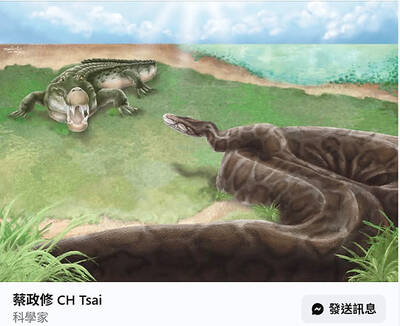
Taiwanese paleontologists have discovered fossil evidence that pythons up to 4m long inhabited Taiwan during the Pleistocene epoch, reporting their findings in the international scientific journal Historical Biology. National Taiwan University (NTU) Institute of Ecology and Evolutionary Biology associate professor Tsai Cheng-hsiu (蔡政修) led the team that discovered the largest snake fossil ever found in Taiwan. The single trunk vertebra was discovered in Tainan at the Chiting Formation, dated to between 400,000 and 800,000 years ago in the Middle Pleistocene, the paper said. The area also produced Taiwan’s first avian fossil, as well as crocodile, mammoth, saber-toothed cat and rhinoceros fossils, it said. Discoveries

Taiwanese paleontologists have discovered fossil evidence that pythons up to 4m long inhabited Taiwan during the Pleistocene epoch, reporting their findings in the international scientific journal Historical Biology. National Taiwan University (NTU) Institute of Ecology and Evolutionary Biology associate professor Tsai Cheng-hsiu (蔡政修) led the team that discovered the largest snake fossil ever found in Taiwan. A single trunk vertebra was discovered in Tainan at the Chiting Formation, dated to between 800,000 to 400,000 years ago in the Middle Pleistocene, the paper said. The area also produced Taiwan’s first avian fossil, as well as crocodile, mammoth, sabre-toothed cat and rhinoceros fossils, it said. Discoveries

Whether Japan would help defend Taiwan in case of a cross-strait conflict would depend on the US and the extent to which Japan would be allowed to act under the US-Japan Security Treaty, former Japanese minister of defense Satoshi Morimoto said. As China has not given up on the idea of invading Taiwan by force, to what extent Japan could support US military action would hinge on Washington’s intention and its negotiation with Tokyo, Morimoto said in an interview with the Liberty Times (sister paper of the Taipei Times) yesterday. There has to be sufficient mutual recognition of how Japan could provide

UPDATED TEST: The new rules aim to assess drivers’ awareness of risky behaviors and how they respond under certain circumstances, the Highway Bureau said Driver’s license applicants who fail to yield to pedestrians at intersections or to check blind spots, or omit pointing-and-calling procedures would fail the driving test, the Highway Bureau said yesterday. The change is set to be implemented at the end of the month, and is part of the bureau’s reform of the driving portion of the test, which has been criticized for failing to assess whether drivers can operate vehicles safely. Sedan drivers would be tested regarding yielding to pedestrians and turning their heads to check blind spots, while drivers of large vehicles would be tested on their familiarity with pointing-and-calling


 RSS
RSS