


Democratic Progressive Party (DPP) presidential candidate Frank Hsieh (謝長廷) yesterday unveiled his housing policy, proposing that the government rent out public housing to young people at discount rates.
Slamming Taipei City's real estate policy, Hsieh said the bubble would burst when investors from Taiwan, China and Hong Kong stopped buying real estate in the capital.
He proposed that the government release state-owned land for the construction of public housing to be rented to people above 25 years of age. Such a privilege would be offered on a once-in-a-life-time basis.
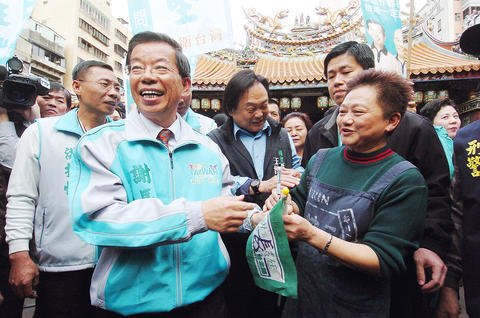
PHOTO: GEORGE TSORNG, TAIPEI TIMES
To alleviate the financial burden on young tenants, the government would offer a 40 percent discount on rent for the first two years and 20 percent discount for another two years.
He also proposed a low interest loan program to make real estate affordable to young people. Under the program, first-time buyers would be entitled to interest-free loans. The government would also build more dormitories on campuses and make efforts to stabilize real estate prices so that young people could afford a house of their own.
"My idea of economic prosperity is first to ease the plight of the people," he said. "If elected, I will make an effort to create more jobs, give jobless people something to do, make houses more affordable, let homeless people have a house of their own and let those who rent a house be able to afford to buy one."
Hsieh criticized his election rival, former Taipei mayor Ma Ying-jeou (
Hsieh said the reason he chose to make his housing policy public at Taipei 101 was because he wanted to highlight the contrast between high real estate prices in the city's Xinyi District and young economically disadvantaged people.
"Some people promote the idea of improving the economy, but the measures they propose are quite shallow and their direction is wrong," he said.
"People have the right to pursue happiness just like they have the right to a referendum. The government should provide the people with an environment where they have the right and opportunity to pursue happiness," Hsieh said.
If Ma were elected president, Hsieh said, real estate prices in Taipei could rise to NT$1 million (US$30,000) per ping. In other words, a person with a standard income would have to work for a year to be able to afford a ping.
"The middle class will become the new poor," he said. "Young people in Taipei City don't have any hope for the future and many have moved elsewhere."
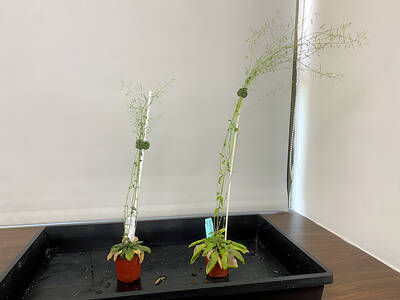
Taiwanese scientists have engineered plants that can capture about 50 percent more carbon dioxide and produce more than twice as many seeds as unmodified plants, a breakthrough they hope could one day help mitigate global warming and grow more food staples such as rice. If applied to major food crops, the new system could cut carbon emissions and raise yields “without additional equipment or labor costs,” Academia Sinica researcher and lead author the study Lu Kuan-jen (呂冠箴) said. Academia Sinica president James Liao (廖俊智) said that as humans emit 9.6 billion tonnes of carbon dioxide compared with the 220 billion tonnes absorbed
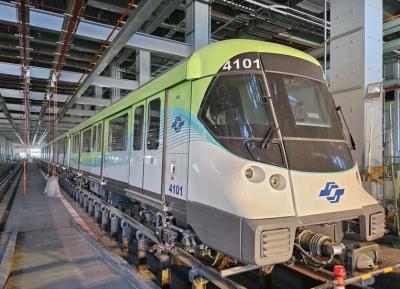
The Taipei Mass Rapid Transit (MRT) Wanda-Zhonghe Line is 81.7 percent complete, with public opening targeted for the end of 2027, New Taipei City Mayor Hou You-yi (侯友宜) said today. Surrounding roads are to be open to the public by the end of next year, Hou said during an inspection of construction progress. The 9.5km line, featuring nine underground stations and one depot, is expected to connect Chiang Kai-shek Memorial Hall Station to Chukuang Station in New Taipei City’s Jhonghe District (中和). All 18 tunnels for the line are complete, while the main structures of the stations and depot are mostly finished, he
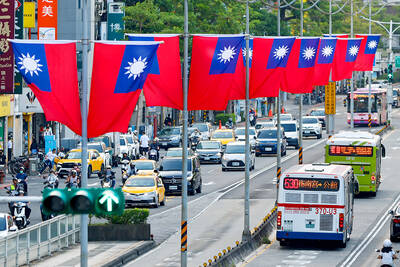
Taipei is to implement widespread road closures around Taipei 101 on Friday to make way for large crowds during the Double Ten National Day celebration, the Taipei Department of Transportation said. A four-minute fireworks display is to be launched from the skyscraper, along with a performance by 500 drones flying in formation above the nearby Nanshan A21 site, starting at 10pm. Vehicle restrictions would occur in phases, they said. From 5pm to 9pm, inner lanes of Songshou Road between Taipei City Hall and Taipei 101 are to be closed, with only the outer lanes remaining open. Between 9pm and 9:40pm, the section is

China’s plan to deploy a new hypersonic ballistic missile at a Chinese People’s Liberation Army Rocket Force (PLARF) base near Taiwan likely targets US airbases and ships in the western Pacific, but it would also present new threats to Taiwan, defense experts said. The New York Times — citing a US Department of Defense report from last year on China’s military power — on Monday reported in an article titled “The missiles threatening Taiwan” that China has stockpiled 3,500 missiles, 1.5 times more than four years earlier. Although it is unclear how many of those missiles were targeting Taiwan, the newspaper reported


 RSS
RSS