


Taiwan Solidarity Union (TSU) Legislator Ho Min-hao (
Ho beat DPP Legislator Wang Shih-hsun (王世勛) in an opinion poll held to determine the best candidate to represent the pan-green camp in Taichung's 3rd district.
Ho told the Central News Agency that the TSU and DPP had been unable to negotiate a single candidate for the district, adding that he would therefore quit the TSU and represent the DPP in the election.
The TSU had urged the DPP to make the decision based on the results of the opinion poll.
Ho said he that he was confident he would win the seat for the DPP.
He said that he had tried to contact former president Lee Teng-hui (李登輝), the TSU's spiritual leader, to inform Lee of his decision.
Meanwhile, TSU Chairman Huang Kun-huei (
Regarding district legislators, Huang said the party "has a strategy," but declined to go into detail.
Ho had been mulling a party switch, announcing last week that he would decide whether to join the DPP before today.
Huang had said that he believed Ho would be a wise choice for the pan-green camp, in spite of pressure from the DPP to have a DPP candidate.
President Chen Shui-bian (
Ho is the fifth of the TSU's 12 incumbent legislators to quit the party. The other four are Liao Pen-yen (
TSU legislators Tseng Tsahn-deng (

FUKUOKA SITUATION: Japanese media reported that the pathogen is expected to be identified by the summer, while the CDC downplayed the idea that it was hMPV A “mysterious cold-like illness” reported in Japan’s Fukuoka Prefecture does not seem to be a new disease, but Japanese authorities have been asked about the situation, the Centers for Disease Control (CDC) said yesterday. The Fukuoka Prefectural Medical Association on Wednesday told a news conference that a “mystery cold” that has become a hot topic on social media is “highly likely to be caused by some kind of viral infection,” Japan’s KBC News reported. “Many people are experiencing symptoms starting with a sore throat, followed by a runny nose, phlegm and a severe cough,” KBC News reported, citing association officials. Health authorities are

Nvidia Corp CEO Jensen Huang (黃仁勳) arrived in Taiwan yesterday ahead of upcoming AI and technology events, saying he plans to meet with clients and Taiwan Semiconductor Manufacturing Co Chairman C.C. Wei (魏哲家) during his visit. After landing at Taipei Songshan Airport, Huang posed for photos with fans and handed out Yakult drinks to reporters and supporters waiting at the scene, saying he has “a lot to do” during the trip. Asked about reports that Nvidia’s planned headquarters site in Taipei’s Beitou Shilin Technology Park could break ground on May 27, Huang said that if the company holds an event, he would

The Ministry of Finance this afternoon announced the winning numbers for the March-April uniform invoice lottery. The winning number for the NT$10 million (US$318,060) special prize is 19531471, and the winning number for the NT$2 million grand prize is 85941329. Three numbers were drawn for the NT$200,000 first prize: 07225810, 20231230 and 83518781. Those with receipts matching the last seven digits of any of the first-prize numbers will win the NT$40,000 second prize, while those matching the last six digits will win the NT$10,000 third prize. Those whose receipts match the last five digits of the first-prize numbers can claim the NT$4,000 fourth prize,
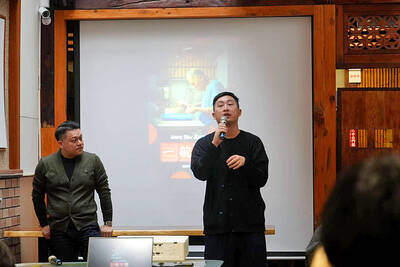
Taiwan Travelogue (臺灣漫遊錄), which earlier this week became the first Taiwanese novel to win the International Booker Prize, is to be adapted into a television series through a Taiwan-Japan coproduction, producer Chang Chen-yu (張辰漁) said yesterday. Chang, a producer at World Softest Production Film Co, wrote on Facebook that the company had been searching for projects with international appeal that retain a strong Taiwanese identity after colleagues and Japanese partners strongly recommended the novel. After reading the book, Chang said he immediately decided to pursue the screen rights. “A great story has the power to transcend time and borders, and connect countless people,”


 RSS
RSS