


In view of the recent frenzy over bamboo charcoal products (BCP), the Consumer Protection Commission (CPC) cautioned the public yesterday that the products may not offer as many health benefits as they claim.
The CPC issued the warning after it commissioned the Industrial Technology Research Institute (ITRI) to examine BCPs on the market.
"The overwhelming selection of BCPs as well as the huge price discrepancies prompted the necessity for such an investigation," CPC director-general Wu Cheng-hsue (
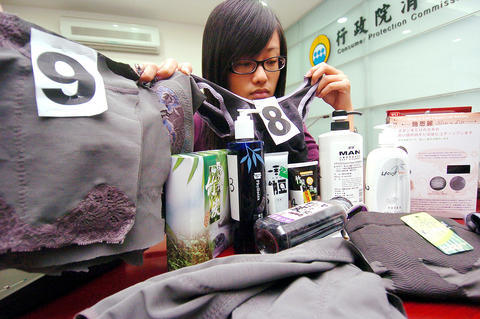
PHOTO: LU CHUN-WEI, TAIPEI TIMES
BCPs are products -- from socks to bagels -- made with bamboo that has been burned at 200oC to 800oC until it becomes charcoal. Benefits are said to include improved blood circulation, air freshening and deodorizing as well as improved mood.
The CPC targeted three types of BCPs: garments, food and cosmetics, Wu said, adding that ITRI found no correlations between the prices of the products and the degree of effect.
The BCP samples included products from Lacoya (台灣百合), ABA Nano-Tech Company (達裕奈米科技), Queen Toys and Bedding Products (坤宇企業), Feilo Mina (菲洛米娜), Footloose Co (足好), Noetic Consultants Canada Inc (九地竹炭), Dr. Green (寰安科技), Bright Product Direct Co (睿杰國際行銷), Nice Group (耐斯企業), Semeur De Pain (聖娜多堡) and Uni-President (統一企業).
Garment manufacturers claim that BCPs emit far-infrared rays, which increase metabolism and release negative ions, which absorb pollutants in the air and act as mood stabilizers, Wu said.
CPC Consumer Ombudsman Hu Hua-tai (
However, he warned, "There is no clear research to support that bamboo charcoal provides health benefits; consumers should know that bamboo charcoal is different from activated charcoal used medically."
He said that claiming a product emits infrared rays at a 75 percent level is pointless since most garments emit at that level.
The atmosphere also naturally releases negative ions at 130psc/cc-270psc/cc.
The highest negative ion release came from Bright Product Direct Co, with the cheapest garment sample at NT$799, which released 5,100psc/cc-6,900psc/cc, he said. The most expensive Feilo Mina model, priced at NT$5,980, emitted 3,600psc/cc-4,100psc/cc, while the second most expensive Lacoya was NT$5,820 and emitted 1,520psc/cc-740psc/cc. Far-infrared emission levels had little to do with price, he said.
In regards to food and cosmetics, "We found BCPs to be benign to human health, however, whether they offer the health benefits they claim is unclear. Manufacturers who make claims about the benefits of the bamboo charcoal may be in violation of labeling laws," Hu said.
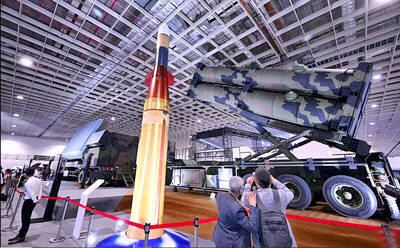
Taiwan is to commence mass production of the Tien Kung (天弓, “Sky Bow”) III, IV and V missiles by the second quarter of this year if the legislature approves the government’s NT$1.25 trillion (US$39.78 billion) special defense budget, an official said yesterday. Commenting on condition of anonymity, a defense official with knowledge of the matter said that the advanced systems are expected to provide crucial capabilities against ballistic and cruise missiles for the proposed “T-Dome,” an advanced, multi-layered air defense network. The Tien Kung III is an air defense missile with a maximum interception altitude of 35km. The Tien Kung IV and V
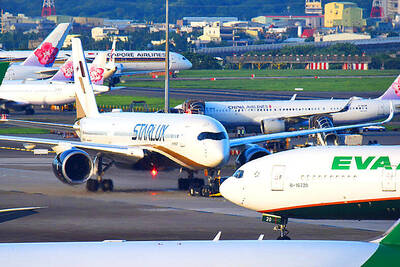
The disruption of 941 flights in and out of Taiwan due to China’s large-scale military exercises was no accident, but rather the result of a “quasi-blockade” used to simulate creating the air and sea routes needed for an amphibious landing, a military expert said. The disruptions occurred on Tuesday and lasted about 10 hours as China conducted live-fire drills in the Taiwan Strait. The Civil Aviation Administration (CAA) said the exercises affected 857 international flights and 84 domestic flights, affecting more than 100,000 travelers. Su Tzu-yun (蘇紫雲), a research fellow at the government-sponsored Institute for National Defense and Security Research, said the air
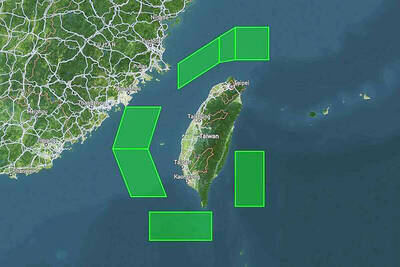
Trips for more than 100,000 international and domestic air travelers could be disrupted as China launches a military exercise around Taiwan today, Taiwan’s Civil Aviation Administration (CAA) said yesterday. The exercise could affect nearly 900 flights scheduled to enter the Taipei Flight Information Region (FIR) during the exercise window, it added. A notice issued by the Chinese Civil Aviation Administration showed there would be seven temporary zones around the Taiwan Strait which would be used for live-fire exercises, lasting from 8am to 6pm today. All aircraft are prohibited from entering during exercise, it says. Taipei FIR has 14 international air routes and
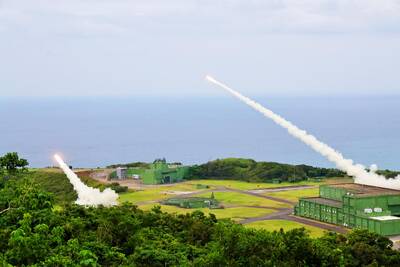
Taiwan lacks effective and cost-efficient armaments to intercept rockets, making the planned “T-Dome” interception system necessary, two experts said on Tuesday. The concerns were raised after China’s military fired two waves of rockets during live-fire drills around Taiwan on Tuesday, part of two-day exercises code-named “Justice Mission 2025.” The first wave involved 17 rockets launched at 9am from Pingtan in China’s Fujian Province, according to Lieutenant General Hsieh Jih-sheng (謝日升) of the Office of the Deputy Chief of the General Staff for Intelligence at the Ministry of National Defense. Those rockets landed 70 nautical miles (129.6km) northeast of Keelung without flying over Taiwan,


 RSS
RSS