


Eel farmers yesterday demanded that the Chinese-language China Times retract a recent story with an inflammatory headline or face legal action.
Fisheries agency officials who participated in a discussion with eel farmers' groups yesterday confirmed that the groups said they would sue the daily for a story published on Tuesday with the headline: "Fisheries agency warns: eels are poisonous," if a written retraction is not issued within three days.
In addition, eel farmers plan to stage a protest that will surround the China Times' head office if the paper refuses to back down, said Shih Sheng-lung (石聖龍), an official at the agency.

PHOTO: CHIEN JUNG-FONG, TAIPEI TIMES
Test results released by the Fisheries Agency under the Council of Agriculture (COA) on Monday showed that eight aquaculture farms around the island were using banned additives, including seven eel farms. However, agency officials point out that only a tiny minority of aquaculture farms sampled tested positive for banned additives, with 99.88 percent of samples passing the test.
"We have had both more and less serious test results in the past that have been announced on our Web site," said Shih Sheng-lung, an official at the agency, "but it was not until the recent report of tainted aquaculture that the press started paying attention."
Shih said that the level of enrofloxacin found in the tainted eels, from 2.59 to 9.68 parts per billion, was not considered a serious health risk and could have resulted from environmental contamination rather than deliberate usage on the part of the farmers.
"The problem is the China Times improperly overemphasized the isolated cases of violation," said James Sha (沙志一), deputy director-general of the fisheries agency. "If this ends up hurting eel farmers, we will do what we can to aid them."
Meanwhile, Sha and Shih said that the COA had not agreed to demands made by eel farmers that the COA take out advertisements explaining the issue.
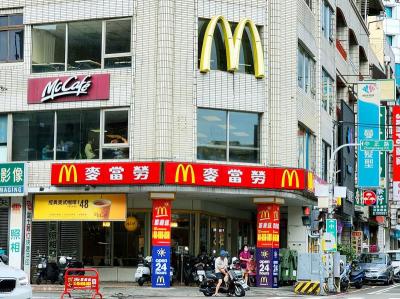
Fast food chain McDonald's is to raise prices by up to NT$5 on some products at its restaurants across Taiwan, starting on Wednesday next week, the company announced today. The prices of all extra value meals and sharing boxes are to increase by NT$5, while breakfast combos and creamy corn soup would go up by NT$3, the company said in a statement. The price of the main items of those meals, if ordered individually, would remain the same. Meanwhile, the price of a medium-sized lemon iced tea and hot cappuccino would rise by NT$3, extra dipping sauces for chicken nuggets would go up

Yangmingshan National Park’s Qingtiangang (擎天崗) nature area has gone viral after a park livestream camera observed a couple in the throes of intimate congress, which was broadcast live on YouTube, drawing large late-night crowds and sparking a backlash over noise, bright lights and disruption to wildlife habitat. The area’s livestream footage appeared to show a couple engaging in sexual activity on a picnic table in the park on Friday last week, with the uncensored footage streamed publicly online. The footage quickly spread across social media, prompting a tide of visitors to travel to the site to “check in” and recreate the

GROUNDED: A KMT lawmaker proposed eliminating drone development programs and freezing funding for counterdrone systems, despite China’s adoption of the technology China has deployed attack drones at air bases near the Taiwan Strait in a strategy aimed at overwhelming Taiwan’s air defense systems through saturation attacks, the Mainland Affairs Council (MAC) said. The council’s latest quarterly report on China said that satellite imagery and open-source intelligence indicate that the Chinese People’s Liberation Army (PLA) had converted retired J-6 fighter jets into J-6W drones, which the PLA has stationed at six air bases near Taiwan, five in China’s Fujian Province and one in Guangdong Province. The report cited J. Michael Dahm, a senior fellow at the US-based Mitchell Institute, as saying that China has

Carrefour Taiwan is to begin using a new name from the start of July, but it cannot divulge the name until then, the chairman of the supermarket chain's parent company said today. President Chain Store Co chairman Lo Chih-hsien (羅智先) was asked by reporters after a shareholders' meeting to confirm whether the company has settled on a new name for the supermarket brand. In March, the government-registered name of two Carrefour Taiwan branches was quietly changed to "Le Chia Kang" (樂家康) in Chinese, raising speculation that has been selected as the name. Lo said that because of local regulations and contractual obligations, the


 RSS
RSS