


The Presidential Office accepted an apology as well as corrections made by Weekly Magazine over a misleading report which claimed that President Chen Shui-bian (陳水扁) had played a role in the Democratic Progressive Party's (DPP) preparations for next year's presidential election, an official said yesterday.
high expectations
David Lee (李南陽), director of the Presidential Office's department of public affairs, said the office had expectations that the news media would fulfill its responsibility and obligations as the Fourth Estate and contribute to the deepening of the country's democracy.
Lee urged the media to avoid making irresponsible or untrue reports which risk causing civic unrest.
On Friday, the Presidential Office threatened to sue the weekly for libel unless it made a correction within 24 hours to a story appearing in its latest issue, in which Chen was said to have met DPP presidential candidate Frank Hsieh (
rumors
The weekly claimed that during the meeting, Chen and Hsieh had reached an agreement which stipulated that if Hsieh were indicted for any irregularities, former premier Su Tseng-chang (
A special investigation task force under the Supreme Prosecutors' Office is probing 10 cases of alleged irregularities involving Hsieh while he was mayor of Kaohsiung.
These include suspected corruption in connection with the construction of the Kaohsiung mass rapid transit system as well as a case in which Hsieh was alleged to have used improper methods to solicit political donations.

FUKUOKA SITUATION: Japanese media reported that the pathogen is expected to be identified by the summer, while the CDC downplayed the idea that it was hMPV A “mysterious cold-like illness” reported in Japan’s Fukuoka Prefecture does not seem to be a new disease, but Japanese authorities have been asked about the situation, the Centers for Disease Control (CDC) said yesterday. The Fukuoka Prefectural Medical Association on Wednesday told a news conference that a “mystery cold” that has become a hot topic on social media is “highly likely to be caused by some kind of viral infection,” Japan’s KBC News reported. “Many people are experiencing symptoms starting with a sore throat, followed by a runny nose, phlegm and a severe cough,” KBC News reported, citing association officials. Health authorities are

Nvidia Corp CEO Jensen Huang (黃仁勳) arrived in Taiwan yesterday ahead of upcoming AI and technology events, saying he plans to meet with clients and Taiwan Semiconductor Manufacturing Co Chairman C.C. Wei (魏哲家) during his visit. After landing at Taipei Songshan Airport, Huang posed for photos with fans and handed out Yakult drinks to reporters and supporters waiting at the scene, saying he has “a lot to do” during the trip. Asked about reports that Nvidia’s planned headquarters site in Taipei’s Beitou Shilin Technology Park could break ground on May 27, Huang said that if the company holds an event, he would

The Ministry of Finance this afternoon announced the winning numbers for the March-April uniform invoice lottery. The winning number for the NT$10 million (US$318,060) special prize is 19531471, and the winning number for the NT$2 million grand prize is 85941329. Three numbers were drawn for the NT$200,000 first prize: 07225810, 20231230 and 83518781. Those with receipts matching the last seven digits of any of the first-prize numbers will win the NT$40,000 second prize, while those matching the last six digits will win the NT$10,000 third prize. Those whose receipts match the last five digits of the first-prize numbers can claim the NT$4,000 fourth prize,
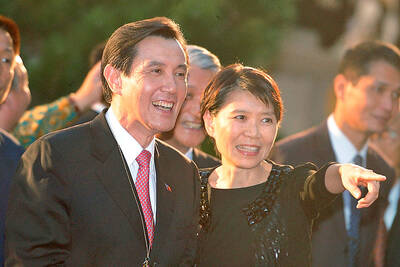
Former president Ma Ying-jeou (馬英九) yesterday expressed “shock and regret” over a statement issued by his wife without his consent, and rejected her assertion that his eldest sister, Ma Yi-nan (馬以南), would manage his medical care or act as his spokesperson amid an ongoing embezzlement probe into his foundation. Ma Ying-jeou in a statement said he was shocked by a statement by his wife, Chou Mei-ching (周美青), regarding his affairs. Ma Yi-nan “must not” be in charge of his healthcare and other personal affairs, nor can she be allowed to represent the Ma family, the former president said. He said he was also


 RSS
RSS