


People First Party (PFP) Chairman James Soong (宋楚瑜) yesterday dismissed media speculation that he would rejoin the Chinese Nationalist Party (KMT) after leaving the party seven years ago.
A story in yesterday's Chinese-language United Daily News quoted an anonymous KMT source as saying that Soong was seriously considering the possibility of returning following the KMT and PFP's completion of the coordination of their district legislative nominations.
The source said Soong and KMT Chairman Wu Po-hsiung (吳伯雄) have been in close contact with each other recently and have a certain implicit agreement on Soong rejoining the KMT, although neither of them have officially discussed the possibility.
Considering that six PFP legislators will run in next year's legislative poll on behalf of the KMT and that the two parties will nominate legislators-at-large together, the KMT and PFP have already in reality merged, which has left Soong with no other choice, another senior anonymous KMT source was quoted as saying in the article.
When approached by reporters at a memorial service, Soong said he could not understand why the United Daily News printed the story.
"The United Daily News always reports false news," he said. "In the past, it has launched personal attacks [against me]. Now it goes as far as reporting things that are far from the truth while at the same time urging the pan-blue camp to integrate," he said.
Soong said the newspaper should instead urge the KMT to detail its standpoints on issues such as joining the UN and the government's "desinicization" campaign or the public would all suffer from "schizophrenia."
Soong withdrew from the KMT to run as an independent in the presidential race in 2000 and established the PFP on March 31 the same year after losing in the election.
The KMT's presidential candidate, Ma Ying-jeou (馬英九), said a merger is the direction in which the two parties are heading.
"The KMT's door is always open," he said.
"After Wu became chairman, one of his ideals was to make as many friends as possible," said Su Jun-pin (蘇俊賓), a spokesman for the KMT. "We respect and welcome an ally like Chairman Soong."
PFP Legislator Liu Wen-hsiung (劉文雄) said the rumor had been started by PFP lawmakers in an effort to secure the KMT's legislator-at-large nominations.
"They are eager to secure the nominations so that they started the rumor with the aim of showing loyalty to the KMT," Liu said without naming any names.
If the merger of the PFP and the KMT takes place before the coming legislative election, scheduled for Jan. 12 next year, the PFP would lose its legislator-at-large seats as well as its election grant.
Under the election grant system, each candidate is subsidized NT$30 for each ballot that exceeds one-third of the votes sufficient to win in the respective single-seat constituency, and political parties receive subsidies of NT$50 for each ballot exceeding 5 percent of the total number of valid votes.
PFP Legislator Lee Fu-tien (李復甸) said that the party members who spread the rumor were thinking only about themselves and had disregarded the party's interests.
"Chairman Soong has said many times that he is open to the possibility of a KMT-PFP merger and the party is still soliciting opinions. It's a pity that some people are in a hurry to make it happen so that they can run in the legislative election as part of the KMT," Lee said.
The report said PFP Legislator Feng Ting-kuo (馮定國) recently visited former KMT chairman Lien Chan (連戰) to arrange the details of Soong's return. Feng was unavailable for comment yesterday.

The Ministry of Finance this afternoon announced the winning numbers for the March-April uniform invoice lottery. The winning number for the NT$10 million (US$318,060) special prize is 19531471, and the winning number for the NT$2 million grand prize is 85941329. Three numbers were drawn for the NT$200,000 first prize: 07225810, 20231230 and 83518781. Those with receipts matching the last seven digits of any of the first-prize numbers will win the NT$40,000 second prize, while those matching the last six digits will win the NT$10,000 third prize. Those whose receipts match the last five digits of the first-prize numbers can claim the NT$4,000 fourth prize,

SIX SUBSIDIES: The monthly allowance for older farmers is to increase to NT$10,000, and NT$5,000 is to be given to homemakers under the national pension system, Lai said The government is to implement major welfare policies for disadvantaged groups, including raising the monthly allowance for older farmers to NT$10,000 and providing homemakers with NT$5,000 per month, President William Lai (賴清德) said yesterday. Lai made the remarks during a visit to Wangling Temple in Chiayi County, saying that the planned increases were being introduced amid economic growth and an increase in tax revenue. Touting a policy, in which the government plans to provide a monthly allowance of NT$5,000 for every child under the age of 18 in a bid to address Taiwan’s low birthrate, Lai said that if received for the
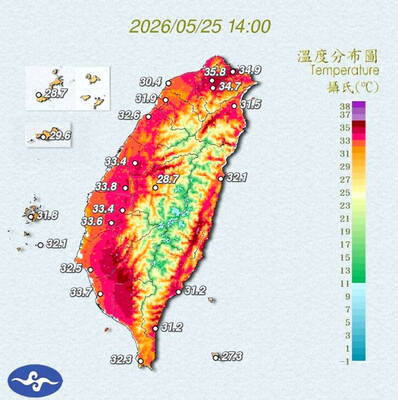
STAY COOL: The HPA recommended that people stay hydrated, use air-conditioning or fans while indoors, wear loose-fitting clothes and walk in the shade while outdoors Employers must implement measures such as installing cooling equipment, and providing drinking water and rest breaks for outdoor workers starting from Monday next week, the Taipei Department of Labor said on Sunday. Employers who fail to comply could face fines of NT$30,000 to NT$300,000 under the Occupational Safety and Health Act (職業安全衛生法), the department said. Businesses in Taipei employing fewer than 100 workers, as well as registered self-employed workers with labor insurance coverage, could receive on-site assessments and guidance from occupational safety consultants to help them apply for central government subsidies to implement or improve heat-protection measures, it said. Under the Ministry of
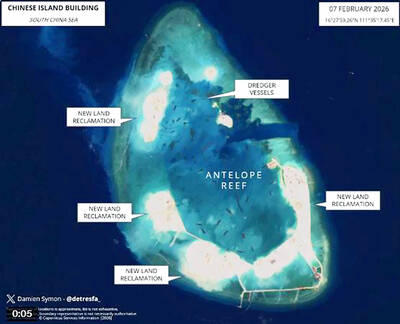
ISOLATION: The outposts would serve as support and backup bases, forcing US forces to either face China head-on or reroute, increasing travel time and operational costs China’s outposts in the South China Sea could be used to delay and constrain foreign forces during a conflict in the Taiwan Strait, giving Beijing a critical window to carry out amphibious landing and blockade operations, a report said. The Chinese Communist Party’s (CCP) forward operating bases on islands and reclaimed features in the South China Sea could delay foreign forces long enough for the Chinese People’s Liberation Army (PLA) to secure a key 48-to-72-hour window in the Taiwan Strait, a report commissioned by the Mainland Affairs Council found. The report, conducted by the Institute for National Defense and Security Research, examined


 RSS
RSS